
Silicon Valley Acquisition Corp.: Quantum Leap or Execution Trap as EigenQ Deal and Funding Advance
Silicon Valley Acquisition Corp.
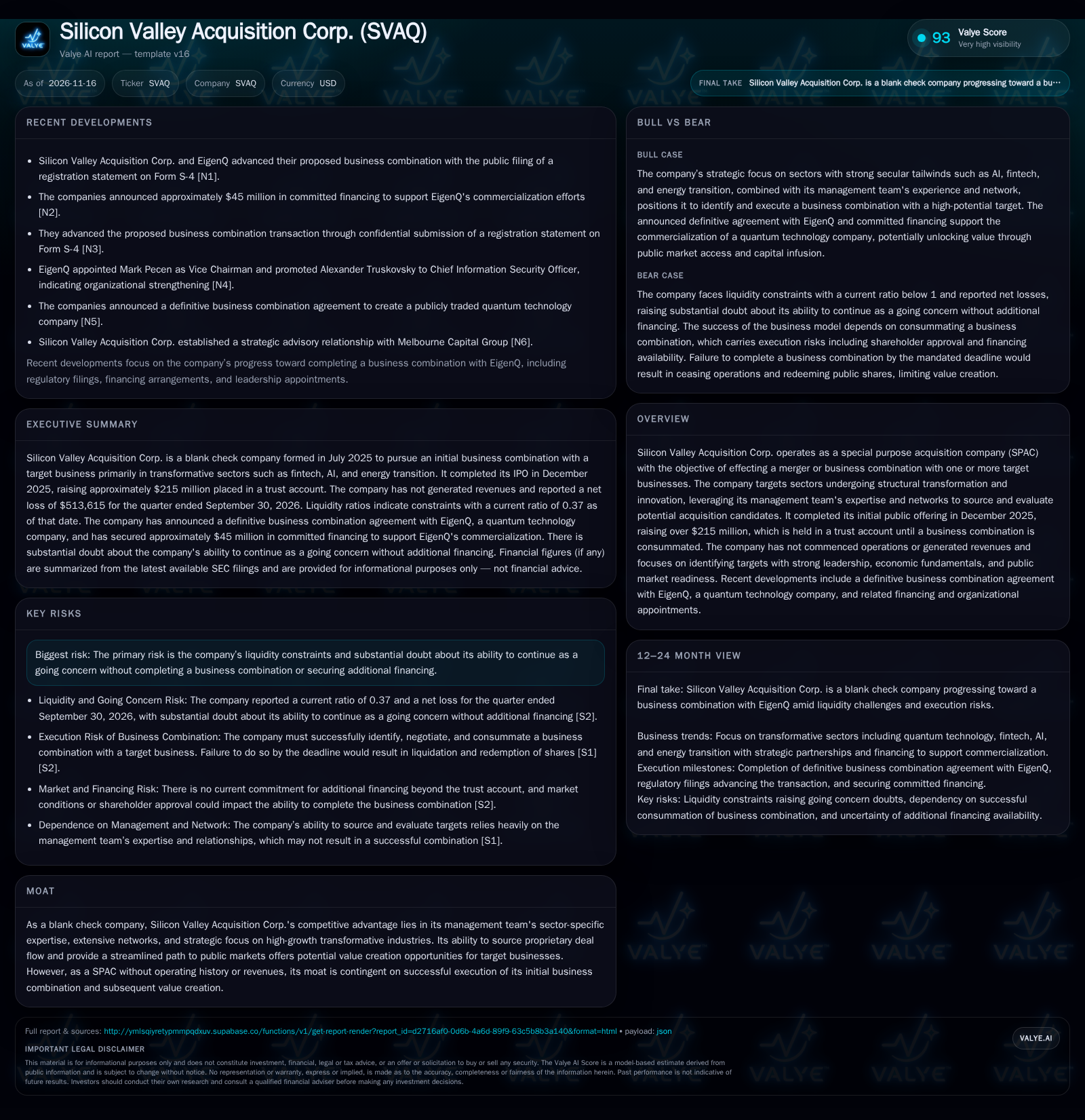
Silicon Valley Acquisition Corp. (SVAQ), a blank check company targeting high-growth, transformative sectors, has announced a definitive business combination with quantum tech company EigenQ and secured $45 million in committed financing for EigenQ’s commercialization.
Silicon Valley Acquisition Corp. stands at a critical inflection point as it seeks to merge with EigenQ, a quantum technology company, and deploy $45 million in committed financing to jump-start commercialization. SVAQ’s future now hinges on the successful completion of the EigenQ merger and the ability of the combined entity to convert technological promise into sustainable public-market value.
Deal Progress and Liquidity Squeeze Define SVAQ’s Present Reality
Silicon Valley Acquisition Corp. has entered into a definitive business combination agreement with EigenQ, aiming to create a publicly traded quantum technology company [N5]. This marks a significant milestone, advancing beyond the target search phase typical of SPACs. To support EigenQ’s commercialization, $45 million in committed financing has been announced [N2], providing a crucial capital injection for post-merger operations. [S2] The company also reported a net loss of $513,615 for the quarter, and management has expressed substantial doubt about SVAQ’s ability to continue as a going concern absent the successful completion of the business combination or new financing [S2]. These facts make the closing of the EigenQ deal and subsequent capital access existentially important for SVAQ’s future.
Beyond the immediate financial metrics and deal progress, understanding the operational cadence leading up to the merger is critical. The timing and sequence of regulatory filings, shareholder communications, and financing draws will shape the liquidity profile and burn rate in the interim. Delays or inefficiencies in these processes can exacerbate liquidity pressures, potentially forcing suboptimal financing decisions or deal renegotiations. Moreover, the alignment of interests among existing shareholders, PIPE investors, and sponsors during this phase will influence the probability of a smooth closing. The interplay between these factors creates a complex execution environment where timing and stakeholder coordination are as pivotal as capital availability.
SPAC Economics: Value Catalyst or Capital Trap?
The economics of Silicon Valley Acquisition Corp. are defined by the SPAC structure: it raised $215 million in its December 2025 IPO, with proceeds placed in trust until a suitable business combination is executed [S1]. Until then, SVAQ generates no revenue, and operating expenses lead to ongoing net losses. The trust assets are typically invested in low-yield government securities or money market funds, offering minimal offset to outflows. If the EigenQ merger closes, the economics pivot dramatically—SVAQ’s value proposition becomes EigenQ’s commercial trajectory, cost structure, and capital intensity.
Post-merger, the combined entity’s economics will depend on EigenQ’s ability to commercialize quantum technologies—a sector characterized by high R&D costs, uncertain adoption curves, and potentially lumpy revenue. Quantum tech, if successful, could command premium pricing and attractive gross margins due to technological moats, but early-stage commercialization is often capital-consumptive. The announced $45 million financing provides initial runway, but quantum ventures typically require substantial follow-on funding. Operating leverage could materialize if EigenQ scales, but this depends on moving from proof-of-concept to commercial contracts and repeatable sales—outcomes that remain unproven at this stage.
A nuanced consideration involves the capital allocation strategy post-merger, particularly how the combined entity prioritizes R&D versus commercialization activities. Quantum technology ventures often face a trade-off between extending the development runway to refine technology and accelerating go-to-market efforts to secure early revenue streams. The optimal balance depends on the maturity of EigenQ’s technology and the competitive dynamics in target markets. If commercialization efforts are front-loaded without sufficient technical validation, the risk of costly pivots or product failures increases. Conversely, excessive focus on R&D without market engagement can lead to capital inefficiency and missed windows of opportunity. Hence, the governance framework and capital deployment discipline post-merger will be critical in shaping the economic trajectory.
Can SVAQ-EigenQ Carve Out a Defensible Quantum Niche?
SVAQ’s competitive position, pre-merger, is largely a function of its management’s ability to source and execute proprietary deals in hot sectors like quantum technology. The announced EigenQ combination targets a field where global interest is intense, with peers ranging from large technology incumbents to venture-backed startups. The competitive landscape in quantum is rapidly evolving, with barriers to entry set by intellectual property, technical talent, and capital requirements—but also subject to rapid technological leapfrogging and shifting standards.
SVAQ’s management touts sector expertise and a strategic advisory relationship with Melbourne Capital Group [N6], potentially aiding diligence and post-deal support. Yet, the SPAC structure itself offers little intrinsic moat post-merger; sustainable advantage must come from EigenQ’s technology, customer traction, and ability to defend IP. The risk is that well-capitalized competitors or more established quantum players could outpace EigenQ in commercialization, partnerships, or ecosystem integration. The question is whether the public listing and capital infusion can accelerate EigenQ’s competitive position enough to offset these headwinds.
From a competitive dynamics perspective, the ability to establish strategic partnerships and ecosystem alliances could serve as a force multiplier for EigenQ’s market entry. In quantum technology, where standardization and interoperability remain nascent, early collaboration with hardware providers, software developers, and end-user industries can create network effects that reinforce market position. However, such partnerships are contingent on demonstrating credible technology roadmaps and aligning incentives across diverse stakeholders. Additionally, the public market listing may impose pressures for short-term performance, potentially constraining long-term strategic initiatives that require patient capital and iterative development. The tension between public market expectations and the inherently long gestation period of quantum tech commercialization adds complexity to sustaining a defensible competitive niche.
If the Deal Closes and EigenQ Delivers: Unlocking Quantum Value on Public Markets
In a favorable scenario, SVAQ successfully closes the EigenQ merger, and the $45 million in committed financing is deployed effectively to accelerate EigenQ’s path to market [N2]. If EigenQ demonstrates technical milestones—such as quantum processor breakthroughs, customer pilots, or early commercial contracts—the combined entity could attract further investor interest and capital, enabling scale-up and ecosystem integration.
This scenario would be confirmed by regulatory approval and shareholder support for the merger, timely S-4 clearance, and public disclosures of EigenQ’s commercial wins or partnership announcements. Additional evidence would include new funding rounds at higher valuations, visible pipeline growth, and signs of market adoption. Falsification would come from regulatory delays, shareholder rejection, or post-close disclosure of technical or commercial setbacks.
What a Typical SPAC-to-Quantum Transition Might Look Like
The most plausible path is that SVAQ completes the EigenQ merger after expected regulatory and shareholder processes, and the combined company begins life as a thinly capitalized, pre-revenue quantum tech play. The $45 million financing provides some operational runway, but capital discipline and milestone achievement are critical.
In this scenario, EigenQ’s commercial progress is gradual: initial technical demonstrations may yield pilot projects or partnerships, but large-scale revenue generation is likely to lag as the market matures. Additional funding rounds may be necessary within 12–24 months, and public-market volatility could impact further capital access. Confirmation would come from steady technical progress, incremental customer wins, and prudent cash burn. The scenario would be falsified by missed milestones, failure to secure new funding, or rapid cash depletion leading to restructuring or down-round financing.
Where Failure to Close or Commercialize Triggers Value Erosion
The adverse scenario is defined by deal execution or commercialization failure. If SVAQ cannot close the EigenQ merger—due to regulatory, shareholder, or financing setbacks—the company faces liquidation, with trust proceeds returned to shareholders and sponsors losing their investment. In this outcome, public shareholders may recover most of their capital, but sponsors and warrant holders are left with little or nothing.
Alternatively, if the merger closes but EigenQ underperforms—failing to meet technical milestones, burning through the $45 million without commercial traction, or facing unforeseen technological barriers—the combined entity could face rapid value erosion. Evidence supporting this scenario would include regulatory or shareholder rejection, adverse S-4 developments, or post-close disclosures of technical problems. The thesis would be challenged if EigenQ’s capital needs outstrip available funding or if market adoption stalls, prompting a need for dilutive rescue financings or strategic alternatives.
Milestones That Will Determine Whether SVAQ’s Quantum Ambitions Succeed
Regulatory approval and timely effectiveness of the Form S-4 registration statement for the EigenQ merger.
Shareholder vote outcome and redemption rate at the combination’s close.
Actual closing of the EigenQ transaction and release of trust and committed funds.
Initial technical milestones or pilot deployments disclosed by EigenQ post-merger, if provided.
Cash burn rate and capital adequacy for the combined entity during first 12–24 months post-close, if disclosed.
Follow-on funding rounds, commercial partnerships, or customer wins announced by EigenQ.
Any unexpected regulatory, litigation, or technical disclosures that could affect commercialization or capital structure.
Disclaimer: This is research-only, informational analysis and not investment advice. It may include AI-generated interpretation and general industry context. Always verify important details using primary sources.

Comments