
Stellar V Capital Unfolds Acquisition Path Amid SPAC Time Constraints
The latest quarterly filing highlights Stellar V Capital’s steady position and looming deadline to complete a business combination.
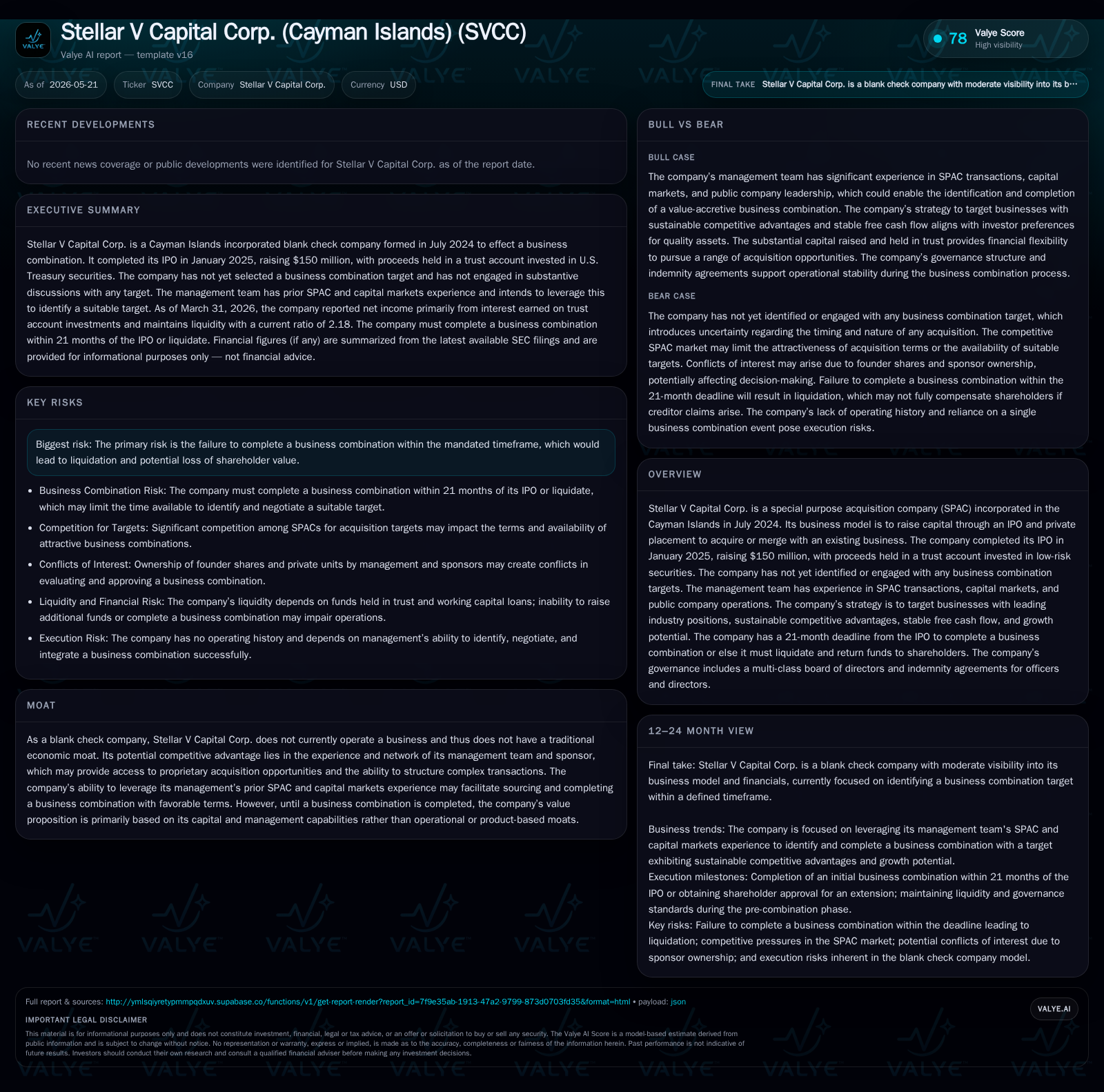
Stellar V Capital Corp., a Cayman Islands-based SPAC formed in mid-2024, remains in its pre-business combination phase with no identified targets as of Q1 2026. The company raised $150 million in its January 2025 IPO, holding proceeds in trust while leveraging management's extensive deal-making experience to pursue acquisitions with durable competitive advantages. With a 21-month deadline to complete a business combination or face liquidation, the firm must accelerate execution amid challenging regulatory and market landscapes common in the SPAC sector. Financially, the company sustains operations through modest working capital, relying primarily on the IPO trust fund for future transactions.
Latest Quarterly Filing Highlights and Implications
In its most recent quarterly filing dated May 14, 2026 [S2], Stellar V Capital Corp. disclosed no material changes to its risk profile or substantive progress toward completing its initial business combination. This stasis underscores the pressing nature of its timeline; the company needs to identify and consummate an acquisition before its hard deadline of October 31, 2026 — marking the end of its 21-month post-IPO combination window. The absence of operational or target-related breakthroughs means execution urgency must now intensify if value creation is to be realized.
Business Model and SPAC Operating Framework
Stellar V Capital operates as a special purpose acquisition company (SPAC), established in July 2024 as a Cayman Islands exempted company [S1]. It raised gross proceeds of $150 million through an IPO completed in January 2025 along with a small private placement by sponsors [S1]. The capital raised is held in a U.S.-based trust account invested primarily in low-risk marketable securities earning interest until deployed for an acquisition. The fundamental revenue mechanism is contingent on successfully merging with or acquiring one or more businesses using these funds combined with potential equity or debt issuance connected to the business combination.
Absent any completed transaction, the company generates no operating revenues but may earn non-operating income from interest on trust assets [S1]. Administrative expenses related to public company compliance and due diligence are ongoing costs during this phase.
If Stellar V fails to consummate a business combination by the prescribed deadline approximately 21 months after IPO (October 31, 2026), it must liquidate and return capital net of expenses to shareholders [S1]. This enforces a finite runway constraining strategic flexibility.
Management Team’s Experience as a Competitive Edge
While Stellar V currently lacks an economic moat by virtue of being a blank check vehicle, it leverages a management team deeply experienced in SPAC transactions, capital markets, public company operations, and mergers & acquisitions [S1]. The team’s extensive network includes contacts across private equity, investment banking, venture capital, and corporate boards worldwide [S16]. Such relationships have historically been instrumental in sourcing proprietary deals that avoid crowded auction processes.
Moreover, their track record in disciplined valuation and operational improvement post-merger aims to position any acquired entity for sustainable growth and favorable investor re-rating [S6]. This intangible asset of experienced stewardship stands as one of Stellar V’s strongest differentiators amid an increasingly competitive SPAC environment.
Industry Landscape for SPACs: Market Context and Peer Overview
The SPAC sector has evolved substantially since its peak popularity a few years prior. Increased regulatory scrutiny over disclosure practices and financial projections has elevated due diligence requirements alongside investor skepticism regarding dilution impacts. Competition among many SPACs targeting quality assets means teams must efficiently leverage relationships for timely proprietary deal flow, often against competing bids.
Additionally, underwriters’ deferred fees depend on successful deal closures adding pressure on structuring economically viable combinations that appeal both to existing shareholders seeking redemption rights protections and new investors aiming for growth exposure [S1]. Stellar V’s choice of flexible transaction structures—including cash, shares, debt or combinations thereof—mirrors common industry practice designed to accommodate diverse target company needs.
Growth Drivers and Acquisition Criteria
Stellar V’s pursuit centers on acquiring businesses with meaningful industry leadership underpinned by sustainable competitive advantages unassailable by rivals—such as proprietary technology, brand strength, distribution scale or defensible markets [S6]. Furthermore, emphasis is placed on companies exhibiting strong free cash flow generation coupled with prudent leverage ratios anticipated at close of combination ensuring financial resilience.
Management also favors targets providing transparent forward visibility into performance metrics enabling reliable near-term guidance typically within one year post-merger [S6]. This level of clarity is critical for public market acceptance given ongoing volatility around newly listed vehicles.
Growth prospects can be organic through product expansion or geographic reach while also potentially supported by bolt-on acquisitions strategically aligned via management’s network [S16]. However,"growth" here principally equates to value delivered through executing the initial de-SPAC transaction optimizing shareholder pricing rather than incremental standalone revenue increases within Stellar V itself prior to acquisition.
Key Risks and Execution Challenges Ahead
The paramount risk confronting Stellar V remains the inability to finalize any business combination before October 31, 2026; such failure results in mandatory wind-down entailing return of IPO funds minus expenses—a guaranteed negative outcome for shareholders from an enterprise value creation standpoint [S19]
Additional execution challenges include protracted negotiations typical in M&A contexts possibly compounded by rigorous SEC reviews focusing on disclosures reflective of public market standards. Target companies under consideration may exhibit financial instability or lack sufficient governance frameworks delaying deal closeability [S3]. Dilution considerations surrounding warrant conversion rights alongside underwriting fee payables impose further constraints on transaction economics impacting shareholder returns.
Managing these complexities demands effective timing coordination, clear communications with stakeholders regarding deal rationale and potential shortcomings if target companies diverge from initially stated criteria.
Milestones and Catalysts to Monitor Moving Forward
Upcoming milestones critical to tracking Stellar V’s progression include public announcements relating to target identification or substantive engagement disclosures mandated via proxy solicitations or tender offer documentation ahead of shareholder votes. Monitoring updates around underwriting fee triggers contingent on successful closing provides insight into deal probability timeline acceleration.
Firm communications delineating adherence or deviations from predefined acquisition criteria will inform investor confidence levels. Additionally, developments concerning board composition changes may signal shifts in governance strategy potentially affecting deal execution dynamics.
Given the ticking clock imposed by regulatory framework requiring finalization within roughly two months from current filings date (May 2026), each subsequent quarterly filing will likely reveal material progress details or growing concerns about timely completion prospects.
Concise Financial Position and Operating Cost Overview
Financially as detailed through latest available data as of March 31, 2026 [F1], Stellar V maintains modest current assets totaling approximately $266 thousand against current liabilities near $122 thousand resulting in an above-average current ratio near 2.18 indicating short-term obligations easily covered.
Nevertheless, zero reported cash equivalents at prior year-end end-2024 underscore that liquid capital resides predominantly within the trust account not reflected as operating cash but secured for future acquisition funding [F1][S1]. Operating expenses relate mainly to legal fees, administrative costs associated with being publicly listed and due diligence activities ongoing during this pre-acquisition phase.
Sponsor support mechanisms exist for working capital loans if required yet have not been drawn upon as noted at year-end reporting dates [S14]. The financial stance thus signals disciplined cost control aimed at preserving substantial IPO proceeds intact pending eventual de-SPAC completion.
This analysis synthesizes publicly available SEC filings up through Q1 2026 alongside Valye News internal research without extending into speculative investment advice. Readers should consult official reports directly for regulatory compliance purposes or engagement decisions.
Disclaimer: This is research-only, informational analysis and not investment advice. It may include AI-generated interpretation and general industry context. Always verify important details using primary sources.

Comments