
From IPO to Target Hunt: Examining Spring Valley Acquisition Corp. IV’s Path Forward
Spring Valley Acquisition Corp. IV has positioned itself with substantial IPO capital as it enters the initial phase of seeking a qualifying Business Combination.
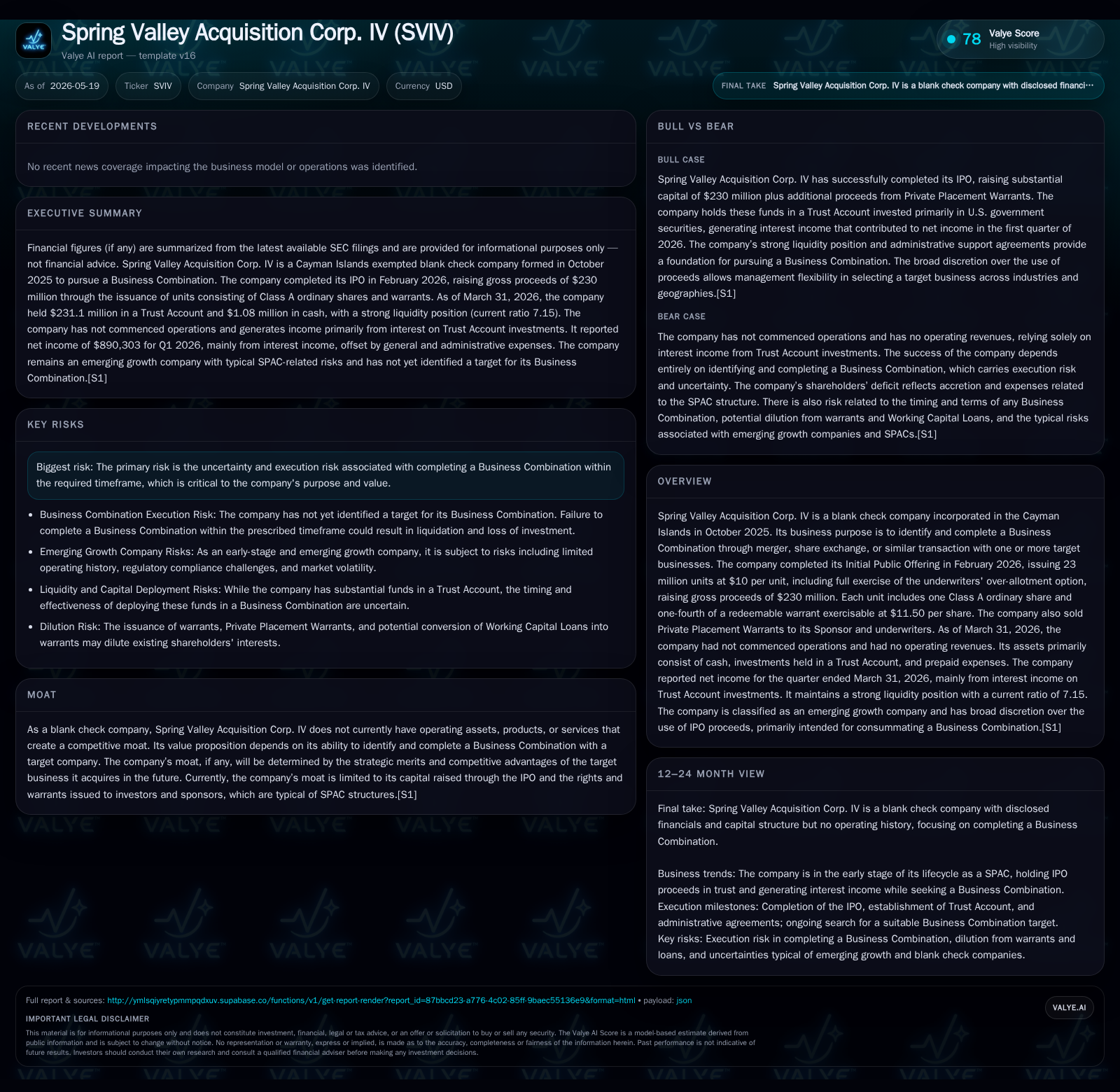
Spring Valley Acquisition Corp. IV completed its IPO in February 2026, raising $230 million gross proceeds and holds over $1.16 billion in current assets as of Q1 2026, primarily from its Trust Account. The company operates as a blank check SPAC with no operating revenues yet, focusing on identifying and consummating an initial Business Combination. Its strategic value hinges entirely on successful deal execution within the prescribed timeframe, amid volatile macroeconomic and geopolitical conditions that impact market sentiment and potential target valuations. Key near-term milestones include the selection of an acquisition target, shareholder votes, and potential redemption mechanics tied to warrant exercise prices.
Latest Operating Update and Capital Position
Spring Valley Acquisition Corp. IV filed its latest quarterly report (Form 10-Q) on May 15, 2026, providing a clear view into its capital structure and operational status as it stands in the early life cycle of a Special Purpose Acquisition Company (SPAC). The company completed its IPO on February 11, 2026, issuing a total of 23 million units at $10 per unit, including the full exercise of the underwriters' over-allotment option, generating gross proceeds of $230 million [S2][S9]. Deducting issuance costs such as underwriting fees ($14.1 million allocated to Class A ordinary shares issuance cost) and adjustments related to public warrants ($2.2 million), the net proceeds were primarily retained in a Trust Account invested in short-term U.S. government securities designed to preserve investor capital until deployment.
As of March 31, 2026, Spring Valley reported current assets totaling approximately $1.16 billion, predominantly comprising cash equivalents and investments held in the Trust Account structured to backstop shareholder redemptions if necessary [F1][S2]. This substantial cash buffer aligns with typical SPAC mechanics where funds raised during the IPO are restricted to fund the eventual Business Combination or returned if no deal occurs.
Notably, the company has not recorded any operating revenues yet, which is consistent with its pathway as a blank check company solely focused on executing an initial merger or acquisition [S1]. It also maintains low levels of debt - roughly $10,420 outstanding as of December 31, 2025 – with a current ratio above 7, indicating strong near-term liquidity positioning to meet working capital requirements through at least one year post-reporting [F1].
Business Model Overview: The SPAC Structure and Value Proposition
Spring Valley Acquisition Corp. IV operates as a frontier-stage SPAC: it raises capital upfront through an IPO by selling units consisting of ordinary shares combined with fractional redeemable warrants to investors seeking exposure to future private market acquisition opportunities without bearing immediate operational risk. Its value creation is contingent upon identifying an attractive private company target for merger or share exchange that meets size thresholds (at least 80% of net assets must be deployed from the trust) and obtaining requisite shareholder approvals within the defined Combination Period (generally up to 24 months post-IPO) [S1][S25]
Investors pay for upside optionality through public warrants exercisable at $11.50 per share post-Business Combination and sponsors receive Private Placement Warrants issued in tandem with the IPO priced at $0.90 each; these warrant structures represent typical SPAC incentives balancing dilution risk against potential equity participation aligned with transaction success [S2][S9]. Management notes they have discretion over net proceeds application but are committed principally to consummating a Business Combination or else returning capital appropriately.
The absence of operations means no revenue is recognized before a Business Combination closes; during this stage, financial statements mostly reflect administrative expenses (notably $184,799 in Q1 general costs), interest income earned modestly on trust investments, and valuation adjustments related to warrant accounting under equity treatment frameworks [F1][S7]. These dynamics position Spring Valley principally as a custodial capital vehicle backed by experienced sponsors holding registration rights agreements defining resale timelines for founder shares and warrants to provide liquidity channels post-combination [S6][S15].
Industry and Market Context: SPAC Competitive Landscape in 2026
In early-to-mid 2026, SPAC formation trends face notable headwinds due to geopolitical disturbances stemming from ongoing conflicts such as Russia's invasion of Ukraine alongside Middle East tensions affecting investor risk appetites broadly across public markets [S8]. These macro considerations increase volatility in commodity prices, credit availability, and capital market liquidity potentially constraining valuations or elongating timelines for deal origination and completion.
The evolving regulatory environment imposes due diligence rigor that weighs on timing while intense competition among blank-check sponsors creates pressure points around sourcing high-quality targets—a critical determinant of post-merger equity attractiveness (). In this environment, capital allocation discipline becomes paramount with a premium placed on sponsors possessing strategic sector knowledge and operational expertise capable of mitigating uncertainties connected to pricing power erosion due to saturated acquisition markets.
Although not explicitly detailed in filings for Spring Valley IV specifically beyond general risk disclosures, it can be inferred that these forces underscore elevated execution risks standard across SPACs currently known industry-wide ().
Growth Drivers: Potential Paths Toward Value Creation Post-Business Combination
For Spring Valley Acquisition Corp. IV, growth is not organic but transactional: securing a suitable target company forms the fulcrum for transforming locked capital into active business operations yielding revenue streams post combination closure [S1][S9]. Success depends foremost on the sponsor team's ability to leverage sourcing networks and sector insights—capabilities typically showcased by seasoned dealmakers who can negotiate terms tying purchase price points favorably relative to future earnings capacity.
The strategic merit and competitive advantage inherent in an eventual target will ultimately define Spring Valley's moat—currently nonexistent—placing emphasis squarely on sponsor quality and deal rationale rather than pre-existing product/service positioning [S1]. Post-combination expansion then depends on traditional drivers such as cross-selling opportunities, geographic market penetration potential, operational margin improvements, or proprietary technology leverage built into acquired assets ().
Risks and Execution Challenges Ahead
The primary risk facing Spring Valley Acquisition Corp. IV lies in successfully closing an initial Business Combination within its contractual window (typically two years), exposing it to definitive time constraints that heighten pressure amidst fluctuating market dynamics [S2][S28]. Should no deal be consummated timely, shareholders are entitled to liquidation distributions eroding sponsor incentives.
Global macroeconomic uncertainties driven by geopolitical conflicts add layer complexity whereby sudden sanctions regimes or supply chain disruptions could dampen valuations or stall negotiations for attractive targets materially impacting prospective deals' feasibility [S8]. Additionally, shareholder redemption rights linked tightly to trust account valuations create variable dilution scenarios dependent on equity price performance relative to warrant strike prices such as the established redemption call threshold at $18 per share designed to prevent premature redemptions absent premium realizations [S2].
Alignment between sponsor/promoter interests and public shareholders constitutes another watchpoint given warrants comprise meaningful equity positions potentially diluting new investors upon conversion; misaligned incentives could affect governance or prolong search durations beyond economically optimal timeframes ().
What To Watch Next: Milestones and Key Catalysts
Investors monitoring Spring Valley Acquisition Corp. IV should track announcements regarding:
- Identification or announcement of potential target companies advancing toward binding agreements;
- Scheduling dates for shareholder meetings or tender offers seeking approval for proposed Business Combinations;
- Redemption activity cues often influenced by stock trading levels approaching or surpassing warrant exercise-related thresholds like the $18 fair market value benchmark;
- Any disclosures relating to utilization or negotiation for Working Capital Loans supporting transaction costs;
- Governance votes reflecting executive compensation advisory outcomes hinting at internal stakeholder alignments post-IPO period.
Total debt was minimal ($10,420 as last reported December 31, 2025), highlighting negligible leverage burden consonant with blank-check companies reliant primarily on equity funding keeping leverage low until combination closure accomplishments occur [F1][S2]. Interest income accrued modestly reflecting conservative Trust Account investments while administrative expenses remained subdued consistent with foundational startup activities prior to revenue generation phases [F1][S7]. This robust financial posture supports management’s assertion that existing resources suffice for projected operational costs across the near term absent external capital raises pending deal completion.
This analysis is based solely on publicly available information provided through SEC filings dated May 15th, 2026 () and corroborated companyfacts data ([F1]). It does not constitute investment advice but aims to contextualize Spring Valley Acquisition Corp. IV’s strategic position within the evolving SPAC framework amid prevailing macroeconomic challenges.
Financial position in context
As of 2025-12-31, companyfacts shows $10,420 of total debt [F1]. Companyfacts also indicates net debt of roughly $10,420 for the latest available period [F1]. Current assets of $1,159,862 and current liabilities of $162,233 imply a current ratio near 7.15x for 2026-03-31 [F1].
Disclaimer: This is research-only, informational analysis and not investment advice. It may include AI-generated interpretation and general industry context. Always verify important details using primary sources.

Comments