
Stanley Black & Decker Balances Brand Strength and Legal Risks in a Challenging 2025
After a slight revenue decline but improved earnings in 2025, Stanley Black & Decker faces legal pressures and supply challenges amid steady cash flow and capital discipline.
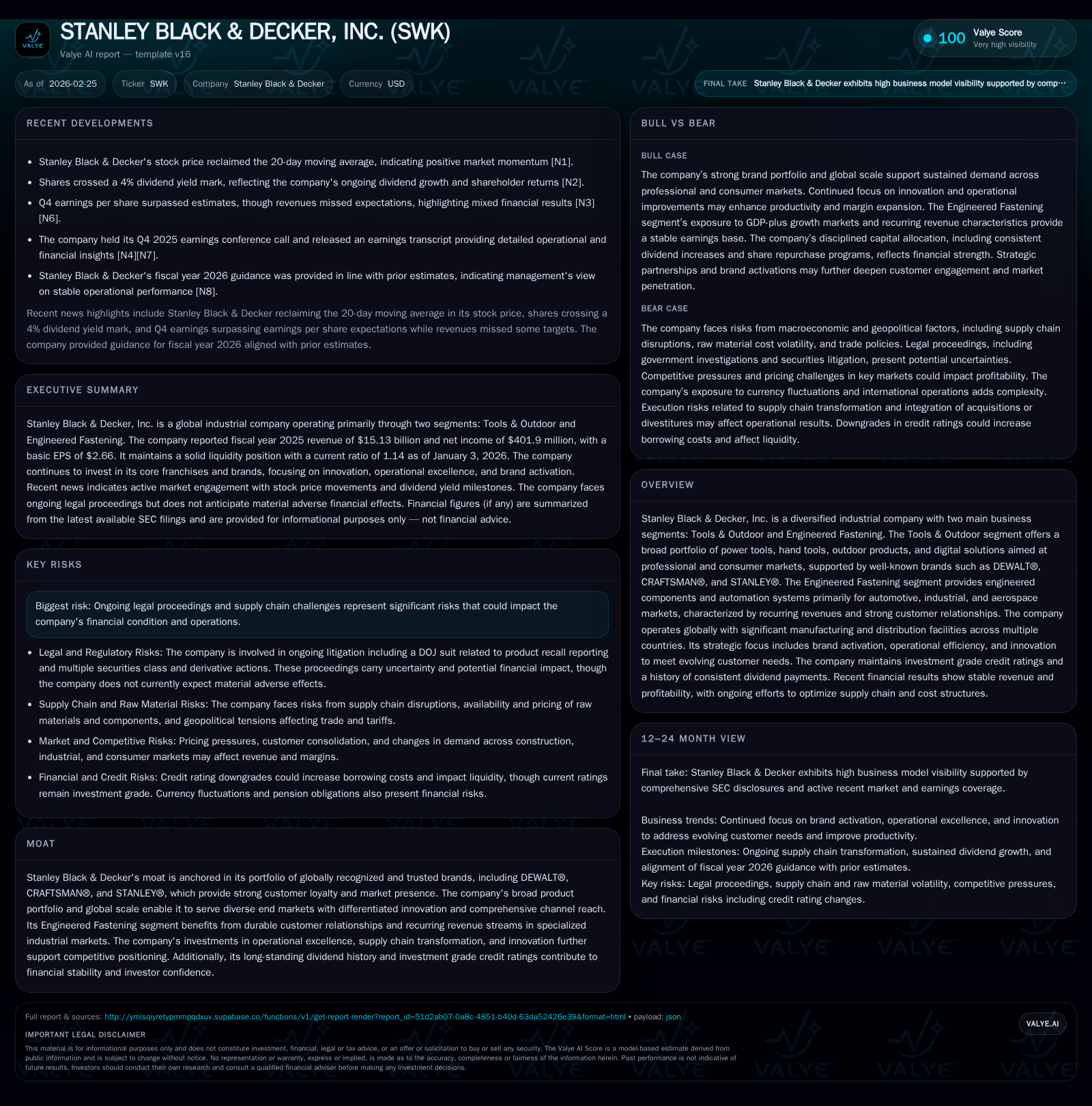
Stanley Black & Decker, a leader in power tools and engineered fastening, experienced a modest revenue dip of 1.5% in fiscal 2025 as economic headwinds and changing demand patterns influenced results. Despite this, net income rebounded by 36.6%, driven by operational efficiencies and cost management. The company maintains solid free cash flow and a strong investment grade credit profile, supporting continued dividends amid moderate share buybacks. However, ongoing legal proceedings related to product recalls and supply chain uncertainties pose potential near-term risks to financial performance. The company’s future growth hinges on brand-driven innovation, market recovery, and execution of operational improvements.
Historical Performance
Stanley Black & Decker has navigated a complex environment marked by evolving consumer behavior, supply constraints, and macroeconomic pressures over recent years. Revenue peaked around $15.78 billion in FY2023 before retreating slightly in the subsequent two years to $15.13 billion by FY2025 ([F1]). This represents a compound challenge affecting cyclical industrial markets and end-consumer demand.
The net income trajectory reveals a more dynamic story: from a loss of approximately $310 million in FY2023, the company swung back strongly to post $294 million profit in FY2024, followed by an even more notable jump to $402 million in FY2025 ([F1]). Operating income showed steady growth as margins improved through operational efficiencies despite top-line softness.
Cash flows have remained robust with operating cash flow at $971 million in FY2025, down about 12% year-over-year but still generating ample liquidity after reducing capital expenditures nearly 20% to roughly $283 million ([F1]). This prudent capex stance underpins free cash flow of approximately $688 million.
Historical performance (annual)
| FY | Rev ($bn) | Net ($mm) | CFO ($mm) | Capex ($mm) | Rev YoY | Net YoY |
|---|---|---|---|---|---|---|
| 2025 | 15.1 | 402 | 971 | 283 | -1.5% | +36.6% |
| 2024 | 15.4 | 294 | 1107 | 354 | -2.6% | +194.8% |
| 2023 | 15.8 | -310 | 1191 | 339 | +295.8% | -129.2% |
| 2022 | 4.0 | 1063 | -1459 | 530 |
Note: Omitted columns lack sufficient annual XBRL coverage in the provided tags (need ≥2 annual points): OpInc. Source: SEC companyfacts cache [F1].
Capital returns and efficiency (annual)
| FY | Div ($mm) | Buybacks ($bn) | FCF ($mm) |
|---|---|---|---|
| 2025 | 501 | 0.0 | 688 |
| 2024 | 491 | 0.0 | 753 |
| 2023 | 483 | 0.0 | 853 |
| 2022 | 466 | 2.3 | -1990 |
Source: SEC companyfacts cache [F1].
Note: Operating Income YoY figures omitted due to data limitations.
Segment Dynamics and Growth Drivers
Stanley Black & Decker's business divides principally into Tools & Outdoor and Engineered Fastening segments ([S1]). The former leans heavily on iconic brands like DEWALT®, CRAFTSMAN®, and STANLEY®, which enjoy loyal followings among professionals and consumers alike. Core drivers include product innovation, expanding digital solutions, and channel development—particularly e-commerce penetration.
Engineered Fastening generates steady recurring revenues via specialized industrial components serving automotive, aerospace, and other sectors sensitive to macroeconomic trends ([S1]). Stability here derives from long-term customer relationships but exposes the firm to cyclicality tied to industrial production volumes.
Operational efficiency initiatives—such as supply chain transformation programs, SKU rationalization, platforming products for scale advantages—have aided margin expansion during recent turbulent conditions ([S1]). Maintaining this momentum alongside technological advancement remains key for sustainable growth.
Capital Structure and Financial Flexibility
Stanley Black & Decker holds investment grade status from major rating agencies (S&P BBB+, Fitch BBB+, Moody's Baa3), though S&P downgraded senior unsecured debt from A- in Q3/2025 reflecting sectoral headwinds ([S5]). The company manages a sizable debt load around $5.3 billion long-term with staggered maturities through2030+ ([S16],[S20]). Commercial paper utilization reached approximately $605 million as of early January 2026 predominantly Euro-denominated from a $3.5 billion program ([S12]).
Liquidity is bolstered by multiple credit facilities totaling about $3.8 billion including committed long- and short-term lines ([S19],[S23]), which were undrawn or lightly used at year-end except for commercial paper borrowings.
Interest coverage covenants require maintenance above a ratio of EBITDA to net interest expense between roughly 2.50x–3.50x depending on quarter ([S6],[S13]). The company recently redeemed higher-cost notes early replacing them with lower-rate commercial paper to optimize its interest expense profile ([S10],[S15]). Interest paid on debt remained elevated near half a billion dollars annually consistent with borrowing levels ([S19]).
Returns, Capital Allocation, and Shareholder Returns
ROE approximates a modest ~4.4% based on FY25 net income over book equity roughly at $9 billion ([F1]). While this is subdued relative to some industrial peers, it reflects substantial reinvestment needs amid evolving product portfolios plus costs associated with legal contingencies.
Dividends sustained steady increases annually culminating in about half a billion dollars paid out in FY2025 ([F1]). However, share repurchases plummeted dramatically from multi-billion-dollar levels pre-pandemic ($2.3 billion repurchased in FY22) down to just $20 million in FY25—a sign of conservative capital stewardship given external pressures.
The company’s free cash flow capacity (~$688 million) provides potential leeway for future dividend growth or appropriate opportunistic buybacks once legal uncertainties clear or market conditions improve ([F1],[S18]).
Legal Proceedings and Risks
A significant headline risk comprises ongoing litigation linked to delayed reporting related to voluntary product recalls involving utility bars and miter saws dating back several years—a matter under review by the Consumer Product Safety Commission (CPSC) escalating into Department of Justice proceedings with civil penalties estimated around $32 million ([S1],[S26]). Stanley Black & Decker disputes the claims vigorously without expecting material financial impact beyond existing reserves.
Other class action suits alleging securities law violations tied to disclosures during volatile pandemic-era demand shifts remain unresolved but currently pose limited financial jeopardy based on management commentary ([S1],[N11]). Supply chain volatility driven by geopolitical factors including raw material tariffs, freight cost inflation, labor shortages, plus rare earth controls also present ongoing operational challenges requiring agile response ([S14],[N6]).
Future Outlook Considerations
The company issued guidance for fiscal year ending January 2027 aligned broadly with analyst expectations reflecting stabilized revenue outlooks despite lingering risks ([N10]). Key drivers shaping future trajectory include:
- Successful rollouts of new tool products integrating battery technology advances driving professional segment rebound.
- Price realization efforts mitigating commodity input cost inflation while preserving competitive positioning.
- Completing portfolio adjustments including divestiture of non-core Engineered Fastening divisions such as CAM business improving focus.[S1]
- Resolution of outstanding legal matters removing uncertainty-related margin pressure.[S26]
- Continued digital initiatives capturing consumer e-commerce growth channels.
- Potential normalization of industrial demand cycles benefiting engineered fastening segment.
Watch metrics like organic revenue growth rates excluding divestitures, gross margin trends linked to raw material pass-through effectiveness, operating expense leverage from transformation programs alongside updates on litigation progressions.
Conclusion
Stanley Black & Decker entered calendar year 2026 facing a mixed set of industry headwinds tempered by strategic strengths anchored in brand equity and operational discipline. While reported revenue softened modestly last year amid softness across core markets, earnings recovery signals effective internal management calibrated for resilience.
Capital structure wise the firm balances substantial debt yet retains liquidity buffers backed by investment-grade ratings despite recent rating setbacks attributed primarily to sector-wide stresses.[S5] Shareholder returns remain supported through reliable dividends though buybacks have paused substantially given near-term uncertainties.
Legal disputes represent salient potential disruptors but currently are managed within anticipated loss frameworks without threatening core business fundamentals.[S1] Ultimately sustaining market leadership will rest on Stanley Black & Decker’s ability to innovate products appealing to professional users while navigating supply chain complexity efficiently.
This memorandum is prepared solely for informational purposes without any recommendation regarding securities transactions.
Disclaimer: This is research-only, informational analysis and not investment advice. It may include AI-generated interpretation and general industry context. Always verify important details using primary sources.

Comments