
Sypris Solutions Strengthens Strategic Contract Base While Managing Cyclical Market Pressures
Sypris Solutions leverages multi-year sole-source contracts and advanced manufacturing to maintain resilience amid market headwinds and supply chain challenges.
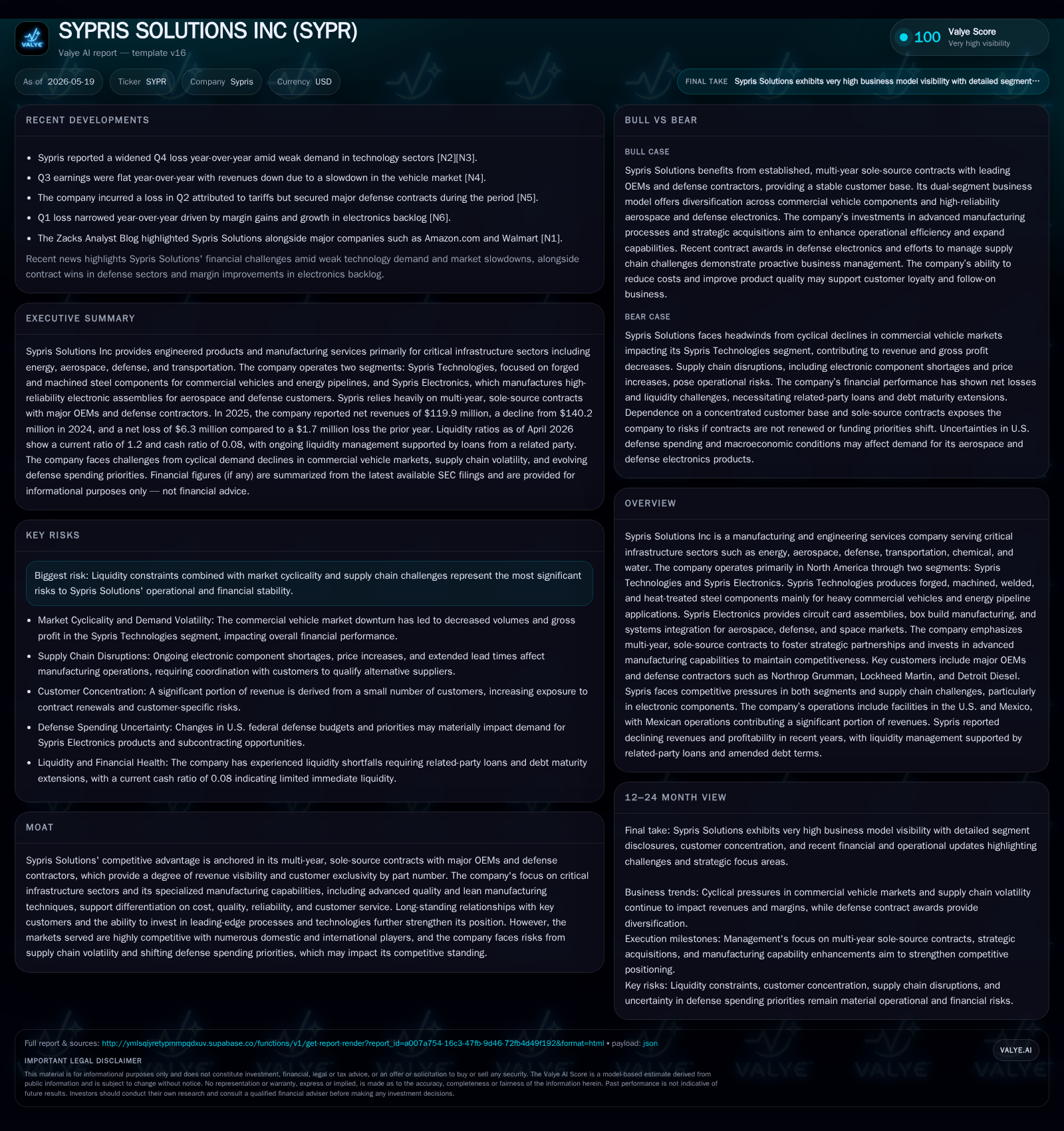
In its latest quarterly filing, Sypris Solutions Inc. reinforced the stability of its operations through continued reliance on multi-year, sole-source contracts despite ongoing cyclical softness in key end markets. The company’s two-segment business spans forged steel components for commercial vehicles and engineered electronics for aerospace and defense, anchored by strategic partnerships with major OEMs and defense contractors. While supply chain pressures and inflation persist, management underscores liquidity adequacy supported by related-party financing and contingency plans. Future growth hinges on a projected rebound in heavy truck production, aerospace/defense backlog expansion, and productivity gains from strategic investments.
Latest Quarterly Operating Performance and Strategic Highlights
Sypris Solutions’ Q1 2026 filings reaffirm operational stability despite broad inflationary pressures and market cyclicality that continue to ripple through its key end markets. The company announced financial results for the quarter ended April 5, 2026, highlighting sustained revenue delivery under longstanding sole-source contracts to major aerospace and commercial vehicle OEMs [S2][S3]. These contracts underpin revenue visibility even as sectoral demand shows mixed signals.
Operationally, Sypris continues to manage supply chain constraints and raw material cost inflation by initiating pricing actions coupled with transformation initiatives aimed at productivity enhancement [S2]. Management notes these efforts should offset cost creep to a degree but expects ongoing challenges throughout 2026. Notably, contract deliveries remain on track although margin pressures persist due to an unfavorable mix in program shipments and timing delays impacting production ramp-up efficiencies
No material changes occurred in the risk profile relative to the annual disclosures filed earlier in the year, providing continuity from the prior operating backdrop [S2]. The recent event filing underscored the press release dissemination without modifications to guidance but stressed monitoring execution against macro uncertainties [S3].
Business Model and Product Offering Deep Dive
Sypris Solutions operates two complementary segments serving critical infrastructure sectors primarily in North America: Sypris Technologies and Sypris Electronics [S1]. The former produces precision-forged, machined, welded, and heat-treated steel components predominantly for heavy commercial vehicles—including Class 8 trucks—and high-pressure energy pipeline applications. Diversification into automotive, off-highway, and recreational vehicle components mitigates exposure inherent in cyclical truck markets [S1][S5].
Sypris Electronics targets aerospace, defense, and space markets with circuit card assembly, box-build manufacturing, systems integration, and engineering design-for-manufacturability services. This segment’s strategic strength lies in high-reliability manufacturing catered to sophisticated defense programs such as radar systems and tactical ground stations. Multi-year sole-source contracts are common here as well by part number, cementing customer lock-in with industry giants like Northrop Grumman, Lockheed Martin, L3Harris Technologies, Collins Aerospace Systems (RTX), BAE Systems, and Analog Devices [S1][S12].
The business model emphasizes building deep partnerships through exclusive contractual engagements that allow Sypris to justify capital investment in cutting-edge manufacturing processes—lean manufacturing techniques including six sigma quality management—as well as real-time engineering change controls that reduce cycle times and improve product quality reliability. These operational capabilities create switching costs that reinforce client retention while enabling differentiation not solely on price but also on service responsiveness and customization expertise.
Revenue flows directly from OEMs or Tier-1 suppliers who pay for delivered components or manufacturing services under fixed or unit-price frameworks embedded within multi-year agreements. Volume fluctuations may occur with cyclical demand shifts—especially evident in commercial vehicle production—but contract terms generally provide some revenue floor through binding purchase obligations or forecast commitments.
Competitive Positioning and Industry Context
Within the competitive landscape of critical infrastructure component manufacturing and high-reliability electronics assembly, Sypris holds a distinct position elevated by its multi-year sole-source contractual model restricting competitor access part-by-part. This exclusivity differentiates it from many peers facing spot-buy competition or less entrenched relationships.
The industrial forging markets supplying automotive/truck components are intensely competitive with domestic OEMs pressing suppliers on cost reductions while simultaneously demanding quality enhancements. Major competitors encompass large Tier-1 suppliers such as Cummins Inc., Meritor, American Axle & Manufacturing, among others. Sypris’s scale is modest compared to these Tier-1 behemoths but compensated by specialization in niche forged driveline components where technical complexity limits commoditization risks [S28].
In the aerospace/defense electronics segment, no dominant market leader prevails given fragmentation among specialized subcontractors serving prime contractors adjudicating government programs. Demand is influenced heavily by federal budgets shaped by geopolitical conditions including tensions in the Middle East conflict zones affecting global energy markets and consequent capital spending patterns of exploration companies served by Sypris’s Tube Turns® brand products [S1][S23]. Regulatory scrutiny intensifies around environmental liabilities given historic contamination at certain sites formerly operated by others; this remains a latent risk factor though currently manageable per management assessment [S24].
Capacity constraints appear moderate as management has invested prudently in plant upgrades supported partially by sale-leaseback transactions enhancing cash flow flexibility. Pricing power is somewhat constrained due to cyclical weaknesses but buttressed over time by contractual protections crystallizing customer obligations legally enforceable.
Key Growth Drivers Underpinning Demand Expansion
Several structural growth pillars emerge for Sypris’s future development:
Heavy Commercial Vehicle Market Rebound: After a marked drop (-24%) in Class 8 truck production during 2025 exacerbated by broader industrial sector weakness affecting freight tonnage hauled domestically, industry forecasts project stabilization in 2026–27 followed by approximately a 27% growth surge in 2028 supporting greater volume demand for drivetrain components manufactured by Sypris Technologies [S1]
Diversification Away from Cycle Sensitivity: The expansion into automotive segments beyond heavy trucks plus off-highway vehicles provides revenue smoothing benefits due to differing cycle timing profiles.
Defense & Aerospace Backlog Expansion: Continued program awards for circuit card assemblies underpin volume growth within Sypris Electronics amid heightened U.S. government focus on space programs and defense upgrades; sustained multiyear backlog formation supports operational throughput planning [S12][N1]
Advanced Manufacturing Investments: Ongoing pursuit of lean manufacturing efficiencies augmented by six sigma methodologies reduces costs while improving quality metrics leading to improved margins over time as volume scales materialize.
Strategic Customer Relationships: Long term sole-source contracts with major OEMs provide durability against competitive encroachment enhancing predictability of sales volumes even under variable macroeconomic conditions.
Expansion into New Energy Markets: Exploration of new product lines and markets related to energy infrastructure including pressure vessels complements existing capabilities targeting pipeline applications thereby broadening addressable market funding pools [S12].
Risks and Operational Constraints to Monitor
Plainly articulated risk factors expose vulnerabilities:
Liquidity & Working Capital Sensitivities: Despite improvements from related-party secured loans totaling $12 million arranged under extended maturity schedules favorable to operating cash flow timing needs (with optional interest deferrals), working capital requirements tied to inventory buildups especially in electronic components remain tight pressure points necessitating vigilant management [S4][S6]
Customer Concentration: The top five customers accounted for approximately 63% of net revenues last fiscal year—including Northrop Grumman (23%) and Detroit Diesel (13%)—amplifying exposure if contract renewals falter or volume forecasts slip unexpectedly amidst shifting procurement priorities driven by federal budget variability or OEM production adjustments [S5][S28]
Market Cyclicality: Heavy commercial vehicle demand cycles have historically fluctuated severely based on industrial activity; despite diversification efforts volatility cannot be fully eliminated impacting top-line consistency over short horizons [S1].
Supply Chain Volatility: Persistent inflationary input costs along with logistical delays continue to challenge timely delivery schedules raising risks of shipment slippage which cascades into payment cycles impacting liquidity dynamics further downstream [S2]
Legal / Environmental Exposure: Historical contamination at acquired facilities imposes latent contingent liabilities although indemnification agreements mitigate direct impact; any unforeseen regulatory enforcement escalations could impose additional remediation burdens constraining cash flows or otherwise distracting management attention [S24]
Defense Spending Uncertainty: Geopolitical shifts influence federal defense budget allocations which determine subcontracting scopes handled predominantly through prime contractors; any policy-driven procurement reductions could negatively affect backlog renewal rates mid-to-long term [S23]
Near-Term Catalysts and What to Watch Next
Key monitoring points include:
Q2 Earnings Results: Investors should scrutinize revenue growth trends versus guidance alongside margin trajectory reflecting whether efficiency measures begin offsetting cost inflation effectively.
Order Backlog Updates: Transparency around firm backlog levels especially from aerospace/defense programs will indicate robustness of future cash-flow generation beyond near-term sales spikes.
Contract Renewals / New Program Awards: Given exclusivity embedded within sole-source contracts by part number renewal announcements act as critical confirmation of customer confidence essential for revenue sustainability.
Supply Chain Stability Indicators: Materials availability improvements or further disruptions will materially alter operational delivery risk profiles impacting working capital utilization.
Cost Control Initiatives Outcomes: Effectiveness of lean process enhancements remains pivotal for margin recovery amidst persistent inflation pressures.
Management commentary during subsequent earnings calls or disclosures will provide directional cues addressing these markers influencing near-term operational forecasts substantially [S3][N1].
Financial Overview: Liquidity and Capital Structure Snapshot
As of the end of Q1 2026, balance sheet data reflect a current ratio around 1.2 indicating moderate liquidity cushions relative to short-term obligations supported chiefly by $5.2 million cash availability complemented by anticipated cash flow generation from operations coupled with measured reductions in working capital inventories primarily within the electronic subsegment [F1][S4]. Total debt includes approximately $12 million related-party promissory notes provided by entities controlled by senior insiders that have been amended multiple times extending maturities through April 2030 with features allowing interest payment deferrals offering flexible capital deployment latitude under constrained cash flow scenarios [S4][S6].
The company's commitment to ongoing transformation initiatives aimed at productivity gains together with strategic investments supports potential margins improvement over time despite current cyclical pressures reflecting prudent financial stewardship focused on maintaining operational solvency while investing selectively in differentiated capabilities.
This analysis is based exclusively on publicly filed SEC documents up to May 19, 2026 ([S1]-[S29]) supplemented minimally by market commentary ([N1]) without making forward-looking investment research views or valuations. It aims to offer an informed overview grounded strictly in disclosed facts consistent with buy-side industry research standards.
Disclaimer: This is research-only, informational analysis and not investment advice. It may include AI-generated interpretation and general industry context. Always verify important details using primary sources.

Comments