
TransAct Technologies: Navigating Profitability Headwinds with Liquidity and Operational Discipline
The company’s ability to leverage its technology portfolio, manage fixed obligations, and adapt to evolving industry demand will determine whether it can convert financial stability into sustainable earnings.
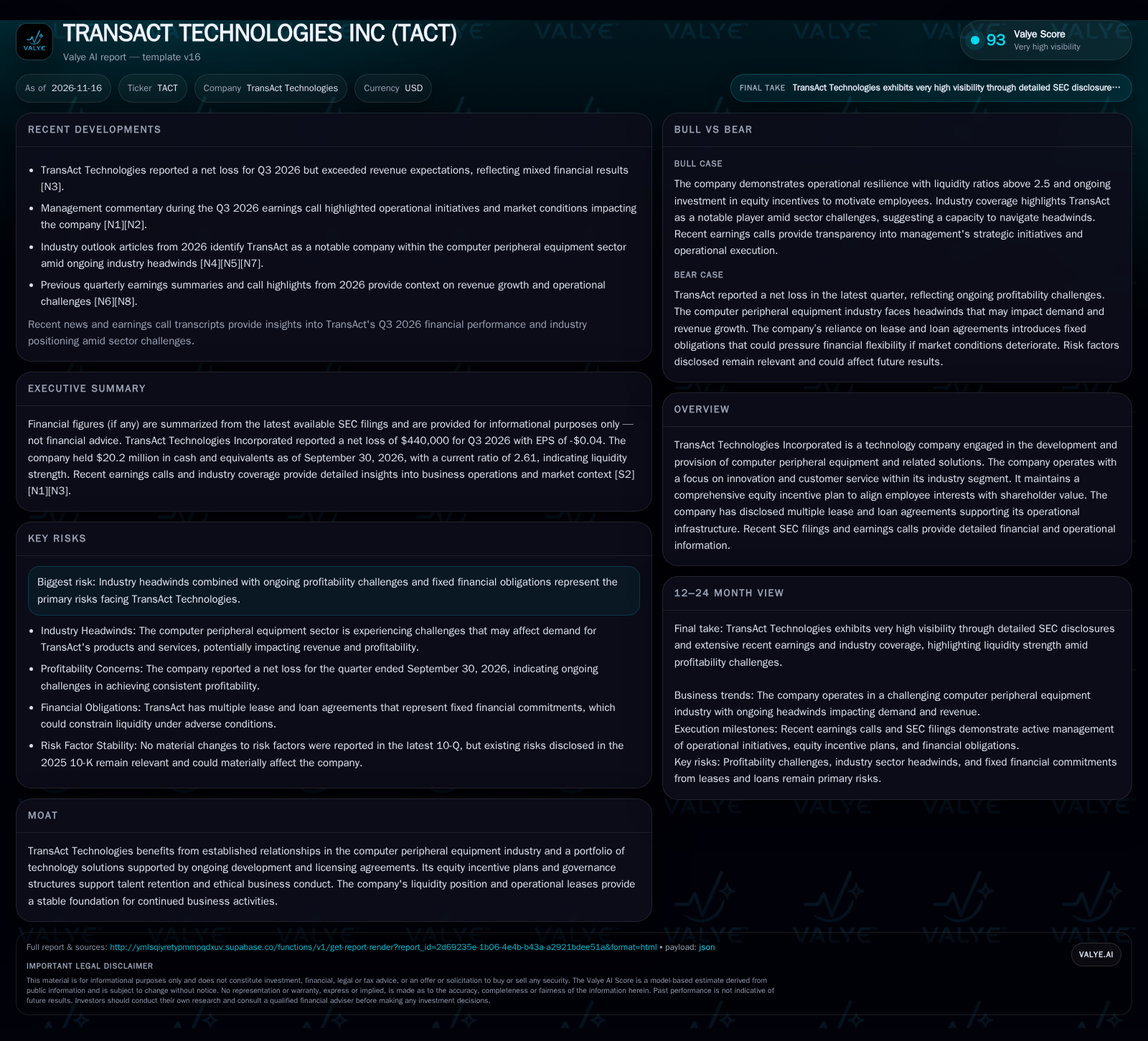
TransAct Technologies reported a Q3 2026 net loss despite exceeding revenue expectations, underscoring persistent profitability challenges amid sector headwinds. The company holds $20.2 million in cash with a current ratio of 2.61, reflecting a reported liquidity position. Its ongoing operational and equity incentive initiatives may drive future adaptability, but reliance on leases and loans introduces fixed commitments that could pressure flexibility if industry conditions worsen. The core question is whether TransAct can translate financial stability and technology investments into consistent profits as the peripherals market evolves. [S2] [N1] [N3] [N4]
As the computer peripherals industry faces structural challenges, TransAct’s future will hinge on its ability to leverage technology investments, manage financial commitments, and adapt to shifting demand. The next phase of the story is whether operational initiatives and a stable financial base can catalyze a return to consistent earnings.
Recent Results: Losses Persist Despite Revenue Outperformance
TransAct Technologies reported a net loss of $440,000 for the quarter ended September 30, 2026, with basic and diluted EPS of -$0.04. This loss came even as the company exceeded revenue expectations for the period, reflecting a disconnect between topline performance and bottom-line profitability. The company reported cash and liquidity metrics for the period; these figures do not by themselves establish operating runway, investment capacity, financial flexibility, or financing capacity. Management commentary in recent earnings calls has highlighted ongoing operational initiatives and a focus on navigating sector headwinds. The industry outlook remains challenging, with TransAct identified as a notable player amid broader computer peripheral equipment sector difficulties. The persistence of fixed financial obligations from leases and loans adds another layer of complexity as the company seeks a path to sustainable profitability. [S2] [N1] [N3] [N4]
How Peripheral Technology Economics Shape Margin Potential
TransAct’s business model centers on the development and sale of computer peripheral equipment and related technology solutions. In this segment, revenue is typically driven by a mix of hardware sales, consumables (such as printer supplies), and potentially recurring service or software fees, though the report does not specify the relative contribution of each stream. The economics of peripheral hardware are often characterized by modest gross margins, high competition, and price sensitivity, which can pressure profitability, especially when industry demand is weak or slow-growing.
The company’s fixed cost base is influenced by lease and loan obligations, which create a floor for necessary cash outflows regardless of revenue variability. This structure means that any revenue shortfall or margin pressure can quickly impact the bottom line. On the other hand, if TransAct can scale volumes or introduce higher-margin solutions—such as proprietary software, maintenance contracts, or integrated systems—it could benefit from operating leverage. Capital needs in this business are moderate; maintaining liquidity is critical for inventory, R&D, and working capital, but the business is not as capital-intensive as semiconductor fabrication or large-scale manufacturing. The presence of an equity incentive plan suggests a strategy to align employee performance with shareholder outcomes, potentially driving innovation and cost control if executed effectively.
Industry Headwinds and the Challenge of Differentiation
TransAct operates in a highly competitive segment of the computer peripheral equipment industry, where barriers to entry are moderate and product commoditization is a persistent risk. Larger, well-capitalized players and specialized niche competitors exert pricing pressure and compete for the same customer base. The company’s moat is described as stemming from established industry relationships and a portfolio of technology solutions, but the durability of these advantages is tested during periods of weak demand.
Ongoing development and licensing agreements may provide some insulation from pure price competition, particularly if TransAct can offer differentiated features or integrated solutions that are less easily substituted. However, the lack of disclosed recurring revenue or long-term contracts in the present evidence suggests that retention and pricing power may be limited. As the industry faces structural headwinds—from shifting end-market demand to potential technology substitution by integrated or cloud-based solutions—the question is whether TransAct’s innovation and customer service focus can sustain its relevance and margins.
Technology Innovation and Execution Unlock Operating Leverage
A favorable outcome for TransAct would involve the successful commercialization of new or enhanced technology solutions that command higher margins or create stickier customer relationships. If the company is able to introduce proprietary software platforms, integrated hardware-software offerings, or value-added services (such as remote diagnostics, analytics, or managed print solutions), it could shift its revenue mix toward higher-margin, recurring streams.
Confirmation of this scenario would come from sequential margin expansion, positive EPS inflection, and management commentary highlighting contract wins or new product launches that resonate with customers. Evidence such as rising deferred revenue, increasing attach rates for services, or the announcement of multi-year customer agreements would support the view that TransAct is building a more resilient and profitable business model. Conversely, if gross margins remain stagnant and revenue is driven primarily by legacy hardware sales, this scenario would be weakened.
Stability Maintained, but Profitability Remains Elusive
The most plausible medium-term outcome is that TransAct maintains its liquidity and operational discipline but continues to struggle with consistent profitability. In this scenario, the company is able to meet its lease and loan obligations, support ongoing R&D, and preserve customer relationships, but industry headwinds and intense competition limit pricing power and margin improvement.
Operational initiatives and employee incentives may help contain costs and drive incremental improvements, but unless there is a step-change in demand or product differentiation, earnings will likely remain volatile and below the company’s cost of capital. Confirmation would come from continued net losses or marginal profits, stable but unremarkable revenue, and management guidance that emphasizes execution and adaptation rather than transformative growth. Evidence against this scenario would be either a marked deterioration in liquidity (suggesting operational stress) or a sharp, sustained improvement in profitability driven by new business wins or successful product introductions.
Fixed Obligations and Market Weakness Erode Flexibility
The adverse scenario is one where persistent industry headwinds, declining demand for peripheral equipment, or increased competition lead to further revenue contraction and margin compression.
This scenario would be confirmed by a rapid drawdown in cash reserves, a deteriorating current ratio, and management commentary signaling restructuring, cost-cutting, or asset sales. Additional red flags would include missed debt covenants, the need for external financing under unfavorable terms, or the loss of key customer relationships. Conversely, stabilization of cash flow and evidence of cost flexibility would help to falsify this negative outcome.
Testing the Thesis: What Will Determine TransAct’s Next Chapter?
Gross margin trends and segment mix: Sustained margin improvement or shifts toward software/services would indicate progress toward a more profitable model, if disclosed.
Recurring revenue indicators: Evidence of deferred revenue growth, multi-year contracts, or subscription-based services would help test whether the company is building revenue resilience.
Cash flow from operations: Positive and growing operating cash flow would signal underlying business stability and the ability to self-fund initiatives.
New product launches and customer adoption: Announcements of successful technology introductions and uptake by key customers would support the upside scenario.
Lease and loan covenant disclosures: Updates on compliance or renegotiation would clarify the degree of potential financial flexibility under stress.
Management guidance on industry outlook: Forward-looking statements on demand trends, competitive positioning, and risk mitigation would provide context for scenario direction.
Disclaimer: This is research-only, informational analysis and not investment advice. It may include AI-generated interpretation and general industry context. Always verify important details using primary sources.

Comments