
Talos Energy’s 2025 Earnings Collapse Highlights Deepwater Challenges and Capital Strategy Shifts
A sharp earnings downturn in 2025 underscores Talos Energy’s regulatory hurdles, commodity price risks, and strategic capital management in the offshore energy sector.
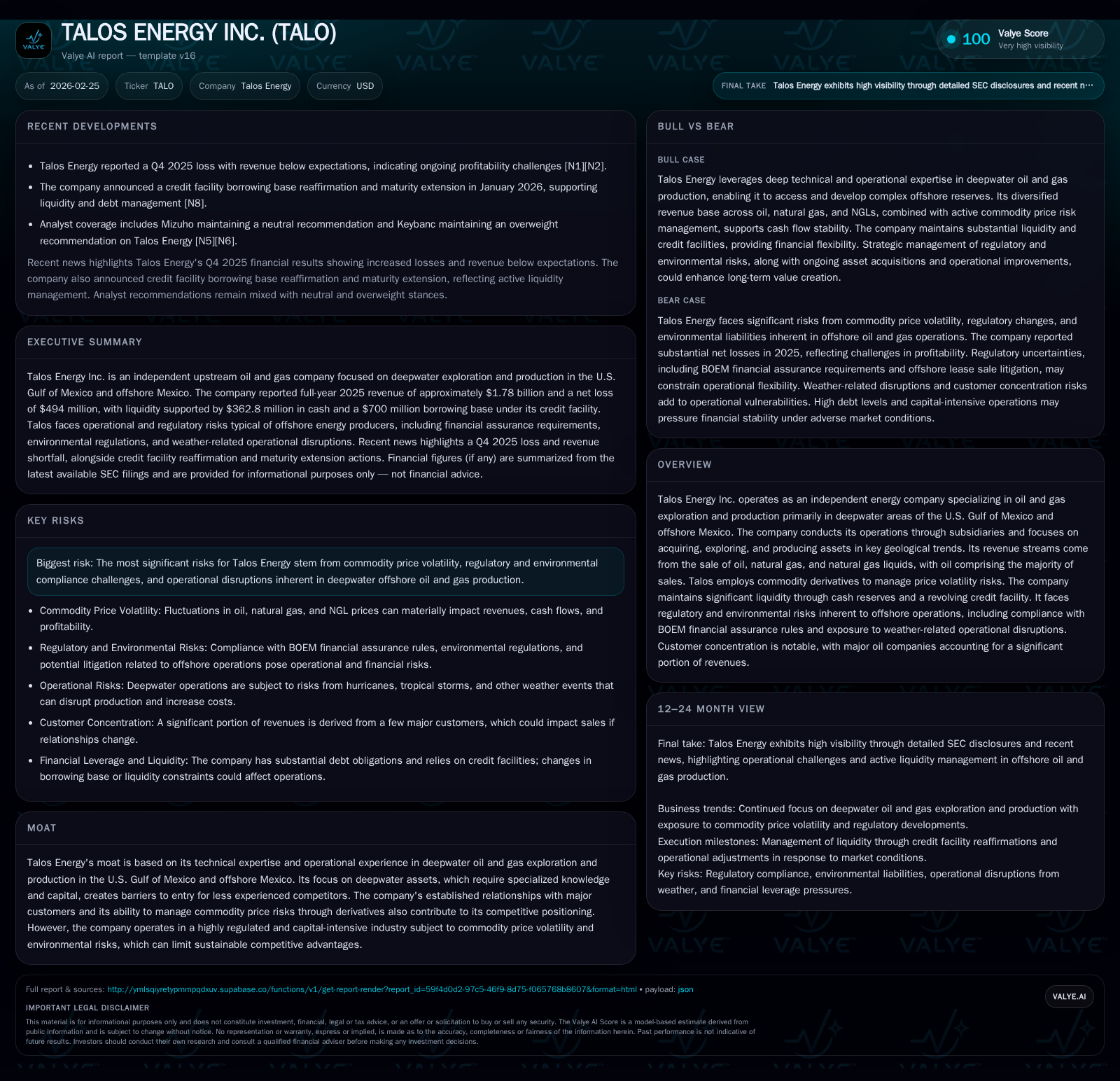
Talos Energy reported a nearly 10% revenue decline to $1.78 billion in fiscal 2025, coupled with a steep operating loss of $560 million, reversing profitable trends from prior years. Persistent commodity price volatility, marked by derivative valuation adjustments, alongside tightening regulations from the Bureau of Ocean Energy Management (BOEM), particularly around supplemental financial assurance, weigh on operational and financial performance. Despite shrinking earnings, Talos maintained liquidity near $965 million through cash reserves and a $700 million borrowing base credit facility, while expanding share repurchases without paying dividends. Going forward, key monitoring points include BOEM regulation updates, the upcoming borrowing base redetermination due Q2 2026, and commodity price trajectories impacting project economics and credit terms.
2022–2025 Financial Trajectory: Revenue Volatility and Profitability Decline
Over the past four fiscal years, Talos Energy’s revenue trajectory has exhibited notable volatility impacted by fluctuating commodity prices and operational challenges inherent in deepwater oil and gas exploration. The company generated revenues of approximately $1.65 billion in FY2022 before surging to nearly $1.97 billion in FY2024 — likely reflecting improved commodity prices or asset contributions [F1]. However, FY2025 saw revenues contract nearly 9.8% to about $1.78 billion compared to FY2024.
This revenue contraction coincided with a dramatic reversal in profitability metrics. Operating income plunged from a positive $173 million (FY2024) to a substantial operating loss approaching $560 million in FY2025 [F1]. The net income line mirrored this deterioration with a swing into a loss of roughly $494 million from smaller historic net losses or profits seen in previous years.
This sharp profit decline is attributable to multiple factors: impairment charges related to asset valuations under lower expected future cash flows; elevated operating costs typical for complex deepwater developments; and substantial derivative mark-to-market losses influencing reported earnings [S1], [N2]. The resulting approximate return on equity for FY2025 stands around negative 22.8%, indicating not only depressed profitability but also erosion of shareholder value given the equity base contraction [F1].
Despite earnings volatility, operating cash flows remained relatively resilient, generating approximately $936 million in FY2025 — modestly down from prior year levels — providing an important buffer for capital investment and obligations. Capital expenditures stayed stable around the mid-$80 million range for incurred (unpaid) capex projects excluding acquisitions [F1].
Historical performance (annual)
| FY | Rev ($mm) | Net ($mm) | CFO ($mm) | OpInc ($mm) | Rev YoY | Net YoY |
|---|---|---|---|---|---|---|
| 2025 | 1780 | -494 | 936 | -560 | -9.8% | -547.0% |
| 2024 | 1974 | -76 | 963 | 173 | +35.4% | -140.8% |
| 2023 | 1458 | 187 | 519 | 210 | -11.7% | -50.9% |
| 2022 | 1652 | 382 | 710 | 736 |
Note: Omitted columns lack sufficient annual XBRL coverage in the provided tags (need ≥2 annual points): Capex, Div. Source: SEC companyfacts cache [F1].
Capital returns and efficiency (annual)
| FY | Buybacks ($mm) | FCF ($mm) | ROE% |
|---|---|---|---|
| 2025 | 119 | 851 | -22.8 |
| 2024 | 45 | 877 | -2.8 |
| 2023 | 48 | 404 | 8.7 |
| 2022 | 604 | 32.8 |
Source: SEC companyfacts cache [F1].
Note: Buybacks data for FY22 unavailable; dividends not disclosed.
Deepwater Exploration Expertise Amid Worsening Regulatory Landscape
Talos Energy holds a defensible competitive moat owing largely to its technical acumen and operational history focused on deepwater oil/gas exploration primarily within the U.S Gulf of Mexico and offshore Mexico . These geographies demand specialized geological knowledge, engineering capabilities, capital investment scale, and regulatory compliance experience — all serving as high barriers to entry.
However, recent regulatory developments from the U.S. Bureau of Ocean Energy Management (BOEM) compound operational challenges [S1]. The imposition of supplemental financial assurance requirements finalized in April 2024 mandates higher bonding amounts independent of predecessor financial strength — introducing significant collateral demands on lessees like Talos engaged on Outer Continental Shelf leases.
The rule's phased compliance period extends over three years but remains under legal contestation by various states and industry groups, prompting BOEM to temporarily limit enforcement scope pending possible revisions [S1]. A Department of Interior announcement foresees reverting toward policies recognizing co-owner financial strength, which would reduce bonding burdens if implemented — though timing remains uncertain.
This evolving surety market environment notably tightens bonding capacity availability given surety firms' retrenchment post-industry bankruptcies [S1]. For Talos, this restricts its ability both to secure necessary bond coverage economically and potentially limits asset acquisition or joint venture participation when co-owner bonding assurances are required — factors that can constrain growth avenues.
Commodity Price Risk Management and Operational Disruptions
Given exposure of offshore operators like Talos Energy to volatile oil & gas prices, notes their active use of commodity derivative instruments designed to hedge price fluctuations on anticipated production volumes.
These instruments employ mark-to-market accounting where unrealized gains or losses are recorded within earnings each quarter though settlements hit cash flows later [S1]. This mechanism leads to pronounced swings in Adjusted EBITDA figures stemming from fluctuations unrelated directly to physical operations but reflecting market sentiment shifts.
For example, Q4 reports show widening losses coincident with falling realized commodity prices causing adverse fair value adjustments on derivative positions [N2], [N6]. Besides market risks, operational disruptions including weather events prevalent in deepwater offshore environments threaten production uptime reliability and safety compliance — further complicating forecast stability.
Liquidity Position, Debt Covenants, and Credit Facility Developments
Talos’ liquidity posture at December 31, 2025 was robust with cash plus undrawn revolver capacity aggregating roughly $965 million — underpinned by cash reserves near $363 million alongside an undrawn bank credit facility sized at $700 million backed by proved reserve collateral ('borrowing base') [F1], [S4–S8], [N8].
The borrowing base reflects half-yearly lender redeterminations scheduled next for Q2 calendar year 2026 based on reserve report submissions incorporating forecasted prices per lenders’ internal decks [S21], [S14]. Any reserve downgrades or price deck reductions could drive contraction reducing available liquidity.
In January 2026 Talos executed an Amended & Restated Credit Agreement extending maturity profiles roughly through early-2030 while preserving traditional covenant structures including:
- Maximum consolidated total debt-to-EBITDAX leverage capped at ~3:1;
- Minimum current ratio floor of 1:1;
- Restrictions on dividend payments and additional indebtedness issuances pending covenant compliance;
- Mortgages on at least ~85% of proved oil & gas assets as collateral security [S6], [S7], [S11], [S16], [N8].
Talos remained fully compliant with all covenants as of FY-end December '25 amidst zero revolver borrowings combined with stable EBITDAX trends bolstered by solid operating cash flows despite GAAP losses.
Capital Allocation: Buybacks Amid Shrinking Earnings, Absence of Dividends
Notwithstanding shrinking net income margins culminating in sizable losses during FY25,[F1] Talos accelerated share repurchases materially rising buyback spend from ~$45 million in FY24 to ~$119 million last year representing over twice as many shares retired under its ongoing authorization program totaling nearly $293 million approved since March '23 [.S10], [S17].
The company has not declared or paid any dividends historically with limitations largely imposed due to debt covenants restricting distributions and priority claims on cash flows by secured lenders [S16], [S17], suggesting retained progression toward deleveraging or reinvestment priorities rather than direct shareholder yield support.
This buyback activity against compressed earnings amplifies share count reduction pressures but also increases leverage ratios measured against reduced equity bases (~$2.17 billion as of FY25 vs ~$2.76 billion prior year), intensifying risk tradeoffs between capital returns versus balance sheet strengthening efforts.
Forward-Looking Growth: Market Conditions and Regulatory Uncertainties To Watch
Absent explicit forward guidance provided currently,[N1],[N5],[S1] industry observers monitor several critical factors influencing Talos’ growth trajectory:
- The outcome timeline for BOEM's revised supplemental financial assurance rule which might ease bonding costs or maintain heightened surety requirements affecting operational expansion capability;
- Impact of Q2 '26 borrowing base redetermination which influences liquidity available under the reserve-based lending framework crucial for drilling funding flexibility;
- Evolving commodity price cycles impacting realized product pricing, derivative hedge effectiveness, and capex budgeting decisions;
- Resolution of ongoing litigation around regulatory frameworks shaping operator risk profiles; and whether market risks may prompt incremental equity or debt issuance to bolster capital structure.
Additionally operatorship changes on key assets such as Zama offshore field transition effective end-'25 introduce new partnership dynamics potentially affecting project execution timelines and cash flow contributions.[S20]
Investor Takeaways: Key Metrics and Monitoring Points
Talos Energy’s sharply negative operating results through FY25 reflect material pressures that investors should contextualize alongside robust free cash flow generation approximating $851 million (operating cash flow less capex) supporting capital program funding without immediate liquidity jeopardy [F1].
Volatility arising from non-cash impairments related to asset valuations along with marked fluctuations induced by commodity derivatives renders headline EPS figures less predictive absent careful adjusted EBITDA scrutiny.[S1]
Meanwhile regulatory uncertainties stemming from tightened supplementary bonding rules impose potential collateral calls constraining liquidity if counterparties withdraw surety market capacity.[S1]
Key ratios reinforce resilience yet caution; the current ratio sustained at ~1.3x marks comfortable short-term solvency cushion while strict debt covenants remain manageable but could amplify downside risk if adverse reserve report outcomes diminish borrowing base size.[F1],[S18]
Ongoing capital allocation emphasis favors selective share repurchases amid null dividend policy reinforcing focus on deleveraging optionality amid cyclical energy sector headwinds.[S10],[S17]
These dynamics recommend watchfulness around:
- Upcoming borrowing base reviews;
- Derivative positions’ fair value movements accruing through quarterly disclosures;
- Regulatory developments impacting decommissioning liability costs; and cash flow trends relative to interest service obligations including senior secured notes maturing in late decade.[S9–S27]
Disclaimer: This is research-only, informational analysis and not investment advice. It may include AI-generated interpretation and general industry context. Always verify important details using primary sources.

Comments