
Texas Capital Bancshares in 2025: Navigating Profitability and Risk Amidst Strategic Capital Allocation
Texas Capital Bancshares delivered strong 2025 financial results driven by disciplined credit risk management and focused capital deployment, balancing growth with cautious market positioning.
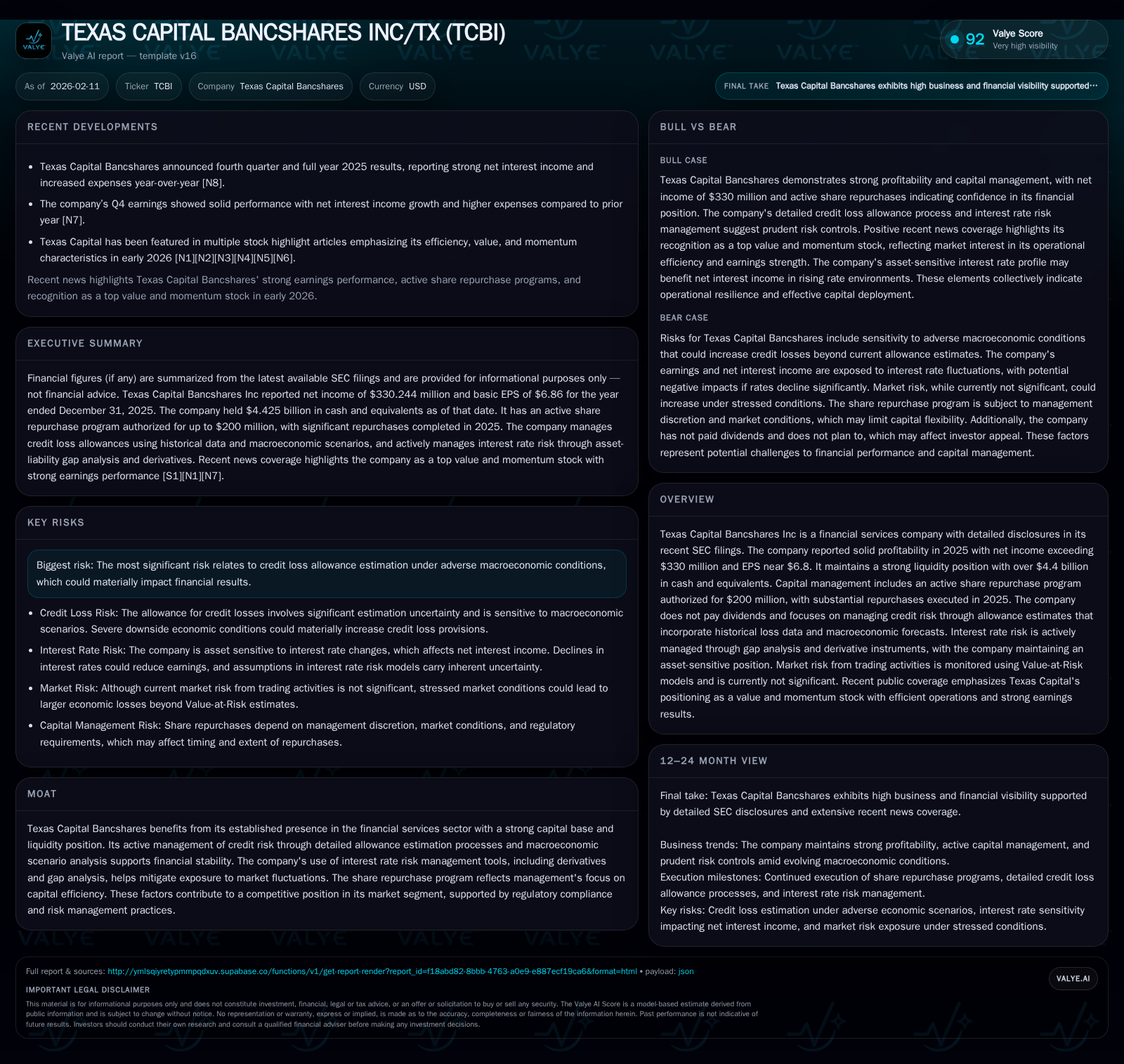
In 2025, Texas Capital Bancshares Inc. reported robust net income surpassing $330 million and maintained a healthy liquidity reserve totaling over $4.4 billion. The company executed an active $200 million share repurchase program while continuing to manage credit risk through a sophisticated allowance estimation framework integrating historical data and macroeconomic forecasts. Interest rate exposure was proactively hedged, contributing to earnings stability, even as the firm acknowledged the material uncertainty related to credit loss estimations under adverse economic scenarios. Market observers have recently emphasized the stock's strong momentum and efficiency attributes, reflecting recognition of its operational discipline and risk-aware strategy amid fluctuating financial conditions.
Quarterly and Annual Performance Highlights: Decoding the Numbers
Texas Capital Bancshares delivered a commendable financial performance in 2025 marked by net income exceeding $330 million and an EPS near $6.8, signaling effective operational leverage despite year-over-year increases in expenses [N1][N2][F1]. The ability to grow net interest income appears to be a major contributor to these results amid some cost pressure. Maintaining robust profitability in such an environment points to disciplined expense control combined with revenue diversification strategies likely centered on core lending and deposit-taking activities.
Liquidity positioned strongly with over $4.4 billion in cash and equivalents provides strategic flexibility for both organic growth initiatives and opportunistic capital deployment [F1]. Such a balance sheet stature supports confidence in navigating potential market turbulence or credit cycles ahead.
Mastering Credit Risk: The Critical Allowance Estimation Approach
Credit risk management remains foundational at Texas Capital Bancshares, anchored by its allowance for credit losses methodology described extensively in recent SEC filings [S1][S2]. The firm's provisioning approach integrates segmented loan portfolio analyses using historical default probabilities and losses coupled with macroeconomic scenario overlays — thus embedding forward-looking caution into valuation reserves.
Notably, loans without homogeneous risk traits receive individual evaluation rather than pooled treatment, allowing for granular identification of impairment risks. This degree of rigor mitigates unexpected charge-offs during economic shocks but also introduces inherent estimation uncertainties influencing reported earnings volatility.
Capital Efficiency in Focus: The Strategic Share Repurchase Programs
In lieu of dividend distribution, Texas Capital emphasizes returning capital through active share repurchases reflecting management's confidence in undervaluation or efficient capital utilization [S1][S2]. During 2025, approximately 2.25 million shares were repurchased at an average price around $82 apiece under a refreshed $200 million authorization finalized at year-end.
This sizable buyback scheme effectively reduces share count while potentially enhancing per-share metrics — illustrating a tactical approach to capital allocation that balances growth investments against returning value to shareholders amid ongoing regulatory compliance considerations.
Interest Rate and Market Risks: Proactive Management Tactics
The company's interest rate risk profile is carefully managed via asset sensitivity positioning alongside detailed gap analyses complemented by derivatives usage [S1][valye_report_excerpt]. Such tactics buffer earnings from abrupt rate fluctuations in the backdrop of evolving monetary policy environments.
Meanwhile, trading-related market risks are closely monitored through Value-at-Risk frameworks but currently remain immaterial contributors to overall risk exposures — underscoring prudent limits on speculative activities within the firm’s risk appetite.
Momentum and Market Perception: What Recent Coverage Reveals
Investor sentiment showcased through recent analyst coverage paints Texas Capital Bancshares as a high-momentum equity demonstrating efficient operational profiles with increasing price strength [N3-N9]. Descriptions as "top momentum pick" alongside inclusion within lists of highly efficient stocks signal growing recognition of both fundamental robustness and positive technical signals.
Furthermore, narratives highlighting long-term value appeal attribute resilience partly to conservative credit practices and active capital return policies — resonating well within current market preferences favoring financially disciplined banks.
Unpacking Regulatory and Accounting Complexity
Texas Capital operates under stringent regulatory frameworks necessitating complex accounting judgments particularly around critical estimates like loan loss allowances [S1][S2]. These policies require judicious integration of data inputs spanning historical defaults to macroeconomic forecasts, demanding expertise across disciplines including accounting, economics, and risk management.
Regulatory capital ratios supplement this complexity by imposing minimum equity thresholds shaping permissible capital actions such as repurchases or debt transactions — reinforcing the interplay between financial reporting integrity and regulatory compliance.
Risk Factors That Could Shape 2026 and Beyond
The most salient risk remains entrenched in credit loss allowance accuracy under stressed economic circumstances [S1][valye_report_excerpt]. Should macroeconomic assumptions prove overly optimistic, resulting shortfalls in reserves could exert meaningful downward pressure on reported earnings or capital levels.
Management’s transparent acknowledgment of this uncertainty alongside robust monitoring processes indicates proactive stewardship though residual vulnerability persists given cyclical economic pressures inherent within banking sectors.
Texas Capital’s Competitive Moat Within Financial Services
The company’s durable moat stems from well-capitalized liquidity positions exceeding several billions combined with disciplined capital deployment exemplified by calibrated buybacks [valye_report_excerpt]. Coupled with rigorous credit risk frameworks employing granular allowance methodologies fortified by macroeconomic foresight, Texas Capital maintains resilience against typical sector volatility.
Compliance with evolving regulatory standards further buttresses trust among stakeholders while enabling strategic flexibility needed to capitalize on market opportunities without excessive leverage or undue risk concentration.
Together these elements delineate a competitive advantage grounded not only on tangible balance sheet strength but also intangible governance quality reflected throughout operational policies.
Disclaimer: This analysis is for informational purposes only based on publicly available data as of early 2026. It does not constitute investment advice or an offer to buy or sell securities.
Disclaimer: This is research-only, informational analysis and not investment advice. It may include AI-generated interpretation and general industry context. Always verify important details using primary sources.

Comments