
Alaunos Therapeutics Faces Critical Inflection After Clinical Setback and Nasdaq Warning
The company halts clinical trials while confronting Nasdaq compliance risks amid a narrow cash runway.
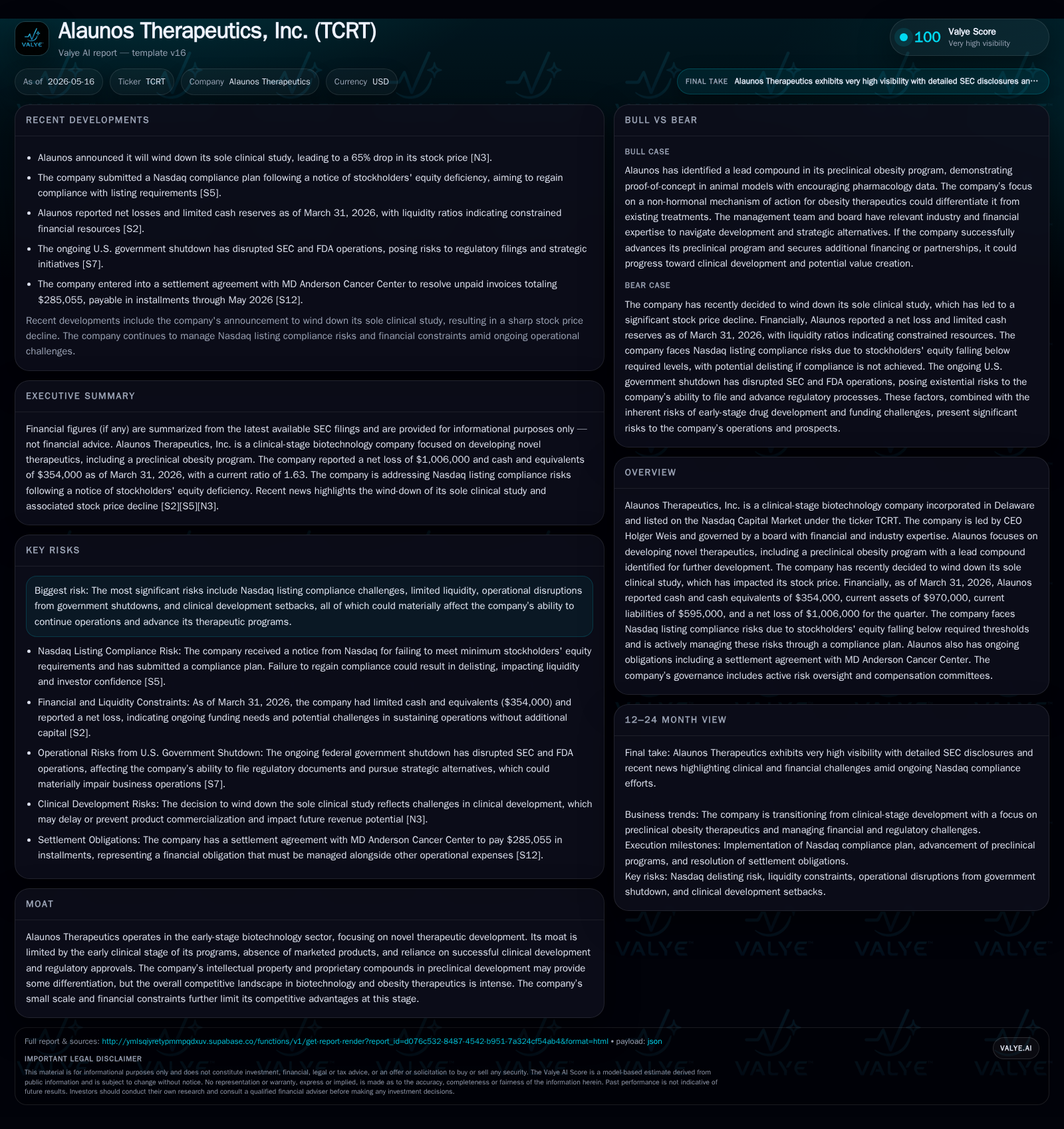
Alaunos Therapeutics recently announced the winding down of its sole clinical study alongside progress in its preclinical obesity program, marking a pivotal operational shift. Concurrently, the company faces significant Nasdaq listing compliance challenges due to diminished stockholders' equity, exacerbating funding pressures. Alaunos’ business model revolves around novel small-molecule obesity therapeutics, but limited scale and financial constraints emphasize the urgency for strategic capital solutions. The progression of the preclinical pipeline and execution of Nasdaq remediation will be critical near-term milestones.
Latest Operating Developments: Clinical Wind-Down and Compliance Challenge
In its May 2026 quarterly filing, Alaunos Therapeutics disclosed the termination of its sole ongoing clinical trial program, signaling a strategic shift to concentrate resources on early-stage preclinical work [S2]. This wind-down came amidst intensified challenges securing capital needed for costly clinical phases and was accompanied by an update concerning their obesity-focused preclinical program that remains active. Coinciding with these operational shifts, the company revealed receipt of a Nasdaq deficiency notice due to shareholder equity falling below the mandated $2.5 million minimum threshold [S3][S19]. The compliance plan filed in response faces uncertainty regarding acceptance by Nasdaq staff, potentially threatening the company’s listing status.
The cessation of clinical activities represents an inflection point for Alaunos’s operational model, which has historically been geared toward progressing proprietary candidates through development pipelines to clinical validation.
Business Model and Therapeutic Focus: Innovation Amid Constraints
Alaunos operates as a clinical-stage biotechnology entity focused primarily on discovering and developing novel small-molecule therapeutics targeting obesity and related metabolic disorders [S1]. Unlike numerous market incumbents focusing on injectable peptide hormone analogs such as GLP-1 receptor agonists or amylin mimetics prevalent in obesity treatment landscapes, Alaunos's key value proposition lies in its lead compound’s non-hormonal mechanism coupled with oral administration potential [S6]. This positions their pipeline as potentially addressing tolerability shortcomings common in hormone-based injectables.
Despite this innovativeness at the molecular level, the company generates no commercial revenue presently and relies heavily on research expenditures funded through equity capital raises or strategic partnerships. The financial profile underscores typical early biotech economics dominated by R&D burn rather than product sales volumes or pricing power. Intellectual property ownership around their lead compounds forms a core competitive asset but remains contingent on navigating IND-enabling studies and eventual clinical endorsement—a path fraught with scientific and regulatory uncertainty.
Competitive Landscape in Biotechnology and Obesity Therapeutics
The biotechnology sector for obesity therapies is intensely competitive, characterized by major pharmaceutical companies dominating through well-established hormonal modalities including GLP-1 analogs (e.g., semaglutide), dual GIP/GLP-1 agonists, and emerging amylin receptor agonists. Against this backdrop, Alaunos’s strategy to develop an orally bioavailable non-hormonal small molecule seeks differentiation but must overcome entrenched market preferences for peptide-based therapies backed by robust clinical data and proven efficacy.
Early-stage biotech firms like Alaunos face systemic barriers such as lengthy clinical timelines, aggregation of regulatory risk during critical transition points (e.g., from preclinical to human testing), and limited economies of scale that constrain investment in broader platform development. Additionally, switching costs among prescribers are high once dominant injectable regimens gain traction. These structural factors temper Alaunos’s competitive advantage until its candidate advances meaningfully into later-phase trials or establishes a distinct therapeutic niche.
Growth Drivers: Preclinical Pipeline Potential and Strategic Alternatives
Key growth opportunities for Alaunos hinge on advancing its lead compound through rigorous IND-enabling pharmacology studies intended to validate safety, pharmacokinetics, and efficacy signals observed in diet-induced obesity mouse models [S6]. Initial GLP-compliant studies demonstrated statistically significant dose-responsive reductions in body weight along with favorable fat composition shifts—data points that could underpin future clinical trial designs if supported by reproducible results [S6][S7].
Potential advantages may emerge from oral delivery convenience compared to currently dominant injectable options, possibly enhancing patient compliance and market adoption if efficacy translates clinically. To capitalize on this potential amid tight liquidity constraints post-clinical wind-down, Alaunos is exploring strategic alternatives including partnerships or equity financings to secure development capital essential for initiating IND filings.
Success depends largely on execution milestones such as completion of formal toxicology assessments, intellectual property fortification around unique compound properties, and securing regulatory approvals for first-in-human studies. Strategic collaborations may also mitigate financial risks while accelerating technology maturation.
Risks and Constraints: Nasdaq Delisting Threats and Funding Pressures
The immediate risks confronting Alaunos are considerable. The Nasdaq Stock Market issued an official notice citing non-compliance with listing standards due to stockholders' equity dropping below $2.5 million—a threshold critical for maintaining listing status under rule 5550(b)(1) [S3]. Although the company submitted a corrective plan within prescribed timelines aiming for remediation within 180 days from April 7th notification [S19], there are no guarantees against delisting if NASDAQ rejects their proposal or implementation falters.
Parallel to these governance risks is acute liquidity pressure: cash reserves stood near $354K at quarter-end March 2026 against operating losses approximating $1 million quarterly—a burn-rate inconsistent with sustaining standard R&D momentum absent fresh funding sources [F1][S2]. Zero reported debt as of late 2023 indicates reliance predominantly on equity financings rather than borrowings [F1], which further elevates dependency on capital markets accessibility.
Strategic advancement is further compromised by terminated financial advisory services with Cantor Fitzgerald earlier this year [S15], reflecting potential difficulties in sourcing transaction partners or investors under current circumstances. Operational risks remain non-trivial given ongoing uncertainties related to SEC review delays caused by external factors like government shutdowns referenced prior [S17], which impede registration statement effectiveness critical for capital raises.
Near-Term Milestones and What to Monitor Next
Critical upcoming markers include Nasdaq's review decision regarding the company’s compliance plan which will either extend runway visibility or trigger delisting processes potentially culminating in hearings that temporarily suspend delisting but add procedural uncertainty [S19].
From a development standpoint, additional updates surrounding IND-enabling studies will provide meaningful signals about pipeline viability—especially success confirmation from further GLP toxicology or pharmacodynamic assessments indicative of safety margins necessary before human trials commence [S6].
Corporate governance changes also warrant attention given ongoing proxy-related activity involving activist shareholders proposing director nominees intending to influence corporate strategy—actions that could reshape board composition or amplify pressure on management toward recapitalization efforts [S6].
Overall market reaction will likely hinge on tangible progress toward overcoming Nasdaq compliance hurdles alongside clarity on financing pathways that sustain pipeline progression beyond preclinical stages.
Financial Snapshot: Liquidity, Burn Rate, and Capital Position
Latest financial snapshot
| Metric | Value | Period |
|---|---|---|
| Cash & equivalents | $354000 | |
| 2026-03-31 | ||
| Current assets | $970000 | |
| 2026-03-31 | ||
| Current liabilities | $595000 | |
| 2026-03-31 | ||
| Current ratio | 1.63x | |
| 2026-03-31 |
Source: SEC companyfacts cache [F1].
As reflected above from Q1 filings and companyfacts data sets, Alaunos's balance sheet shows a liquidity position with limited cash reserves resulting from sustained operating losses. Its current ratio of approximately 1.63 indicates short-term asset coverage over liabilities but leaves minimal buffer beyond immediate obligations [F1]. The absence of any reported long-term debt simplifies leverage considerations yet underscores full reliance on continued capital raises or asset monetization strategies to maintain solvency during ongoing drug development cycles.
This analysis focuses exclusively on factual disclosures provided through formal SEC filings and does not constitute investment advice or forecasts about future performance. The biotech sector is inherently volatile with high developmental risk profiles; readers should consult dedicated professional advisors before making decisions related to securities connected to Alaunos Therapeutics.
Disclaimer: This is research-only, informational analysis and not investment advice. It may include AI-generated interpretation and general industry context. Always verify important details using primary sources.

Comments