
TDAC’s ProLogium Merger: Execution Stakes, SPAC Economics, and the Realities of Advanced Battery Commercialization
Translational Development Acquisition Corp. The committed $50 million capital injection and ProLogium’s commercialization track record set the stage for a high-stakes transaction, but realization of value depends on closing the deal and navigating the technology’s adoption curve.
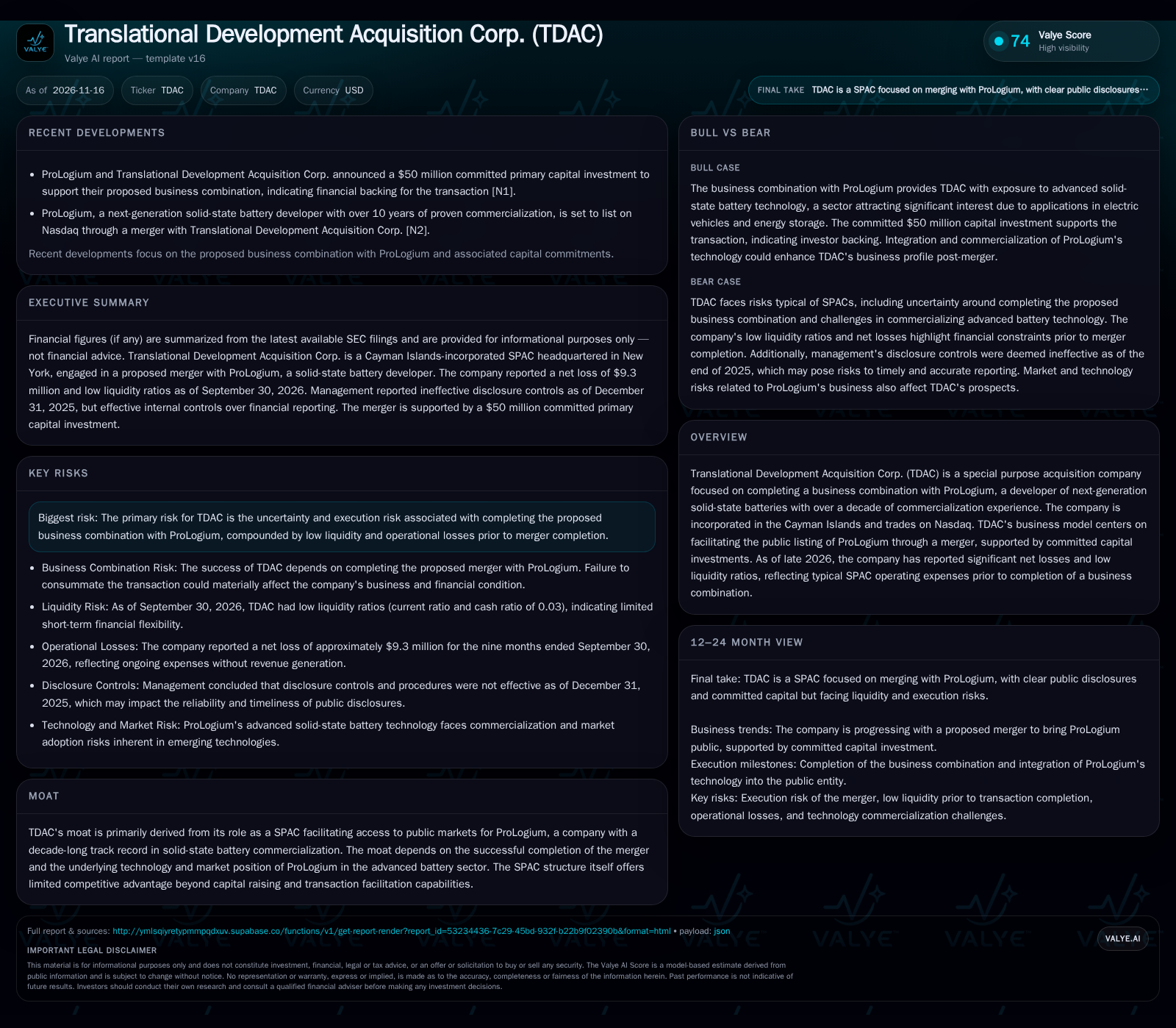
TDAC is a SPAC aiming to merge with ProLogium, a developer of solid-state batteries. The merger’s success could provide public market access for ProLogium, but failure to close or commercialize effectively would leave TDAC exposed.
Translational Development Acquisition Corp. (TDAC) stands at the threshold of its central purpose: facilitating a public listing for ProLogium, a next-generation solid-state battery company, via a high-profile SPAC merger. With a $50 million capital commitment and ProLogium’s decade-long commercialization track record, the deal could provide public market access to a promising technology sector.
TDAC’s Liquidity Crunch and the Pivotal ProLogium Transaction
As of September 30, 2026, TDAC reported cash and cash equivalents of $85,852, current assets of $89,754, and current liabilities of $2,884,984, resulting in a current ratio and cash ratio of just 0.03 [S2]. These figures highlight the classic pre-merger SPAC dynamic: minimal operating assets and significant liabilities, with no underlying revenue stream. The company also posted a net loss of $9,293,622 for the period [S2].
The central event is TDAC’s pending merger with ProLogium, a solid-state battery firm with over a decade of commercialization experience, supported by a $50 million committed capital investment [N1] [N2]. This capital backing is crucial, as it not only funds the transaction but signals investor confidence in ProLogium’s prospects. However, TDAC’s management acknowledged ineffective disclosure controls as of December 31, 2025, raising governance and reporting reliability questions [S2].
Collectively, these facts frame a business at a binary inflection: the merger must close and ProLogium must execute, or TDAC’s limited resources and lack of operations leave little margin for error.
How SPACs Monetize: Deal Completion, Dilution, and Platform Transition
TDAC’s economic model is typical for SPACs: it generates no operating revenue prior to merger, instead raising capital through an initial public offering and warrant sales. Proceeds are earmarked for a business combination, in this case with ProLogium. The economics hinge on successful deal execution; only upon merger completion does the combined entity transition to an operating business with potential revenue streams.
SPAC sponsors and early investors typically benefit through founder shares and warrants, which convert into equity in the post-merger entity—often at favorable terms. For public shareholders, value is contingent on the quality of the acquired business and its ability to generate operating cash flow post-transaction. The $50 million committed capital injection provides some financial runway for the combined entity, but the magnitude of ProLogium’s capital requirements will depend on its scale-up and commercialization needs—solid-state batteries are capital-intensive, requiring significant investment in R&D, pilot lines, and manufacturing capacity.
Fixed costs for SPACs are relatively low pre-merger (legal, listing, administrative), but the transition to a technology operating company introduces substantial fixed and variable costs. The post-merger entity’s ability to achieve operating leverage will rest on ProLogium’s revenue growth outpacing these costs, alongside the successful absorption of public company compliance expenses.
SPAC as Gatekeeper: Temporary Moat and the Technology Transfer Challenge
TDAC’s competitive advantage is transitory, rooted in its role as a public-listing vehicle for ProLogium. The true long-term moat, if any, will reside in ProLogium’s intellectual property, manufacturing capabilities, and customer traction in the solid-state battery space—not in TDAC’s own structure or sponsor relationships.
Solid-state batteries represent a highly contested field, with incumbent lithium-ion players, automotive OEMs, and deep-pocketed technology conglomerates all vying for leadership. ProLogium’s decade-plus commercialization history is notable, but market penetration will depend on demonstrating cost, safety, and energy-density advantages at scale. Alternative battery chemistries and improvements in existing lithium-ion technologies represent constant substitution threats.
The SPAC structure provides speed and certainty of capital, but offers little by way of sustainable competitive advantage once the transaction closes. The challenge for the post-merger entity is to leverage public market access to accelerate commercialization, build strategic partnerships, and fend off incumbent and emerging competitors.
If ProLogium’s Technology and Market Adoption Accelerate
The most favorable outcome for TDAC shareholders hinges on two sequential successes: closing the ProLogium merger and ProLogium rapidly scaling commercialization of its solid-state battery technology. In this scenario, the $50 million capital commitment enables ProLogium to expand pilot production, secure initial automotive or energy storage contracts, and demonstrate cost-competitive, high-performance batteries at scale.
Success would likely be confirmed by the announcement of major commercial agreements, rapid revenue ramp, and validation of ProLogium’s technology by leading OEMs or energy integrators. Share price appreciation would be driven by the market’s confidence in ProLogium’s ability to displace or supplement incumbent battery suppliers.
Falsification would occur if the merger stalls, the capital commitment is withdrawn, or ProLogium fails to convert technical milestones into commercial wins.
Most Plausible Outcome: Merger Closes, Commercialization Remains Uncertain
The likeliest path is that TDAC completes the merger with ProLogium, supported by the $50 million capital injection. The combined entity enters the public markets, but faces the typical challenges of advanced technology commercialization: protracted validation cycles, long sales lead times, and the need for continued capital investment.
Confirmation of this scenario would come from the merger closing as planned and ProLogium providing credible roadmaps for scaling production and customer acquisition. However, solid-state battery adoption is likely to be gradual, with revenue and margin expansion occurring over several years rather than quarters.
Falsification would result from a failed deal, significant delays, or the emergence of superior competing technologies that erode ProLogium’s opportunity.
Merger Failure or Technology Setbacks Trigger Value Erosion
The principal risk is that the merger with ProLogium does not close, whether due to regulatory, financial, or operational hurdles. In this case, TDAC’s minimal liquidity (current ratio 0.03) and lack of operating assets leave little residual value for shareholders [S2]. Even if the transaction closes, setbacks in ProLogium’s technology—such as failure to achieve commercial yields, safety issues, or inability to secure customers—could lead to continued losses and capital constraints.
Downside confirmation would come from merger termination disclosures, withdrawal of the $50 million capital commitment, or material negative developments in ProLogium’s commercialization efforts. Persistent net losses and the need for dilutive follow-on capital raises would further weigh on residual value.
What Will Determine TDAC’s Fate as a ProLogium SPAC Vehicle
Progress toward closing the ProLogium business combination, including regulatory and shareholder approvals, is the most immediate milestone.
Clarity on the status and terms of the $50 million committed capital investment—its conditions and timing—would help test the funding runway.
Any updates on ProLogium’s commercial contracts, pilot production ramp, or customer adoption (if disclosed) would provide evidence of post-merger viability.
Resolution and remediation of prior disclosure control weaknesses, as well as ongoing internal control effectiveness, will be important for public company credibility.
Post-merger liquidity and capital needs—specifically, whether ProLogium will require additional financing soon after listing—will affect dilution and execution risk.
Disclosure of ProLogium’s revenue backlog, order pipeline, or contracted volumes (if provided) would serve as leading indicators of commercialization momentum.
Monitoring competitive developments in solid-state and alternative battery technologies will be crucial for assessing ProLogium’s differentiation and market opportunity.
Disclaimer: This is research-only, informational analysis and not investment advice. It may include AI-generated interpretation and general industry context. Always verify important details using primary sources.

Comments