
TransDigm in 2026: Aerospace Aftermarket Strength Meets Debt and Cyclical Exposure
TransDigm Group’s robust 2026 results underscore the power of its diversified aerospace component portfolio and aftermarket model, but the company’s significant debt load and exposure to sector cycles leave its future trajectory tightly linked to industry demand and capital market conditions.
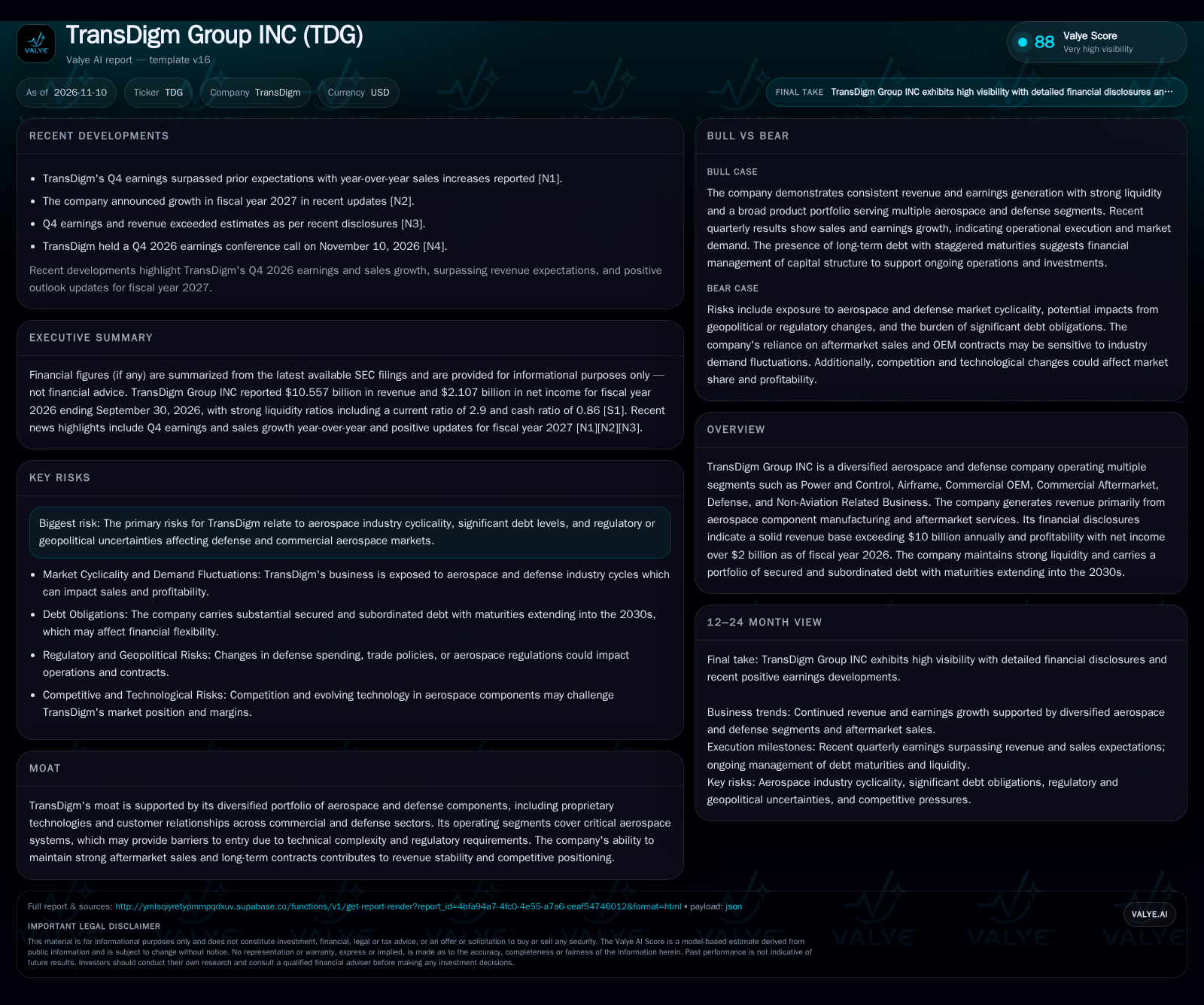
TransDigm Group reported over $10.5 billion in fiscal 2026 revenue and more than $2.1 billion in net income, buoyed by strong aftermarket and OEM aerospace sales. Sustained outperformance will depend on maintaining pricing power, aftermarket penetration, and the ability to manage leverage through sector downturns. [S1] [N1] [N2] [N3]
TransDigm Group’s fiscal 2026 performance highlights the enduring appeal of its aerospace components franchise, with both revenue and net income reaching new highs and liquidity ratios well above typical industrial peers. The company’s ability to consistently outpace expectations—even in a complex macro environment—reflects the power of its aftermarket-focused model and product breadth. Yet with a balance sheet weighted by long-term debt and persistent exposure to sector cycles and regulatory currents, TransDigm’s forward momentum will hinge on its ability to defend pricing, capture aftermarket share, and manage leverage as industry conditions evolve. The interplay between these strengths and risks will define the next phase of value creation.
2026 Results Highlight Aftermarket Model and Capital Structure
TransDigm reported $10.557 billion in revenue and $2.107 billion in net income for the fiscal year ended September 30, 2026, translating to basic and diluted EPS of $35.51. The company ended the year with $2.279 billion in cash and a current ratio of 2.9, well above typical industrial benchmarks. However, it also holds significant secured and subordinated debt with maturities that extend into the 2030s, reflecting a capital structure that leverages both liquidity and long-term obligations. Notably, fourth-quarter earnings and revenue exceeded estimates, and management has indicated expectations for continued growth into fiscal 2027. These results reinforce the resilience of TransDigm’s aftermarket-centric business model and its ability to manage through cyclical and competitive headwinds, but also sharpen the focus on debt servicing and the durability of demand across its core aerospace and defense markets. [S1] [N1] [N2] [N3]
How TransDigm’s Aftermarket Economics Drive Cash Flow—and Risk
TransDigm’s business model is built on supplying proprietary aerospace components to both OEMs and, crucially, the aftermarket—where replacement parts and services typically command higher margins due to regulatory certification, mission-critical functionality, and limited competition for legacy platforms. Aftermarket revenue generally delivers greater pricing power and recurring cash flow, as airlines and defense operators must source certified components for ongoing maintenance, repair, and overhaul (MRO) needs.
The company’s product mix spans Power and Control, Airframe, and other critical systems, and it benefits from the long operational life cycles of commercial and defense aircraft. High fixed costs in engineering, certification, and manufacturing are offset by the variable-margin profile of aftermarket sales, supporting operating leverage as volumes rise. However, this structure also makes TransDigm sensitive to aircraft utilization rates and broader industry cycles. Capital needs remain significant, not only for R&D and regulatory compliance but also for servicing its material debt load—meaning sustained cash generation is essential for both growth investments and meeting interest and principal obligations.
The company reported cash and liquidity metrics for the period; these figures do not by themselves establish operating runway, investment capacity, financial flexibility, or financing capacity.
Barriers, Substitution, and the Battle for Aftermarket Share
TransDigm’s competitive position is underpinned by its portfolio of proprietary, highly engineered components and systems, protected by regulatory certifications and long-standing customer relationships. These could increase switching costs for airlines and defense operators, who must source parts approved for specific aircraft platforms. The aftermarket, in particular, is characterized by limited competition for many legacy parts, allowing for higher margins and pricing stability.
However, the company faces counterforces: OEMs seeking to capture greater aftermarket revenue, independent parts manufacturers (PMAs) aiming to certify substitute components, and airlines’ procurement efforts to lower lifecycle costs. In the defense sector, budgetary pressures and shifting program priorities could create volatility, while technological advances—such as predictive maintenance or digital twins—may alter the economics of MRO and parts replacement over time.
TransDigm’s product breadth and regulatory know-how help defend its share, but the company must continue to innovate and adapt to evolving platform requirements and customer expectations. The competitive landscape is defined less by direct rivals for each part, and more by the broader tug-of-war for lifecycle value between OEMs, PMAs, and integrated service providers.
If Aftermarket Dominance and Aircraft Utilization Remain Robust
In a favorable scenario, commercial air travel demand continues to recover or outpace expectations, driving higher aircraft utilization rates and sustained demand for aftermarket parts and services. TransDigm leverages its proprietary product base and regulatory moats to maintain pricing power, even as airlines and defense operators seek cost efficiencies. OEM production rates stabilize or grow, supporting steady new-installation sales, while the company’s existing platforms remain in service longer than anticipated, prolonging high-margin aftermarket revenue.
Confirming evidence would include further revenue and earnings beats, robust free cash flow, aftermarket growth outpacing OEM sales, and successful refinancing or paydowns of long-term debt without material increases in interest expense. Additional regulatory or customer wins for key platforms would reinforce this scenario.
Sustaining Value Amid Cyclical and Financial Headwinds
The most plausible pathway is that TransDigm maintains solid, though potentially moderating, growth as commercial and defense markets normalize after recent volatility. Aftermarket demand remains resilient, but pricing power faces incremental pressure from airline cost controls and regulatory attention. OEM production may plateau, with new program launches offset by retirements of older platforms, keeping overall sales growth in the mid-single digits.
The company may pursue bolt-on acquisitions or incremental R&D, but large-scale capital returns or transformative deals are less likely unless leverage is reduced. Evidence supporting this scenario would include stable or slightly rising aftermarket revenue, manageable interest coverage ratios, and continued positive (if less dramatic) earnings surprises.
When Industry Cycles and Leverage Collide
In an adverse scenario, a downturn in commercial air travel or defense procurement—driven by macroeconomic, geopolitical, or regulatory shocks—reduces aircraft utilization and demand for aftermarket parts. Pricing pressure intensifies as customers defer maintenance or seek lower-cost alternatives, and OEM production rates decline.
If refinancing conditions worsen or debt covenants tighten, the company could face higher interest costs or constraints on investment, making it more vulnerable to competitive incursions or technological disruption. Evidence for this scenario would include sequential declines in aftermarket revenue, margin compression, negative free cash flow, or any indications of distress in refinancing or debt service metrics.
Milestones That Will Shape TransDigm’s Value Creation Potential
Aftermarket revenue growth rates—especially relative to OEM sales—would help test the durability of TransDigm’s core business model.
Pricing trends or disclosures on average selling prices for critical aftermarket components (if disclosed) would indicate the company’s ability to defend margins.
Aircraft utilization rates in major commercial and defense markets, as they drive underlying demand for replacement parts.
Progress on debt refinancing, repayment, or changes in interest expense—particularly as large maturities approach.
Regulatory developments or customer procurement shifts that could alter the competitive landscape for certified components.
Any material changes in working capital or free cash flow conversion, which would reflect operational discipline amid cyclical swings.
Updates on OEM production schedules or major platform retirements that could affect the installed base and future aftermarket potential.
Evidence of new platform wins, proprietary technology introductions, or successful integration of bolt-on acquisitions.
Disclaimer: This is research-only, informational analysis and not investment advice. It may include AI-generated interpretation and general industry context. Always verify important details using primary sources.

Comments