
TE Connectivity Drives Record Margins on Robust Bookings Despite Supply Chain Pressures
TEL's latest quarter highlights operational strength and margin expansion amid global supply challenges.
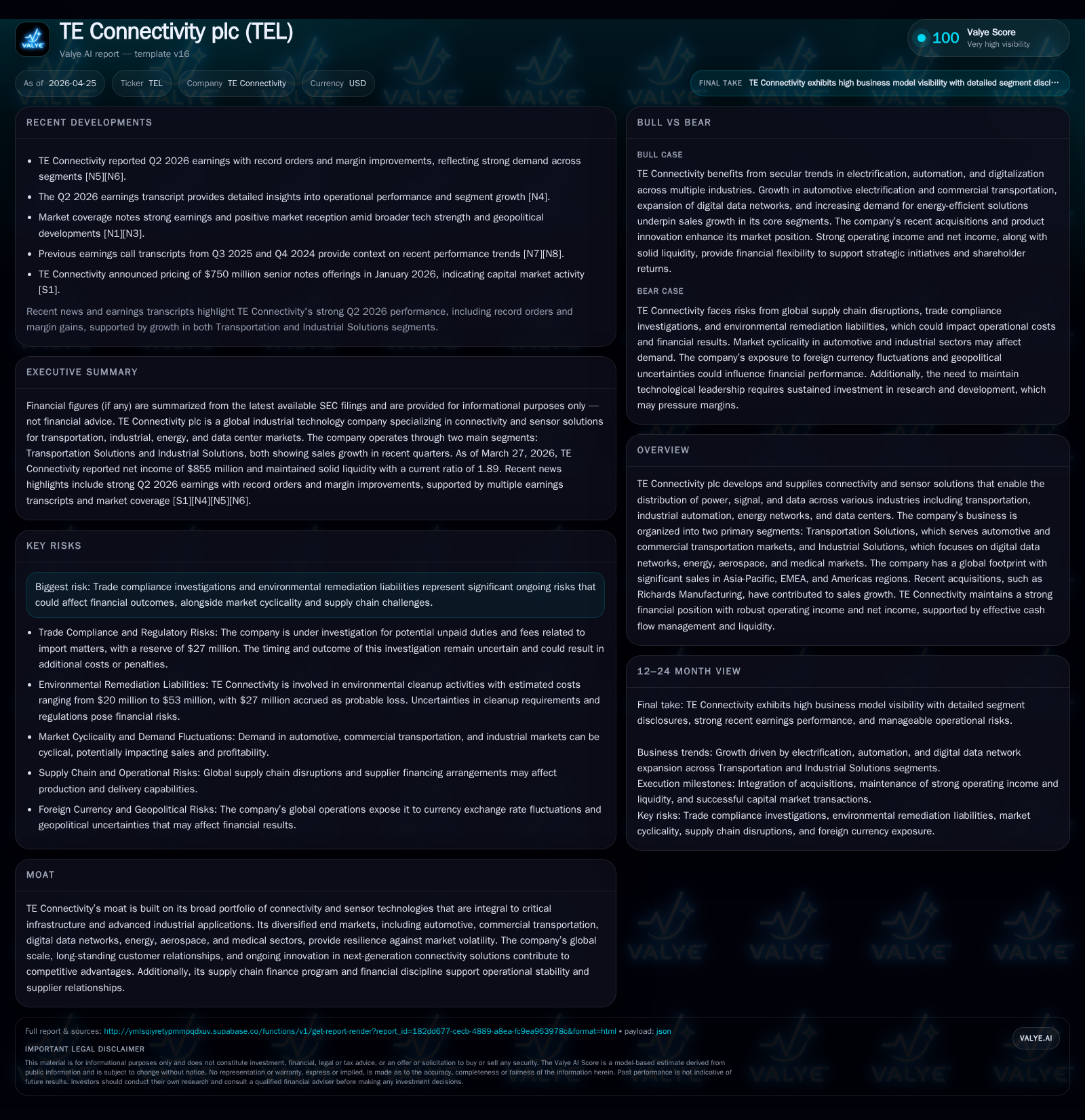
In its Q2 2026 filing, TE Connectivity reported a surge in order intake alongside improved operating margins, reinforcing its leadership in connectivity and sensor technologies across diverse industrial markets. The company’s disciplined supply chain finance program and steady liquidity position underpin operational resilience despite ongoing trade compliance investigations and supply volatility. Looking ahead, digitization in data networks and transportation electrification remain pivotal growth drivers, supported by acquisitions and innovation initiatives.
Q2 2026 Operating Highlights: Strong Orders and Margin Gains
TE Connectivity’s latest quarterly report (filed April 24, 2026 [S2]) reveals a continuation of robust operational momentum with key improvements that set a positive near-term tone. The company noted record order levels that spotlight healthy demand across its two major segments—Transportation Solutions and Industrial Solutions. Coupled with effective cost management initiatives, these orders contributed to expanded operating margins this quarter despite challenging external environments characterized by volatile supply chains.
In particular, the supply chain finance program balance declined to $134 million as of March 27, 2026 from $161 million six months prior [S2]. This indicates controlled use of third-party supplier financing without triggering the need for collateral postings. Such stability underscores TEL's prudent working capital policies while mitigating upstream risk.
A recent event filing (April 22, 2026 [S3]) also disclosed several senior note issuances that reflect ongoing debt management strategies supporting liquidity.
These developments collectively anchor expectations that TE Connectivity can navigate evolving market conditions while preserving financial discipline.
Business Model and Portfolio Quality: Connectivity Fuels Vital Infrastructure
TE Connectivity operates through two main segments: Transportation Solutions caters predominantly to automotive and commercial transport applications, while Industrial Solutions addresses digital data networks, energy infrastructure, aerospace, marine, and medical markets, [S9].
Revenue streams depend heavily on engineered connectivity components—such as high-performance connectors, sensors, relays—and sensor-enabled systems that transmit power, signal, or data. These products are integral to the performance and safety of complex industrial systems where failure is costly. This creates notable switching costs predicated on the reliability TE Connectivity can assure its longstanding customers.
Investment in R&D remains substantial (approximately $225 million recently [S25]), focusing on next-generation sensor technologies embedded within automated factories or electric vehicles. The diversification into sensor-augmented offerings bolsters differentiation against competitors primarily competing on basic connectivity hardware.
Industry Structure: Diversified End Markets with Durable Competitive Advantages
TEL’s competitive environment spans broad industrial landscapes marked by different demand cycles. The Transportation segment is exposed to automotive production trends but mitigated by expansions in commercial transportation [S9]. The Industrial segment benefits from secular growth in data center infrastructure buildouts and renewable energy network upgrades.
Competition includes well-established players like Amphenol and Molex; however, TE Connectivity’s scale enables global customer reach across Asia-Pacific, EMEA, and Americas [S9]. Its wide product offering coupled with embedded sensor innovation enhances customer retention via integrated solutions rather than plug-and-play components alone.
Nonetheless, trade compliance investigations disclosed in January 2026 [S5], with reserves set at $27 million for unpaid duties under Section 301 imports to the U.S., pose financial outcome uncertainties although currently viewed as manageable risks. Additionally, environmental remediation liabilities have increased modestly but remain within provision ranges [S13].
Pricing power appears durable given the strategic importance of connectivity solutions within critical infrastructure sectors less prone to commoditization-led margin erosion.
Growth Drivers and Challenges: Digital Data Networks, Transportation, and Supply Chain Dynamics
The industrial digitization trend propelling demand for digital data network products accelerates growth within TEL’s Industrial Solutions. Equally impactful is the Transportation segment’s exposure to electric vehicle advancements where advanced sensor arrays support battery management and safety systems.
Supply chain volatility remains a persistent constraint; however, the company's consistent reduction of its supply chain finance obligations demonstrates proactive cash flow management alleviating supplier relationship risks [S2], [S16]. Yet global geopolitical factors could intermittently pressure raw material availability or tariffs.
Acquisitions such as Richards Manufacturing contribute both incremental sales ($107 million reported) and market penetration especially in digital network connectors, fostering organic revenue expansion beyond cyclicality inherent in transportation end markets.
Operational Execution and Strategic Initiatives: Acquisitions and Innovation
Operational excellence is evident from margin improvements driven by scale efficiencies and product mix optimization aligning with higher-value sensor-integrated offerings. TEL’s acquisition strategy notably incorporating Richards Manufacturing has broadened its portfolio allowing deeper integration into fast-growing data infrastructure verticals [N4], [N5].
Innovation pipeline focuses on miniaturized sensors capable of enhanced data fidelity for automated industrial environments. These initiatives reinforce TEL’s moat combining technology leadership with entrenched supply relationships.
Continued focus on integrating acquired businesses swiftly limits dilution risks ensuring accretive contributions support bottom-line trajectory.
Financial Position and Capital Strategy Supports Sustainable Growth
Historical performance (annual)
|
| FY | Net ($bn) | CFO ($bn) | OpInc ($bn) | Capex ($mm) | Net YoY |
|---|---|---|---|---|---|
| 2025 | 1.8 | 4.1 | 3.2 | 936 | -42.3% |
| 2024 | 3.2 | 3.5 | 2.8 | 680 | +67.2% |
| 2023 | 1.9 | 3.1 | 2.3 | 732 | -21.3% |
| 2022 | 2.4 | 2.5 | 2.8 | 768 |
Source: SEC companyfacts cache [F1].
Capital returns and efficiency (annual)
|
| FY | Div ($mm) | Buybacks ($bn) | FCF ($bn) |
|---|---|---|---|
| 2025 | 803 | 1.3 | 3.2 |
| 2024 | 760 | 2.1 | 2.8 |
| 2023 | 725 | 0.9 | 2.4 |
| 2022 | 685 | 1.4 | 1.7 |
Source: SEC companyfacts cache [F1].
TE Connectivity’s financial footing remains strong entering FY2026 Q2-end with approximately $1.11 billion cash and equivalents on hand plus no outstanding borrowings under a new $3 billion unsecured revolving credit facility maturing in February 2031 [F1], [S2],. Long-term debt maturities are well-staggered (~$2.15 billion total over fiscal years through 2031), minimizing refinancing risks.
Operating cash flows remain robust (around $4.14 billion FY2025 annualized per [F1]), sustaining free cash flow after capex investments upwards of $936 million last fiscal year that enable R&D funding plus capacity enhancements.
The balance between shareholder returns via dividends ($803 million FY2025) together with share repurchases ($1.35 billion FY2025) reflects a balanced capital distribution policy favoring deleveraging alongside reward.[F1], [S20]
Low leverage relative to cash flows coupled with conservative liquidity covenants underpin resilience even amid episodic supply disruptions.
Key Upcoming Milestones and Performance Indicators to Monitor
Investors should track sustained organic net sales growth particularly within Industrial Solutions where demand forecasts remain promising due to ongoing digital infrastructure investments. Margin progression amidst inflationary cost pressures will test operational discipline maintained so far.
Regulatory developments on trade compliance inquiries could impact provisions or require further disclosures; monitoring these outcomes will clarify potential financial exposures.[S13]
Additionally, successful integration of recent acquisitions beyond Richards Manufacturing may offer new avenues for revenue diversification or cross-selling synergies.
Finally, maintaining steady cash flow generation allowing continued shareholder returns balanced against capital reinvestment for innovation will underscore long-term value creation prospects.
Disclaimer: This analysis is based solely on information available as of April 25, 2026 from TE Connectivity plc's SEC filings and reputable secondary sources. It does not constitute investment advice or recommendations regarding securities transactions.
Disclaimer: This is research-only, informational analysis and not investment advice. It may include AI-generated interpretation and general industry context. Always verify important details using primary sources.

Comments