
UP Fintech’s Accelerated Growth and Platform Resilience in 2025
UP Fintech Holding showcased strong revenue growth and operational momentum in its 2025 quarterly and full-year results, underscoring its technological edge and diversified global footprint.
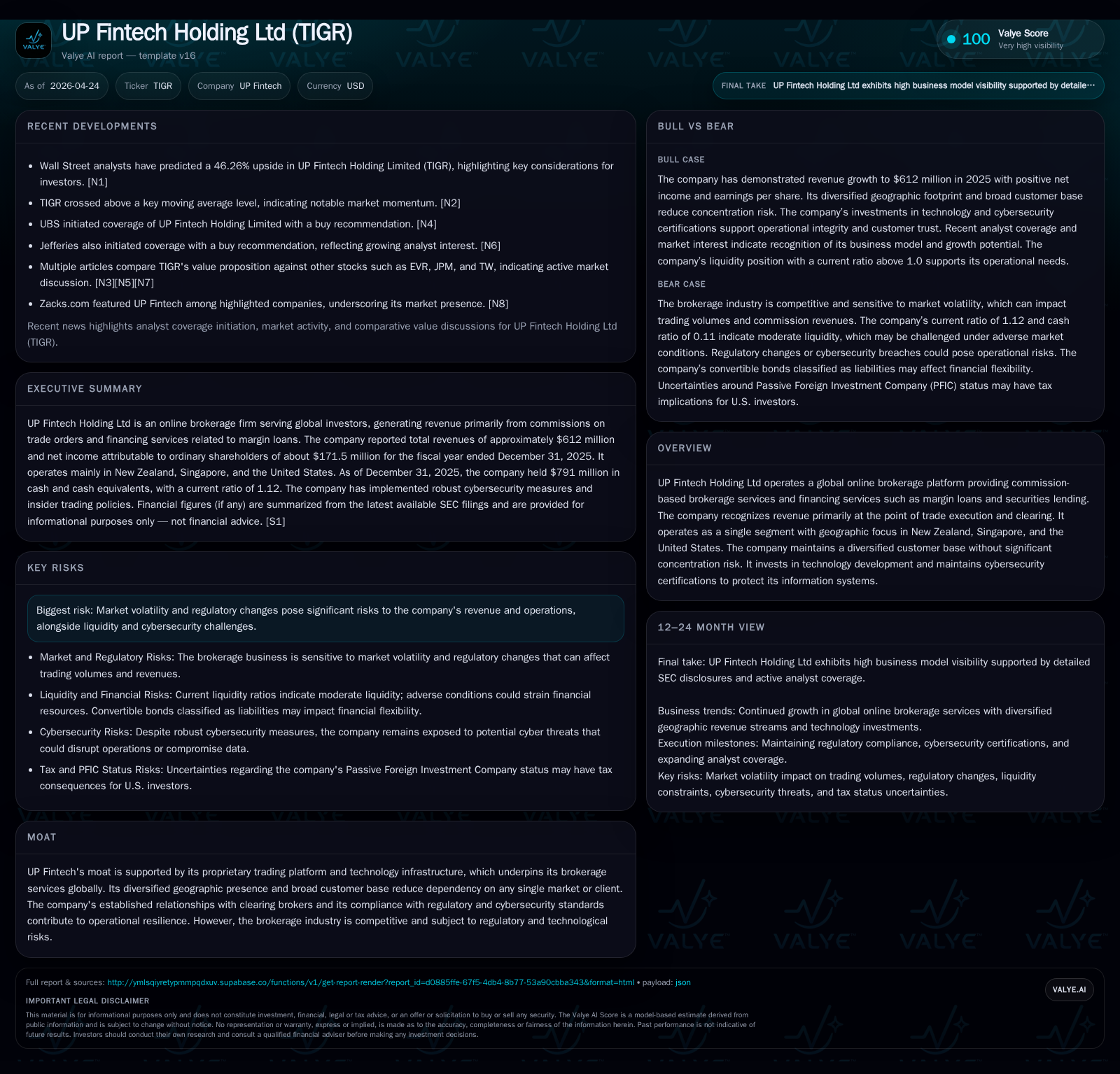
UP Fintech Holding Ltd reported robust fourth quarter and full year 2025 financial results highlighted by a sharp increase in revenues driven by commission brokerage and financing services. The company benefits from a proprietary platform underpinning a geographically diversified customer base primarily in New Zealand, Singapore, and the United States. Cybersecurity certifications and board-level risk oversight reinforce operational resilience amid an intensely competitive and regulated industry environment. Retail investor adoption, platform innovation, and financing product expansion are key growth drivers balanced against risks from market volatility impacting margin lending and evolving regulatory frameworks.
Latest Quarterly Results: Signals of Momentum into 2026
UP Fintech Holding Limited released its unaudited financial results for Q4 and the full year ended December 31, 2025 ([S2]). The report highlights substantial revenue growth anchored by the firm's commission brokerage services complemented by ancillary financing products such as margin loans. Full-year revenue surged approximately 56.3% year-over-year to $612 million, reflecting sustained demand for trading services across its key markets ([F1]). Operating cash flow showed significant strength reaching nearly $1.32 billion, indicative of solid earnings quality despite the unaudited status emphasized in the filing.
The company’s ability to expand revenue amidst challenging global market volatility illustrates underlying platform resilience. Notably, the margin loan portfolio underpinning interest income displayed stable management practices despite inherent credit risks during periods of market turbulence ([S1]).
Business Model Overview: Commission Brokerage & Financing Integration
UP Fintech operates a vertically integrated model offering commission-based online brokerage executed on a proprietary platform servicing retail investors globally ([S1], [S3]). Revenue recognition occurs primarily at trade execution and clearing, supplemented by financing revenue streams derived from margin loans collateralized by customer securities deposits. Securities lending also contributes incremental interest income.
The firm’s geographic focus spans New Zealand, Singapore, and the United States—regions representing diversified regulatory regimes and investor profiles ([S3], [S4]). This multi-jurisdictional approach reduces reliance on any single market while maintaining operational efficiency via centralized platform technology.
Margin lending introduces credit exposure risks intensified during rapid price movements or collateral concentration events; however, UP Fintech employs real-time margin compliance enforcement coupled with automated liquidation protocols to mitigate potential losses ([S1]). This lending integration fosters stickier customer relationships by bundling trading execution with financing solutions.
Additional service offerings include IPO distribution in US and Hong Kong markets, currency exchange services tailored to cross-border clientele, and wealth management products mainly focused on Singapore fund management activities ([S11]). These ancillaries diversify revenue beyond the core brokerage commissions.
Platform Quality and Security: Cybersecurity as a Strategic Asset
UP Fintech emphasizes cybersecurity as a critical strategic differentiator within the fintech space ([S1]). The platform maintains ISO27001 and ISO27701 Information Security Management System certifications evidencing robust defense-in-depth controls addressing confidentiality, integrity, and availability of trading data.
The Chief Information Officer (CIO), with extensive fintech engineering expertise including building trading, anti-fraud, and risk systems, leads the security program with daily oversight by a dedicated security team embedded within R&D.[S1] Monthly security posture reports escalate critical issues up through vice presidents to licensed entity leaders.
Board-level supervision occurs via an Operations Committee (a sub-committee comprising non-independent directors) meeting weekly to review cyber risks based on CIO reports. This high frequency governance structure allows swift response to incidents as evidenced by recent ransomware event remediation efforts.[S1]
Vendor security diligence extends to third parties with access to company data through formal contract reviews and targeted cybersecurity assessment procedures mitigating supply-chain vulnerabilities.
Industry Context: Competitive Dynamics & Geographic Diversification
Operating within a highly competitive online brokerage sector characterized by thin pricing power, UP Fintech leverages technological differentiation through proprietary trading infrastructure to maintain cost-effective service delivery.[S3], [S7]
Geographic diversification across New Zealand ($220M revenue), Singapore ($163M), and the US (~$157M) provides risk mitigation against adverse regulatory shifts or market downturns localized to one jurisdiction.[S3], [S4] This distribution aligns with retail investor trends favoring accessible platforms offering seamless multi-asset trading capabilities.
Vendor dependencies particularly relate to clearing broker partnerships responsible for trade execution finality; failure or delays here could temporarily inhibit transaction processing impacting client satisfaction.[S9], [S16].
Customer concentration is low with no single client contributing more than 10% of revenues reducing counterparty credit risk.[S8].
The broader industry faces ongoing regulatory scrutiny focused on margin lending transparency, order routing ethics, data privacy compliance, and capital adequacy standards necessitating continual adaptability ([S7]).
Growth Drivers and Constraints: Market Expansion and Regulatory Risks
Structural drivers enabling UP Fintech's growth include expanding retail investor participation globally fueled by digital adoption trends. The integrated margin lending product penetration promotes higher customer lifetime value by locking users into both execution and credit cycles.[S1], [F1]
Continuous enhancement of trading technology platforms supports the introduction of new features compatible with varied investor sophistication levels while improving user experience — crucial in reducing churn.[S11]
Conversely, cyclical market volatility profoundly affects credit exposure linked to margin loans collateralized predominantly by equities.[S24] Rapid depreciations in collateral value can trigger forced liquidations potentially impacting realized margins adversely.
Regulatory environments remain complex particularly across multi-jurisdiction operations requiring compliance investments which may act as growth headwinds but also barriers protecting established players from new entrants.[S7]
Cybersecurity threats pose latent risks although current defenses appear robust; failures would materially impact reputation as well as operational stability.
Outlook and Monitoring Points: What To Watch in Upcoming Quarters
Key near-term indicators include continued quarterly revenue trajectory post-Q4 surge reflecting sustained investor activity levels. Monitoring margin loan portfolio health via allowance for doubtful accounts trends will shed light on credit loss provisioning adequacy amid shifting market conditions.[S2], [S16]
Regulatory updates in principal markets particularly US SEC commentaries or policy changes around retail margin lending practices require close attention given their potential operational impact.[S7]
Execution cadence on planned platform upgrades such as enhanced risk management systems or customer interface optimizations will be observable through R&D spending patterns relative to prior years plus qualitative guidance from management communications.[S9]
Capital deployment strategy including share repurchase activity or further equity raises remain relevant though diluted direct evidence post-2025 is limited.[S13]
Financial Summary: Supporting Strength from Cash Flow and Capital Position
A snapshot overview based on SEC filings ([F1], [S2]) underscores UP Fintech’s improving financial profile:
Historical performance (annual)
| FY | Rev ($mm) | CFO ($mm) | Capex ($mm) | Rev YoY |
|---|---|---|---|---|
| 2025 | 612 | 1317 | 5 | +56.3% |
| 2024 | 392 | 828 | 2 | +43.7% |
| 2023 | 273 | -7 | 3 | +20.9% |
| 2022 | 225 | 258 | 5 |
Source: SEC companyfacts cache [F1].
Capital returns and efficiency (annual)
| FY | FCF ($mm) |
|---|---|
| 2025 | 1311 |
| 2024 | 826 |
| 2023 | -9 |
| 2022 | 253 |
Source: SEC companyfacts cache [F1].
Revenues grew at a compound pace exceeding 50% annually evidencing demand expansion for brokerage services enhanced by financing products integration. Operating cash flow recovery from negative territory in early years to strong positive free cash flow demonstrates improving efficiency alongside effective working capital management. Capex growth spiked in 2025 reflecting increased investment into proprietary technology development aimed at sustaining competitive advantage. Cash & equivalents totaled approximately $791 million providing ample cushion for near-term obligations alongside segregated client funds held separately under regulatory protections ([F1], [S5]). Overall ROE remains modestly negative attributed primarily to historical net losses; however, positive operating cash flows point towards improving fundamental profitability metrics over time.
This analysis articulates UP Fintech Holding Ltd’s strengthened operational performance driven by scalable technology platforms complimented by geographic diversification providing risk mitigation benefits across three major markets. Despite prevailing industry challenges around regulatory complexity and credit exposure volatility associated with margin lending products, the company’s disciplined approach to cybersecurity risk management combined with sustained R&D investment poises it well for continued growth capture. Close monitoring of upcoming quarterly financial disclosures alongside regulatory developments will be critical in assessing execution effectiveness amidst evolving fintech landscapes.
This report is intended solely for informational purposes regarding UP Fintech Holding Ltd’s business operations based on publicly available SEC disclosures as of April 2026 without offering investment advice.
Disclaimer: This is research-only, informational analysis and not investment advice. It may include AI-generated interpretation and general industry context. Always verify important details using primary sources.

Comments