
Transportation & Logistics Systems Faces Critical Pivot with Planned Acquisition and Restructuring
TLSS is transitioning from a dormant shell company toward reactivation through acquisition amidst severe financial constraints and operational risks.
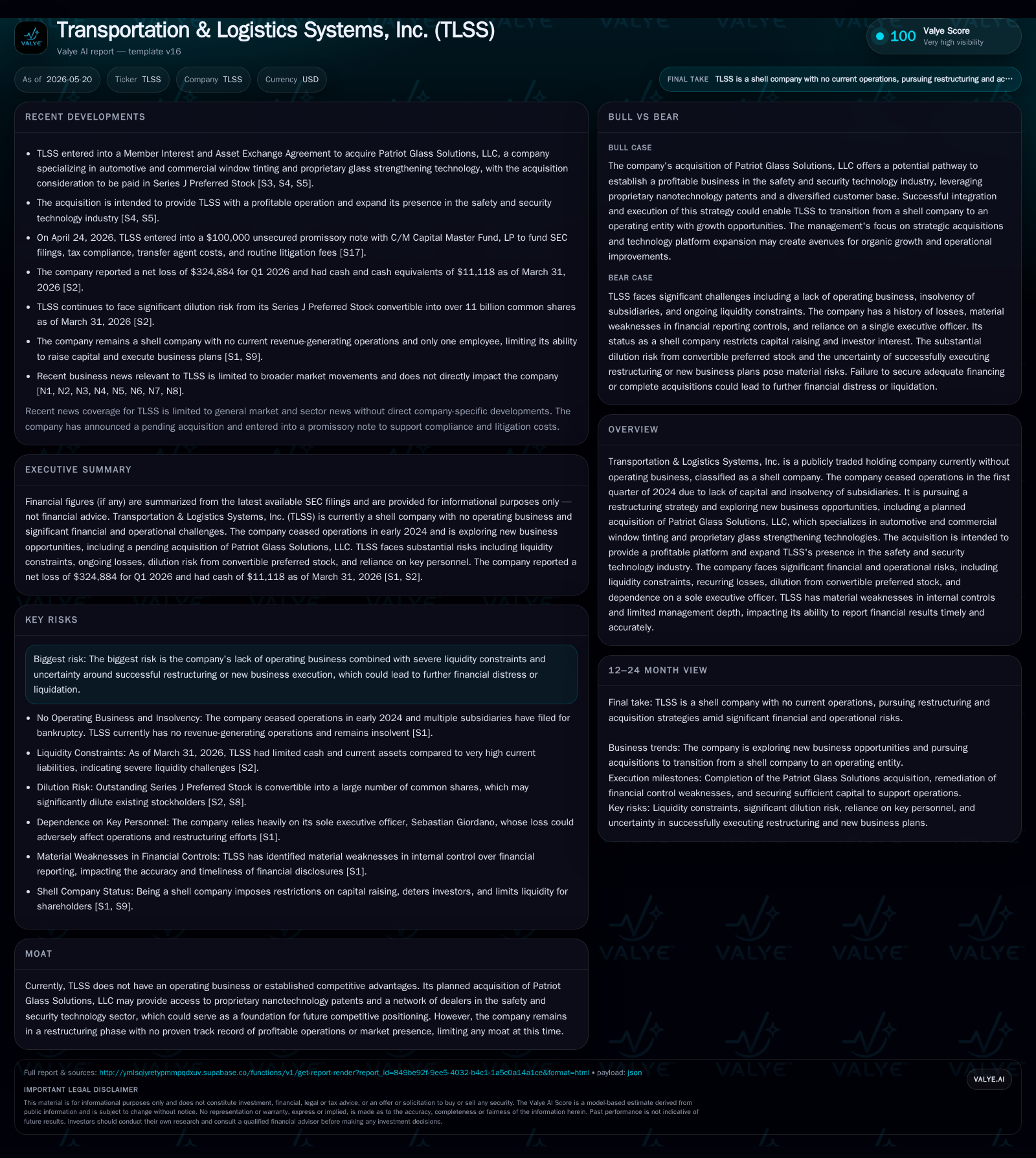
Transportation & Logistics Systems, Inc. remains a non-operating shell company following cessation of operations in early 2024 and faces substantial liquidity and restructuring challenges as disclosed in its latest 10-Q for Q1 2026. The company is actively pursuing a strategic acquisition of Patriot Glass Solutions, LLC—a Texas-based automotive and commercial glass safety technology provider—to establish a new business platform focused on proprietary nanotechnology patents and dealer networks. While this acquisition could catalyze growth by leveraging differentiated technology in a niche safety sector, TLSS’s lack of operational history, ongoing insolvency concerns, and significant share dilution risks create material uncertainties around execution. Key upcoming milestones include completion of due diligence and closing conditions for the acquisition by June 2026, alongside a critical need for incremental financing to support operations and SEC compliance.
Latest Quarterly Update Highlights Urgency of Restructuring
Transportation & Logistics Systems, Inc. (TLSS) filed its latest Form 10-Q on May 14, 2026, underscoring the company’s continuing status as a publicly traded shell with no active operating business since ceasing operations in Q1 2024 [S2]. The filing recapitulates historical insolvency among subsidiaries and ongoing liquidity challenges that necessitate the pursuit of restructuring alternatives.
A key recent development reported via an 8-K on April 28, 2026, details TLSS entering into an unsecured promissory note agreement for $100,000 at a 10% interest rate, maturing six months after issuance [S3]. The capital infusion was explicitly aimed at funding necessary SEC filings while advancing the restructuring effort. This short-term financing reflects TLSS’s precarious cash position but indicates intent to maintain compliance and explore new strategies.
However, balance-sheet scrutiny reveals extremely constrained liquidity: as of March 31, 2026, TLSS held only approximately $11,000 in cash against current liabilities exceeding $8.5 million, resulting in a effectively zero current ratio [F1]. Total debt outstanding last reported approximated $3.3 million as of September 2023 [F1], highlighting significant financial strain that persists absent operational inflows.
Current Business Model Status: From Shell to Opportunity Seeker
TLSS has transitioned into what is effectively a publicly traded shell company without revenue-generating operations since early-2024 insolvency triggered cessation [S1],[S2]. The traditional business model centered on transportation and logistics services has collapsed under capital scarcity and bankruptcy filings among subsidiaries [S1].
Currently, TLSS’s strategic focus is entirely on identifying viable inorganic growth opportunities through acquisitions that can restore operational substance and provide positive cash flow. The planned acquisition of Patriot Glass Solutions (PGS), LLC represents this strategic pivot from being an inactive holding entity toward reestablishing a functioning enterprise with proprietary technology offerings [S1],[S2].
Management acknowledges no existing economic moat or legacy profitability; rather the future value proposition hinges on the technology IP and market positioning embedded within PGS’s automotive/commercial glass safety niche. This pivot embodies typical shell company dynamics where value creation depends on execution of transformational transactions supported by patent portfolios and dealer networks.
Competitive Landscape and Industry Positioning in Safety Technologies
The safety and security technology industry targeted through Patriot Glass Solutions largely comprises technologically specialized yet fragmented markets focused on protective coatings like window tinting and glass strengthening films [S1]. The competitive environment values proprietary nanotechnology patents — such as PGS’s C-Bond applications — which enhance glass durability against breakage or ballistic impacts.
Distribution plays an outsized role since dealer networks provide essential local presence for installation services across residential, automotive, institutional, and commercial sectors. PGS reports over fifty dealers nationwide providing a sales channel advantage uncommon among smaller competitors [S1]. However, barriers to entry remain high for new market entrants lacking intellectual property rights or established dealer relationships.
Regulatory considerations also influence product acceptance given safety standards governing ballistic resistance or forced-entry deterrents for commercial installations. This regulatory overlay imposes compliance costs but creates switching friction benefiting firms like PGS with demonstrated technical credentials.
Planned Acquisition of Patriot Glass Solutions: Growth Catalyst or Risk?
The announced reverse triangular merger agreement signed April 1, 2026 sets terms for TLSS to acquire an eighty percent membership interest in PGS along with four nanotechnology patents underpinning its core product offerings [S11],[S27]. Payment consists primarily of Series J Preferred Stock valued at $4.75 million payable upon closing anticipated by June 1, conditional on due diligence milestones including audited financials from PGS [S11].
Strategically this acquisition would supply TLSS with an operating business possessing profitable historical performance metrics—a stark contrast to TLSS’s dormant state since early-2024 shutdowns—and a ready avenue into safety/security tech markets backed by IP assets [S1]. The deal also aligns TLSS’s demographic focus towards Texas-centric operations with plans for operational leadership continuity via employment agreements with existing managers [S11].
Despite these positives potential pitfalls loom large. Risks arise from integrating an acquired platform after two years without internal revenues plus the scaling demands inherent to patent licensing and dealer penetration expansion. Furthermore, the reliance on convertible preferred stock consideration adds dilution pressure while existing debt burdens remain unresolved [S2],[S27]. Execution will require deft financial management combined with operational expertise foreign to a former transport/logistics infrastructure.
Growth Drivers Anchored in Technology Licensing and Dealer Network Expansion
Assuming successful transaction closure, growth catalysts center on monetizing PGS's proprietary nanotechnology patents related to C-Bond glass strengthening processes. These patents support high-margin licensing revenues scalable beyond physical tint installation services offered today [S1],[S11].
Further organic expansion depends heavily on deepening the dealer network deployment to capture additional geographic regions—a process requiring relationship management skills common in specialty distribution but new territory for TLSS historically. Additionally, growing end-user demand for enhanced automotive safety features and energy-efficient window treatments could drive sustained volume increases if matched by capacity investment.
Key performance indicators post-acquisition likely include patent license deal closures, incremental dealer onboarding rates (currently about fifty dealers nationwide), revenue run rate improvements from existing service contracts, and retention or growth of marquee customers spanning government facilities to residential homes [S1]. Achieving these milestones underpins the strategic premise that TLSS can transform into an active competitor within safety-related technology markets rather than remaining classified as a public shell.
Key Risks: Liquidity, Dilution, and Execution Challenges
TLSS faces pronounced financial vulnerabilities that ripple throughout all prospective turnaround avenues:
- Cash resources are severely limited at roughly $11K as of Q1-end vs massive current liabilities near $8.5 million—an acute working capital deficit constraining runway absent rapid capital injections or asset monetization [F1],[S2].
- The Series J Preferred Stock structure poses overwhelming dilution risk: each preferred share converts initially into approximately 100,000 shares of common stock at a nominal conversion price of $0.001 per share while accruing dividends compounding further issuable shares—over eleven billion common shares were potentially issuable as conversion candidates at March 31, excluding accrued dividends [S2]. This dilution threatens existing shareholders’ voting power.
- Operationally TLSS lacks active personnel beyond one executive officer creating key-person dependency risks alongside material internal control weaknesses documented around financial reporting accuracy [S1],[S2].
- Integration risk remains significant given absence of recent operating experience combined with assumption of new liabilities upon acquiring PGS including leases and contingent litigation claims noted historically for corporation-related matters [S1].[S13]
- Failure to secure additional liquidity beyond the $100K short-term note obtained April 2026 would jeopardize ability to sustain SEC compliance filings or fund necessary transaction expenses leading to increased probability of involuntary liquidation scenarios [S3],[F1].
These combined factors impose material uncertainty on both successful restructuring outcome realization or subsequent profitability emergence.
What to Watch Next: Transaction Milestones and Capital Developments
Investors should monitor several critical near-term developments shaping TLSS’s trajectory:
- Completion status of PGS acquisition notably hinge on fulfillment of due diligence outcomes including year-end audited results for fiscal years ending December 31st of both 2024 and 2025 plus first quarter unaudited financials before planned closing date no later than June 1st, 2026 [S11],[S27].
- Updates regarding negotiations over employment agreements with PGS management personnel vital for maintaining operational continuity post-merger.
- Additional financing measures or equity raises beyond the April unsecured promissory note are indispensable; attention should be paid to any announcements concerning cash runway extensions or capital commitments amid persistent working capital deficiencies noted in filings [S3],[F1].
- Proxy statements surrounding shareholder approval votes related to transaction consummation may unveil stakeholder sentiment relative to dilution risks posed by Series J Preferred issuance [S2].
- Any disclosures addressing resolution or contingency planning over legacy litigation cases bearing financial impact will signal risk mitigation progress or further exposure [S6],[S13].
Brief Financial Overview: Cash Position and Debt Profile
As reported at quarter-end March 31, 2026, TLSS held approximately $11,118 in cash equivalents compared to total current assets near $14,868—minuscule relative to its current liabilities tallying nearly $8.55 million—yielding an untenable current ratio effectively equal zero reflecting extreme illiquidity [F1]. Total debt was last identified at roughly $3.3 million as of September 30, 2023 indicating continued leverage burden though more recent figures were not updated explicitly in the latest quarterly filing [F1].
Such financial constraints underline the imperative need for successful deal closure coupled with supplementary funding sources essential if TLSS hopes to emerge from its dormant shell status toward renewed operating viability.
This analysis is based solely on publicly available SEC filings ([S1], [S2], [S3]) alongside company facts data ([F1]). It does not constitute investment advice or research views. Readers should consider all risks carefully when evaluating the prospects of Transportation & Logistics Systems given its precarious financial condition and nascent stage transition toward reactivation via acquisition.
Disclaimer: This is research-only, informational analysis and not investment advice. It may include AI-generated interpretation and general industry context. Always verify important details using primary sources.

Comments