
TMC Advances Toward Commercial-Scale Polymetallic Nodule Production from the Deep Seabed
TMC progresses key development milestones and regulatory filings for its integrated deep-sea polymetallic nodule project in the Clarion Clipperton Zone, targeting critical strategic metals.
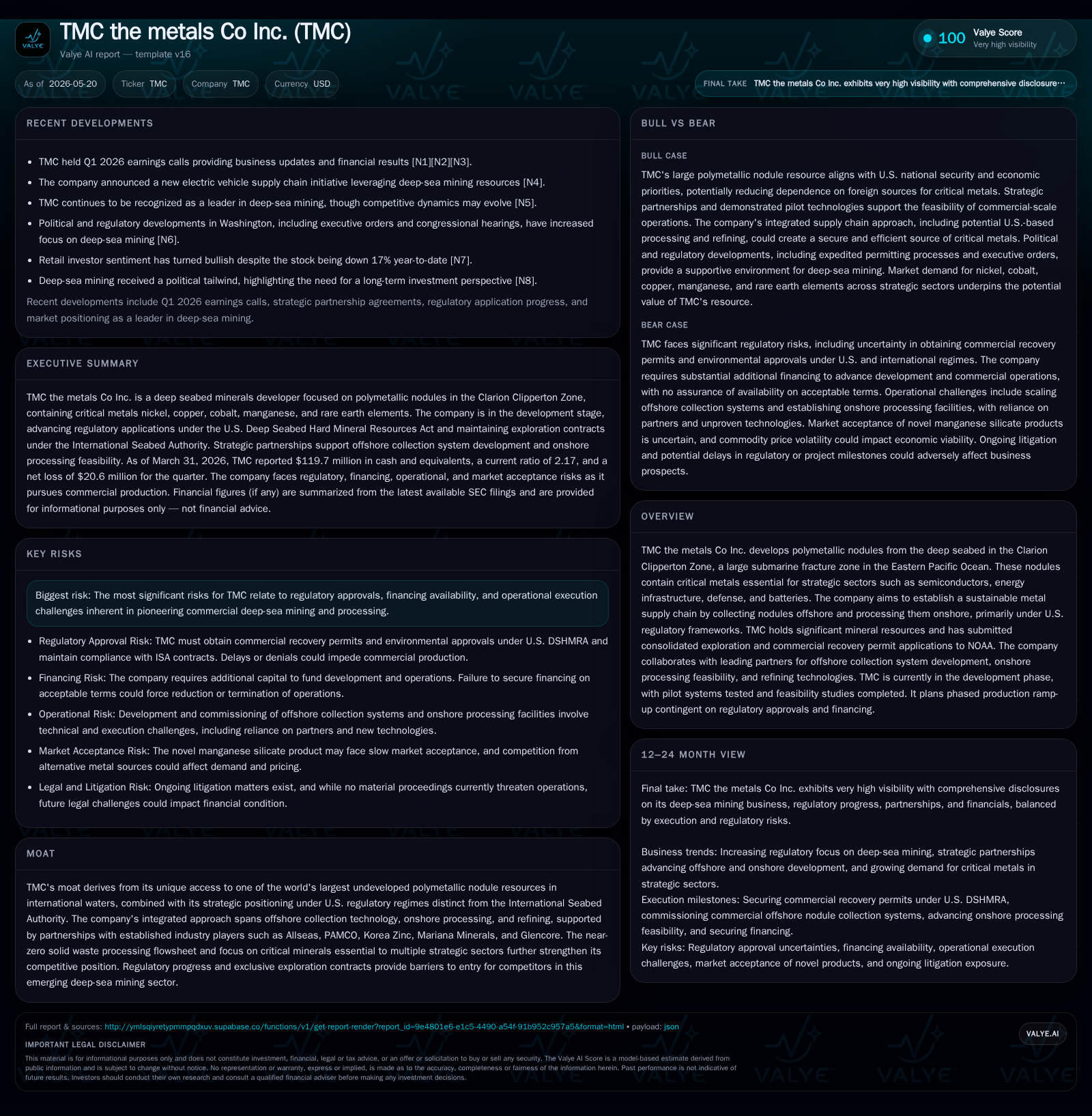
In its May 14, 2026 quarterly filing and related disclosures, TMC the metals Co Inc. reported continued progress toward commercial-scale production of polymetallic nodules from the deep seabed. Key developments include ongoing pilot testing of offshore collection technology, regulatory review of U.S. permit applications under NOAA's Deep Seabed Hard Mineral Resources Act (DSHMRA), and advancing feasibility studies for onshore processing partnerships. The company’s vertically integrated model encompasses offshore collection, onshore processing, and refining aimed at producing nickel-, cobalt-, and copper-bearing intermediate products. While regulatory and operational execution risks remain significant, near-term growth catalysts are centered on permit approvals and scaling pilot technologies to commercial operations.
Recent Operational Developments: Progress Highlighted in Latest Quarterly Filing
TMC the metals Co Inc., in its May 14, 2026 quarterly report [S2] and accompanying event filing [S3], detailed meaningful advances despite remaining pre-revenue. The company continues iterative pilot testing of its offshore polymetallic nodule collection systems developed with Allseas, advancing engineering modifications toward commercial readiness. Regulatory progress includes positive indications from NOAA regarding compliance of TMC USA's consolidated application for exploration licenses and commercial recovery permits under the Deep Seabed Hard Mineral Resources Act (DSHMRA). This U.S.-domiciled regulatory pathway offers a distinct alternative to the International Seabed Authority (ISA) framework.
Onshore processing feasibility is progressing through TMC’s partnership with PAMCO in Japan, which is evaluating toll treatment capacity up to 1.3 million tonnes of wet nodules annually [S1][S3]. Additionally, TMC formalized a strategic partnership with Mariana Minerals to incorporate AI-driven process controls aimed at optimizing future U.S.-based metallurgical facilities [S3]. Risk factors remain consistent with prior annual disclosures [S17], underscoring ongoing regulatory dependencies.
Business Model: Integrated Deep-Sea Mining to Critical Metal Production
TMC’s business model integrates the entire value chain from deep-sea polymetallic nodule acquisition in the Clarion Clipperton Zone (CCZ)—a vast submarine fracture zone located about 2,400 kilometers southwest of San Diego—to onshore processing and refining [S1]. These nodules contain critical minerals including nickel, copper, cobalt, manganese, and rare earth elements vital to semiconductor manufacturing, defense sectors, and clean energy technologies.
The company operates under exclusive ISA exploration contracts sponsored by NORI Ocean Resources Inc. and TOML while also pursuing permits under U.S. law through DSHMRA [S1]. Collected nodules are transported via specialized vessels such as Hidden Gem to shore-based facilities where PAMCO applies toll treatment converting raw nodules into nickel-copper-cobalt alloys suitable for downstream refining.
Future product expansions may include silicomanganese alloys, battery-grade sulfates, precursor cathode active materials (pCAMs), and rare earth element extraction [S22]. Complementary partnerships strengthen this model: Allseas provides offshore engineering expertise; Glencore holds offtake rights for key metals; Mariana Minerals contributes AI-enhanced metallurgy; Hatch Ltd. supports near-zero solid waste flowsheet development enhancing environmental sustainability [S1][S22].
Industry Context: Competitive Positioning and Barriers to Entry
Within the emergent deep-sea mining sector, TMC enjoys a competitive edge via exclusive access to some of the world’s largest undeveloped polymetallic nodule deposits under U.S.-regulated contracts alongside ISA licenses [S1][F1]. This dual-regulatory approach differentiates it from peers focused solely on ISA-administered projects.
The company's moat is reinforced by validated mineral reserves demonstrated through its NORI-D pre-feasibility study, a diversified partner ecosystem mitigating technological risk across collection-to-refining stages, and a supportive domestic regulatory framework accelerated by Executive Order 14825 facilitating expedited permitting [S24].
Operational challenges include scaling a fleet capable of extracting multi-million tonnes of wet nodules annually—initial plans call for up to four vessels targeting approximately 3 Mtpa each post-2027 commissioning—and aligning onshore processing capacities accordingly [S22]. Environmental scrutiny remains a reputational challenge amid NGO opposition and evolving ESG considerations detailed in filings [S14].
Growth Drivers: Regulatory Approvals, Technology Scaling, and Market Demand
Critical growth milestones hinge on obtaining NOAA commercial recovery permits within an expected timeframe near one year from May 2026 submission [S18][S29]. Permit approval would enable commissioning of upgraded collection vessels starting late 2027 with progressive fleet expansion through early 2030s aiming for steady state output near 12 Mtpa wet nodules.
Pilot testing offers actionable feedback improving offshore collector reliability while feasibility studies advance toll treatment plant capacity expansion initially at PAMCO’s Hachinohe site with potential U.S. plant development leveraging Mariana Minerals’ AI-driven process innovations [S3][N5]
Robust demand stems from accelerating electrification trends requiring high-purity nickel-cobalt intermediates for EV batteries and defense supply chains prioritizing critical minerals security—nickel was designated among top minerals by the Department of War as of March 2026 [S1]. Production scalability focuses on meeting volume targets while delivering flexible product mixes compatible with diverse end markets.
Risks and Constraints: Regulatory Uncertainty and Execution Complexity
Regulatory risk remains paramount given no commercial recovery permits have yet been granted; complex environmental impact assessments evaluating novel marine extraction methods could delay or deny approvals influenced by geopolitical factors [S14][S17].
Technological execution risks arise from unproven commercial-scale seafloor collection equipment still undergoing manufacture/testing beyond pilots. Dependence on partners like Allseas introduces counterparty risk should collaborations falter or engineering challenges mount [S14]. Cost overruns or CAPEX escalation are inherent risks given pioneering project nature lacking fixed cost benchmarks.
Additional constraints include capital intensity requiring financing beyond current reserves [F1], ongoing litigation risks from shareholder claims alleging disclosure issues [S14][S21], and reputational risks linked to environmental activism that might impact public policy or permitting outcomes.
Financial Position: Solid Liquidity Supports Development Stage Activities
As of March 31, 2026, TMC held approximately $120 million in cash and equivalents against minimal long-term debt below $3 million based on latest data [F1]. The company’s current assets of approximately $123 million exceed current liabilities of about $57 million, resulting in a current ratio of approximately 2.17, indicative of healthy short-term liquidity supporting continued R&D expenditures and pilot program funding [F1].
The company remains pre-revenue with no operating income generated due to capital-intensive development focus [F1]. Cash burn rates will require monitoring approaching prospective commercial launch phases post-2027 when substantial incremental investments will be needed. Financing strategies may include equity offerings or project-specific debt structures as outlined in disclosures [S16][S19], implying dilution risks absent non-dilutive funding sources.
Disclaimer: This analysis is based exclusively on SEC filings dated through May 20, 2026 ([S1]-[S29]) and related data without providing investment advice or price targets.
Disclaimer: This is research-only, informational analysis and not investment advice. It may include AI-generated interpretation and general industry context. Always verify important details using primary sources.

Comments