
Thermo Fisher Scientific’s Financial Momentum and Innovation Challenges After 2025
A review of Thermo Fisher's robust financial gains against rising innovation demands and operational risks shaping its near-term trajectory.
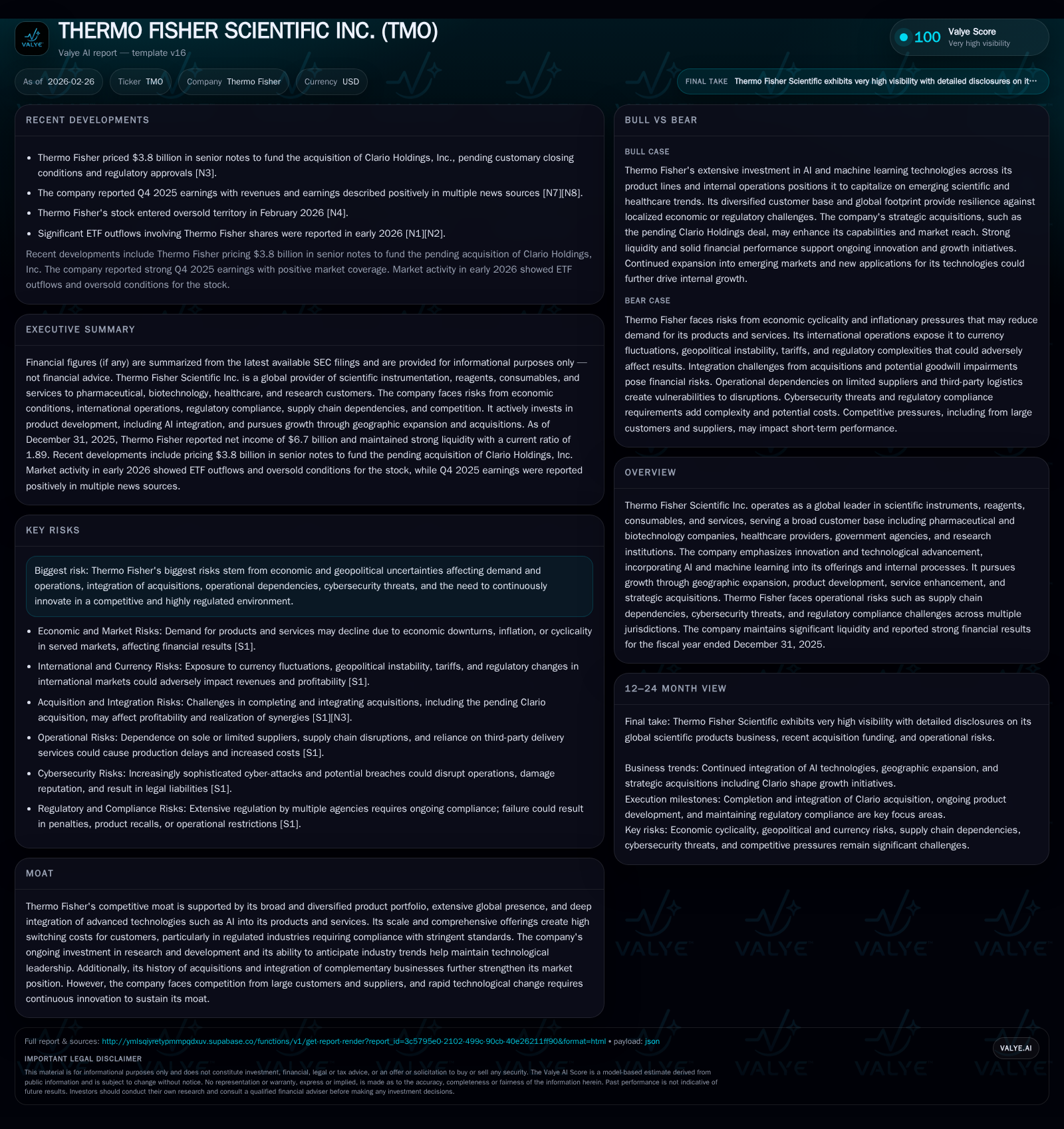
Thermo Fisher Scientific delivered strong fiscal 2025 results, driven by diversified product innovation, geographic expansion, and acquisitions including AI integration into offerings. While revenue surged by 22.1% YoY and net income surged nearly eighteenfold, the company faces mounting risks from global regulatory complexities, supply chain vulnerabilities, and cybersecurity threats. Capital allocation reflects a balance between shareholder returns via dividends and buybacks, alongside sustained investment in R&D and capacity expansion. The near-term outlook hinges on successful integration of recent acquisitions like Clario and managing regulatory headwinds amid volatile economic conditions.
Strong 2025 Performance Highlights Robust Growth Momentum
Thermo Fisher Scientific reported impressive financial results for fiscal year 2025, underscoring a continuation of its growth trajectory that has roots in both organic expansion and acquisition activities. Reported revenue reached approximately $77.46 billion, marking a robust increase of 22.1% compared with the prior year [F1]. This surge was fueled not only by broad product adoption across global markets but also benefited from a favorable foreign currency translation effect amounting to $0.37 billion due to the weakening U.S. dollar [S1][N1][N3]. Operating income rose more modestly by 5.6%, reaching $7.75 billion, while net income skyrocketed by an astonishing 1859.7% to $6.70 billion [F1], indicating potential one-off impacts or significant margin improvements.
The wide product portfolio spanning scientific instruments, reagents, consumables, and services enabled Thermo Fisher to mitigate exposure to any single market or regulatory environment's downturns [S1]. However, inflationary pressures persisted globally throughout 2025, introducing cost headwinds that challenged margin expansion efforts amid elongated sales cycles and order delays highlighted in company disclosures [S1]. The diversity of customer segments—including pharma & biotech companies, research institutions, healthcare providers, and government bodies—enabled resilience but necessitates continuous product lifecycle management discipline to sustain growth.
Innovation Through AI and Strategic Acquisitions as Growth Catalysts
Central to Thermo Fisher’s expansion is its aggressive integration of artificial intelligence (AI) and machine learning (ML) technologies into both product development pipelines and internal business processes [N8]. These advancements accelerate diagnostic capabilities and enhance data analytics embedded in their scientific instruments, creating differentiated offerings tailored to evolving customer needs.
Recently executed strategic acquisitions have further propelled growth ambitions; most notably the Clario clinical trial services business was acquired in early 2026 through financing via $3.8 billion senior notes issuance [N7][S3]. This venture extends Thermo Fisher’s reach deeper into clinical development services—a highly complex industry segment requiring stringent quality control systems—and enhances its pharmaceutical sector engagement .
These moves align with sector trends where life sciences firms increasingly seek integrated solutions combining instrument hardware with software-driven analytics platforms leveraging AI for next-generation diagnostics and drug development acceleration protocols . Financing via senior debt suggests disciplined capital structure management aimed at balancing aggressive growth pursuit with manageable leverage levels.
Regulatory and Operational Risks in Complex Global Markets
Despite technological momentum, Thermo Fisher contends with substantial regulatory compliance overhead and operational complexities across myriad jurisdictions [S4]-[S11]. The company operates under intense scrutiny from the FDA, DEA, EMA, and equivalent international bodies that regulate manufacturing practices for medical devices, pharmaceuticals production, clinical trial services, and laboratory-developed tests.
Noncompliance risks encompass potential inspections leading to remediation orders or penalties such as recalls, seizures or injunctions that could disrupt supply continuity or lead to costly litigation [S4][S9][S14]. Additionally, data privacy laws such as the EU GDPR impose demanding controls on handling sensitive personal data integral to clinical research operations; breaches could trigger significant fines or reputational damage [S10][S14].
Cybersecurity remains a critical vulnerability given reliance on IT systems for manufacturing oversight, order processing, billing functions, and proprietary AI algorithm integrity across products [S29]. Although no material cyber incidents have been reported recently, ongoing threat exposure mandates rigorous defense-in-depth strategies involving employee training and third-party risk assessments.
Operational dependencies include single-sourced suppliers for specialized raw materials as well as extensive logistics coordination using third-party carriers like FedEx and DHL; disruptions here risk escalating costs or delayed deliveries impacting customer satisfaction [S8][S13][S26]. Geopolitical uncertainties amplify these risks especially given exposure to emerging markets with variable political stability and trade policies.
Capital Allocation: Balancing Shareholder Returns With Strategic Investments
Thermo Fisher exhibits proactive capital deployment balancing consistent shareholder returns against reinvestment needs. Cash & equivalents totaled $9.85 billion at year-end 2025 [F1], providing substantial liquidity cushion supporting acquisitions such as Clario alongside internal growth initiatives.
Operating cash flow declined by about 9.8% from previous periods to $7.82 billion while capital expenditures rose nearly 8.9% to $1.53 billion reflecting investment in facility expansions and next-generation product capabilities [F1]. Dividend payments increased steadily to $636 million evidencing commitment to returning value to investors; meanwhile share repurchases amounted to approximately $3 billion indicative of capital efficiency focus amidst balanced leverage dynamics [F1][N7][S22].
With equity base rising to over $53 billion paired with net income of $6.7 billion yields an approximate return on equity (ROE) near 12.6% suggesting effective use of invested capital despite elevated outstanding debt nearing $39 billion which requires careful coverage monitoring [F1][S22]. Continued free cash flow generation after capex — about $6.3 billion — bodes well for funding flexibility.
Future Outlook: Navigating Market Demand, Competitive Pressures, and Expansion
Explicit forward guidance remains limited currently; however key factors warrant close observation going forward [N1][N7][S1]. Integration success of recent acquisitions such as Clario will influence deliverable synergies critical for revenue uplift beyond acquisition cost absorption.
The pace at which innovative AI-powered products translate into new revenue streams amid elongated sales cycles affected by macroeconomic uncertainties will shape top-line trajectory. Regulatory evolutions particularly around FDA oversight on drug discovery processes or laboratory-developed tests may introduce compliance-driven delays or additional costs compressing margins [S4][S5].
Competitive dynamics involve both large customers who sometimes pose direct competition risks themselves as well as suppliers potentially shifting relationship terms [S12][S21]; mitigating these requires constant innovation along with service excellence.
Ultimately challenges include balancing pressure on pricing due to inflationary environments against maintaining technological leadership through ongoing R&D investments targeting evolving industry needs for speedier commercialization pathways.
Key Metrics and Historical Performance Trends Snapshot
Historical performance (annual)
| FY | CFO ($bn) | OpInc ($bn) | Capex ($bn) |
|---|---|---|---|
| 2025 | 7.8 | 7.7 | 1.5 |
| 2024 | 8.7 | 7.3 | 1.4 |
| 2023 | 8.4 | 6.9 | 1.5 |
| 2022 | 9.2 | 8.4 | 2.2 |
Source: SEC companyfacts cache [F1].
Capital returns and efficiency (annual)
| FY | Div ($mm) | Buybacks ($bn) | FCF ($bn) |
|---|---|---|---|
| 2025 | 636 | 3.0 | 6.3 |
| 2024 | 583 | 4.0 | 7.3 |
| 2023 | 523 | 3.0 | 6.9 |
| 2022 | 455 | 3.0 | 6.9 |
Source: SEC companyfacts cache [F1].
*2017 shown for revenue historical baseline only per available data; other metrics unavailable for this year [F1]
This table encapsulates Thermo Fisher’s evolving scale from a mid-single-digit revenue figure in early years toward dominating tens of billions in sales with consistent profit improvement except noted cash flow normalization recently likely reflecting invested growth phase.
This analysis synthesizes publicly available financial data combined with detailed disclosure from SEC filings alongside recent news reports to provide an informed view without presuming undisclosed projections or estimates.
Disclaimer: This document is for informational purposes only without offering investment advice or recommendations regarding Thermo Fisher Scientific Inc.'s securities.
Disclaimer: This is research-only, informational analysis and not investment advice. It may include AI-generated interpretation and general industry context. Always verify important details using primary sources.

Comments