
Tompkins Financial Corp Accelerates Profit Growth Driven by Core Banking and Strategic Divestitures
TMP leverages its community banking model and strategic capital moves to boost earnings amid moderate cash flow volatility.
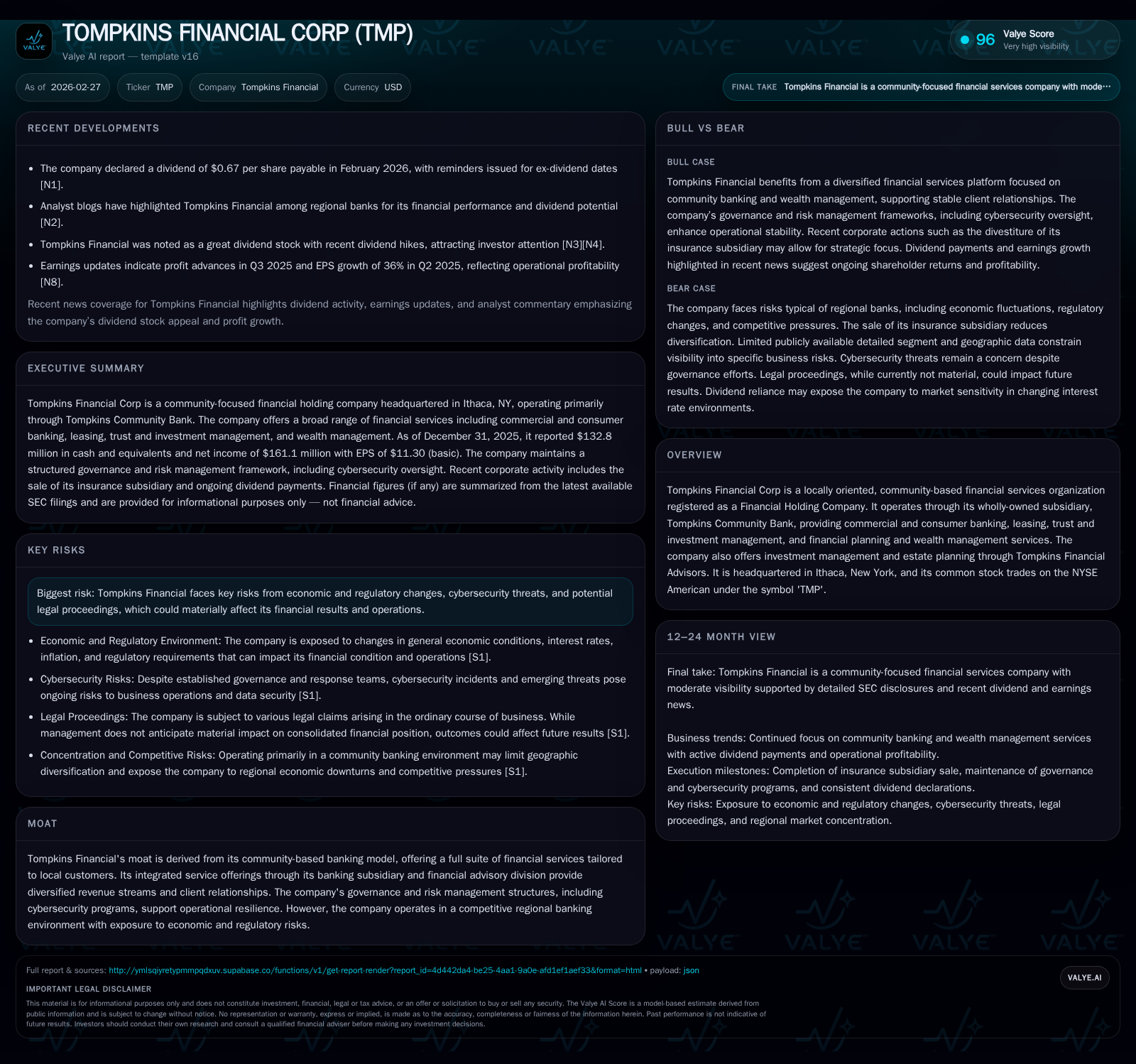
Tompkins Financial Corp, a community-focused financial holding company, posted a 127% increase in net income for 2025, reflecting strong core banking operations and the impact of divesting its insurance subsidiary. Despite a notable decline in operating cash flow due to working capital changes and transaction effects, the company maintains solid capital levels and shareholder returns. The sale of Tompkins Insurance Agencies streamlined TMP’s focus on banking and wealth management, supporting disciplined capital allocation including steady dividends. Governance frameworks remain robust, with ongoing risk management amid regulatory and cyber challenges. Investors should watch loan growth and cash flow trends in upcoming quarters.
Company Overview
Tompkins Financial Corporation (TMP) is a financial holding company headquartered in Ithaca, New York, primarily operating through its wholly owned subsidiary Tompkins Community Bank. The company offers commercial and consumer banking products alongside leasing, trust services, wealth management, and financial planning via its Tompkins Financial Advisors division. TMP emphasizes a community-based banking approach focused on personalized service and integrated financial solutions tailored to its regional clientele [S1].
Historical Performance
TMP’s financial performance shows a significant turnaround culminating in fiscal 2025. Net income increased substantially from $70.85 million in FY2024 to $161.07 million in FY2025 — a 127.3% jump illustrating improved profitability driven by stronger core banking revenues and strategic asset sales including the divestiture of Tompkins Insurance Agencies (TIA) [F1]. Prior years showed more modest or volatile earnings.
Operating cash flow decreased sharply by nearly 60% year-over-year to $38.9 million in FY2025 reflecting changes in working capital linked partly to the TIA sale transaction costs and timing differences [F1], [S15]. Capital expenditures rose slightly to $6.9 million, indicating sustained investments in technology infrastructure and regulatory compliance initiatives.
Historical performance (annual)
| FY | Net ($mm) | CFO ($mm) | Capex ($mm) | Net YoY |
|---|---|---|---|---|
| 2025 | 161 | 39 | 7 | +127.3% |
| 2024 | 71 | 95 | 6 | +645.4% |
| 2023 | 10 | 89 | 7 | -88.8% |
| 2022 | 85 | 103 | 8 |
Source: SEC companyfacts cache [F1].
Capital returns and efficiency (annual)
| FY | Div ($mm) | Buybacks ($mm) | FCF ($mm) |
|---|---|---|---|
| 2025 | 36 | 2 | 32 |
| 2024 | 35 | 0 | 89 |
| 2023 | 35 | 9 | 82 |
| 2022 | 34 | 15 | 95 |
Source: SEC companyfacts cache [F1].
Buyback activity notably declined after FY2023 with minimal repurchases recorded in FY2025.
Capital Allocation and Returns
The company maintains a strong equity base of approximately $713 million as of December 31, 2024 supporting an approximate return on equity of 22.6%, indicative of efficient capital use within its focused business segments [F1]. Dividend payments have been consistent with a slight upward trend reaching about $36 million annually in FY2025, underscoring capital allocation discipline balanced with liquidity considerations [F1], [N3], [N5].
Share repurchase programs have been less active recently as TMP prioritizes liquidity preservation amidst market uncertainties.
Executive retention remains a focus post-divestiture with supplemental retirement plans structured for key leadership aligning incentives with long-term corporate objectives [S21], [S22].
Strategic Developments
In late 2025, TMP completed the sale of its insurance subsidiary Tompkins Insurance Agencies to Arthur J. Gallagher & Co. for approximately $223 million. This transaction refocused the company’s business strategy toward core commercial banking and wealth management while generating significant cash proceeds for strategic use or balance sheet strengthening [S15]. Transition arrangements included retention payments for key employees ensuring continuity.
The company aims to leverage cross-selling opportunities through Tompkins Financial Advisors by expanding investment advisory and estate planning services within its established regional markets—primarily upstate New York—where it competes against both traditional banks and fintech entrants [S6].
Governance and Risk Management
TMP employs robust governance structures including the Directors Risk Committee overseeing cybersecurity policies with quarterly reporting from the Chief Information Security Officer (CISO). The Enterprise Risk Management Committee manages broader risk parameters including credit quality and operational risks with regular updates provided to the Board [S1], [S8]. Cybersecurity practices adhere to National Institute of Standards and Technology (NIST) Incident Response Framework guidelines — an important focus given heightened cyber threats targeting community banks.
Legal proceedings exist but are not expected to materially impact consolidated financial position based on current assessments; ongoing reviews ensure preparedness for any potential litigation outcomes typical within financial services operations [S7]. Regulatory compliance efforts continue amid evolving Federal Reserve requirements related to capital adequacy and operational risk.
Outlook
TMP’s growth prospects rest on increasing local commercial lending volumes paired with fee-generating wealth management services that benefit from demographic trends favoring personalized advisory relationships.
Challenges include potential regulatory changes, cybersecurity risk mitigation costs, regional economic variability impacting net interest margins, and competitive pressures within community banking sectors.
Investors should monitor upcoming quarterly results closely for loan portfolio developments, deposit growth dynamics, operational cash flow trends, efficiency ratios, and credit quality indicators that collectively will signal sustainability of recent earnings gains.
Conclusion
Tompkins Financial Corporation has delivered a pronounced rebound in profitability driven by core banking performance augmented by strategic divestitures refining its business focus. Despite short-term operating cash flow fluctuations tied to transactional activities, underlying capital returns remain robust supported by disciplined dividend policies.
Strong governance frameworks coupled with deep regional customer relationships position TMP well for measured growth tempered by prudent risk management practices amid evolving industry challenges.
Disclaimer: This report is prepared solely for informational purposes as of February 27, 2026; it does not constitute investment advice or endorsement of any security or strategy.
Disclaimer: This is research-only, informational analysis and not investment advice. It may include AI-generated interpretation and general industry context. Always verify important details using primary sources.

Comments