
Kartoon Studios: Scaling Children’s Content Across Platforms, But Profitability Hinges on Execution
Kartoon Studios has built a unique, diversified platform in children’s animation, combining proprietary IP, major production capabilities, and global multi-channel distribution. Yet persistent operating losses, customer concentration, and intense competition highlight the importance of cost discipline and successful monetization as the business expands digital reach and pursues new capital.
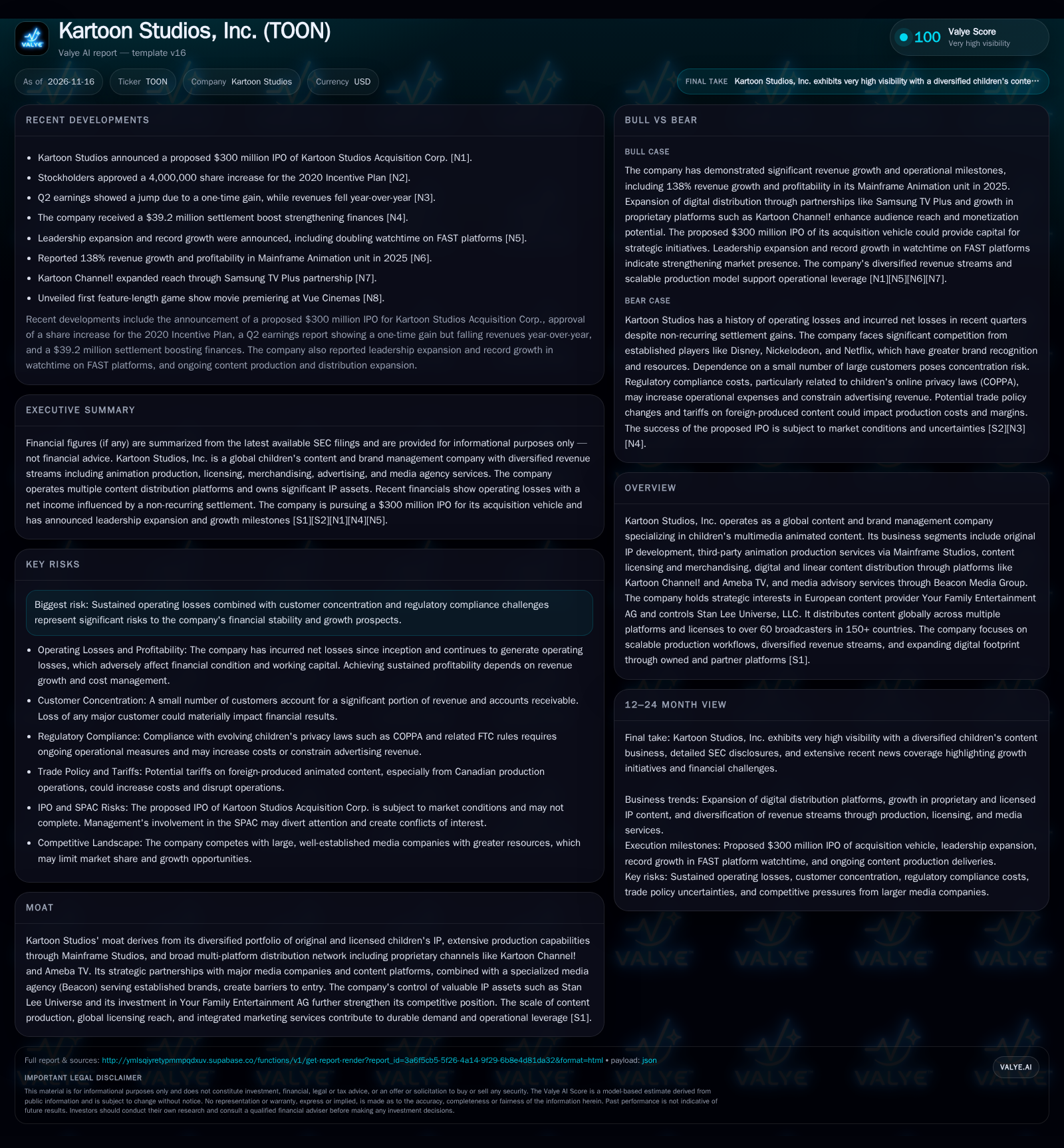
Kartoon Studios’ multi-pronged content and distribution strategy is gaining traction, with significant IP, production partnerships, and digital audience growth. However, the company’s history of operating losses, customer concentration, and the uncertain outcome of its $300 million SPAC IPO underscore the need for sustainable revenue and margin gains to justify its strategic ambitions. [S1] [S2] [N1] [N5] [N6]
Kartoon Studios occupies a distinctive niche in the global children’s content ecosystem, blending original IP, large-scale production capacity, and broad digital distribution. The company’s recent financials reflect both promise and challenge: headline net income for 2026 was due to a one-time settlement rather than operating strength, and quarterly losses persist. Meanwhile, its Mainframe Animation unit has shown that production scale can deliver growth and profit, and digital reach is expanding through new platform deals. The launch of a $300 million SPAC IPO signals ambition, but with customer concentration and cost pressures, Kartoon Studios’ ability to translate scale into sustainable, recurring profitability remains the central question. [S1] [S2] [N1] [N4] [N5] [N6] [N7]
Recent Settlement, Animation Unit Growth, and Strategic Capital Moves Define 2026 Snapshot
Kartoon Studios reported net income for the nine months ended September 30, 2026; however, this was primarily the result of a $39.2 million non-recurring settlement, not improved core operations. The company continues to incur operating losses, with a net loss of $3.7 million on $5.4 million revenue for the latest quarter. [S2] [N3] [N4]
The Mainframe Animation division stands out for delivering 138% revenue growth and profitability in 2025, illustrating the potential for production scale to generate margin in the right segments. [N6]
On the capital front, Kartoon Studios has launched a proposed $300 million SPAC IPO (Kartoon Studios Acquisition Corp.), seeking new resources for acquisitions and expansion. The outcome of this fundraising, and its subsequent deployment, could materially alter the company’s strategic options. [N1]
Digital distribution gains are evident: partnerships (notably with Samsung TV Plus) have driven record growth in watchtime on FAST platforms and broadened the reach of proprietary channels like Kartoon Channel!. [N5] [N7]
How Kartoon Studios’ Multi-Segment Model Could Drive Profitable Scale
Kartoon Studios’ economics are anchored in four primary revenue streams: third-party animation production, IP licensing/merchandising, advertising (especially on digital platforms), and media agency services. The Mainframe Studios unit’s profitability hints at the margin potential from high-volume, outsourced production, provided capacity utilization remains strong.
Licensing and merchandising of proprietary IP—such as Stan Lee’s Superhero Kindergarten and Rainbow Rangers—offers potential for higher-margin, recurring revenue if franchises gain traction. However, the children’s content space is hit-driven, and monetization often lags content creation due to lengthy development and distribution cycles.
Digital channel expansion (Kartoon Channel!, Ameba TV, YouTube syndication) provides an opportunity to capture advertising and subscription revenue, but audience acquisition and retention costs can be significant, especially in a landscape dominated by larger streaming competitors.
Operating leverage is plausible: as more content is distributed across owned and partner platforms, incremental distribution and licensing revenue should outpace fixed costs tied to production infrastructure and IP amortization. However, this depends on sustained content demand and disciplined cost management—otherwise, scale could simply magnify losses.
Defensible IP and Production Scale Meet Intense Children’s Content Competition
Kartoon Studios sits at the intersection of several competitive dynamics: it owns a library of original and licensed IP, controls major animation production (Mainframe Studios), and operates digital platforms for direct distribution. This integrated model is rare outside of the largest media conglomerates, potentially providing bargaining power with both content buyers and advertisers.
Yet the company faces formidable competition from global giants like Disney, Nickelodeon, and Netflix, all with deeper catalogs, stronger brands, and larger marketing budgets. These incumbents can outbid for talent, secure premium distribution, and cross-promote franchises across multiple channels.
A partial hedge lies in Kartoon’s third-party production business, where it serves as a supplier to these same giants, creating a recurring (if lower-margin) revenue stream. However, this also exposes Kartoon Studios to customer concentration risk—losing a major production client could have outsized impact.
Switching costs may be moderate for platform partners, but proprietary channel development (e.g., Kartoon Channel!, Ameba TV) and unique content (Stan Lee Universe, original animated series) could deepen audience loyalty over time. The strategic stake in Your Family Entertainment AG broadens the European footprint, but the monetization of these assets remains a work in progress.
If IP Flywheel and Digital Distribution Deliver, Kartoon Studios Could Achieve Margin Expansion
A bullish scenario unfolds if Kartoon Studios’ proprietary IP gains cultural resonance, driving licensing and merchandising revenue and enabling the company to command more favorable terms with distributors. Mainframe’s production scale could then be leveraged not just for third-party service revenue but to seed the company’s own channels with exclusive, in-demand content.
Digital distribution growth—evidenced by doubling FAST watchtime and the Samsung TV Plus deal—could accelerate, attracting advertisers and boosting Kartoon Channel! and Ameba TV’s share of AVOD/SVOD revenue. If digital ARPU rises and audience acquisition costs stabilize, platform economics could materially improve.
Successful execution of the $300 million SPAC IPO could enable targeted acquisitions (e.g., IP libraries, niche distribution platforms) that reinforce content depth and platform reach, compounding both scale and negotiating leverage.
Key confirming evidence would include: sustained increases in recurring digital revenue, growth in licensing/merchandising tied to owned IP, reduction in customer concentration, and further proof of operating leverage (i.e., higher incremental margins as revenue grows).
Expanding Content Slate and Digital Footprint, But Profitability Remains Elusive
The most plausible path forward sees Kartoon Studios continuing to expand its content library and digital reach, driven by ongoing production wins, new platform partnerships, and selective investment in proprietary IP. Mainframe Studios likely remains a reliable—if lower-margin—growth engine via third-party production.
Revenue diversification increases, but licensing and merchandising from original IP scale gradually, with only select franchises achieving breakout success. Advertising and subscription revenue on Kartoon Channel! and Ameba TV grow, but are partly offset by content acquisition and marketing costs.
Operating losses persist, albeit with occasional quarters of positive net income due to non-recurring events or strong project deliveries. The SPAC IPO provides optionality but, unless backed by accretive deals, does not fundamentally alter the earnings profile.
Evidence confirming this scenario would be continued quarter-to-quarter revenue growth, stable or slightly improved margins, and ongoing platform audience expansion, but without a decisive inflection to recurring profitability.
Customer Concentration, Cost Overruns, and Competitive Pressures Threaten Value Creation
A negative scenario could result if Kartoon Studios’ largest production clients reduce orders or shift to in-house teams, exposing the company’s reliance on a few revenue sources. This risk is heightened if proprietary IP fails to generate licensing or merchandising traction, leaving the company dependent on lower-margin, project-based revenue streams.
Escalating content acquisition and marketing costs—especially in digital—could erode margins, while regulatory changes or trade policy shifts (e.g., tariffs on Canadian-produced animation) may further pressure cost structure and profitability.
If the SPAC IPO fails or proceeds are not deployed productively, Kartoon Studios may face capital constraints, limiting its ability to invest in content, technology, or acquisitions necessary to sustain growth.
Downside evidence would include: declining production revenue, increasing customer concentration, rising operating losses without offsetting digital or licensing gains, and dilution or distraction from unsuccessful capital raises.
What Will Determine If Kartoon Studios Can Turn Scale Into Sustainable Profit?
Recurring digital revenue growth on Kartoon Channel! and Ameba TV (if disclosed)—tracking both ARPU and audience retention would help test the digital monetization thesis.
Trends in customer concentration in production services—disclosure of top client revenue share would clarify risk.
Growth in proprietary IP licensing and merchandising revenue—a useful metric would be the proportion of total revenue derived from owned franchises versus third-party projects.
Mainframe Studios’ margin trajectory and capacity utilization—continued profitability would validate operating leverage.
Cost trends in content acquisition and platform marketing—would help assess scalability of digital platforms.
Execution and outcome of the $300 million SPAC IPO—completion, capital raised, and subsequent deployment are pivotal milestones.
Any new long-term distribution or licensing deals with major platforms or retailers—would indicate increased revenue visibility and IP traction.
Impact of regulatory or trade policy changes on production costs—especially regarding Canadian operations.
Disclaimer: This is research-only, informational analysis and not investment advice. It may include AI-generated interpretation and general industry context. Always verify important details using primary sources.

Comments