
ReposiTrak’s Regulatory Momentum and Network Growth: Compliance, Competition, and Scaling in Food Supply Chain SaaS
ReposiTrak’s SaaS platform sits at the intersection of food safety regulation and B2B supply chain digitization. With proprietary traceability technology, a hub-and-spoke network model, and recent profitability, the company’s future will hinge on its ability to outpace larger software rivals and catalyze broad adoption ahead of the extended FSMA 204 deadline.
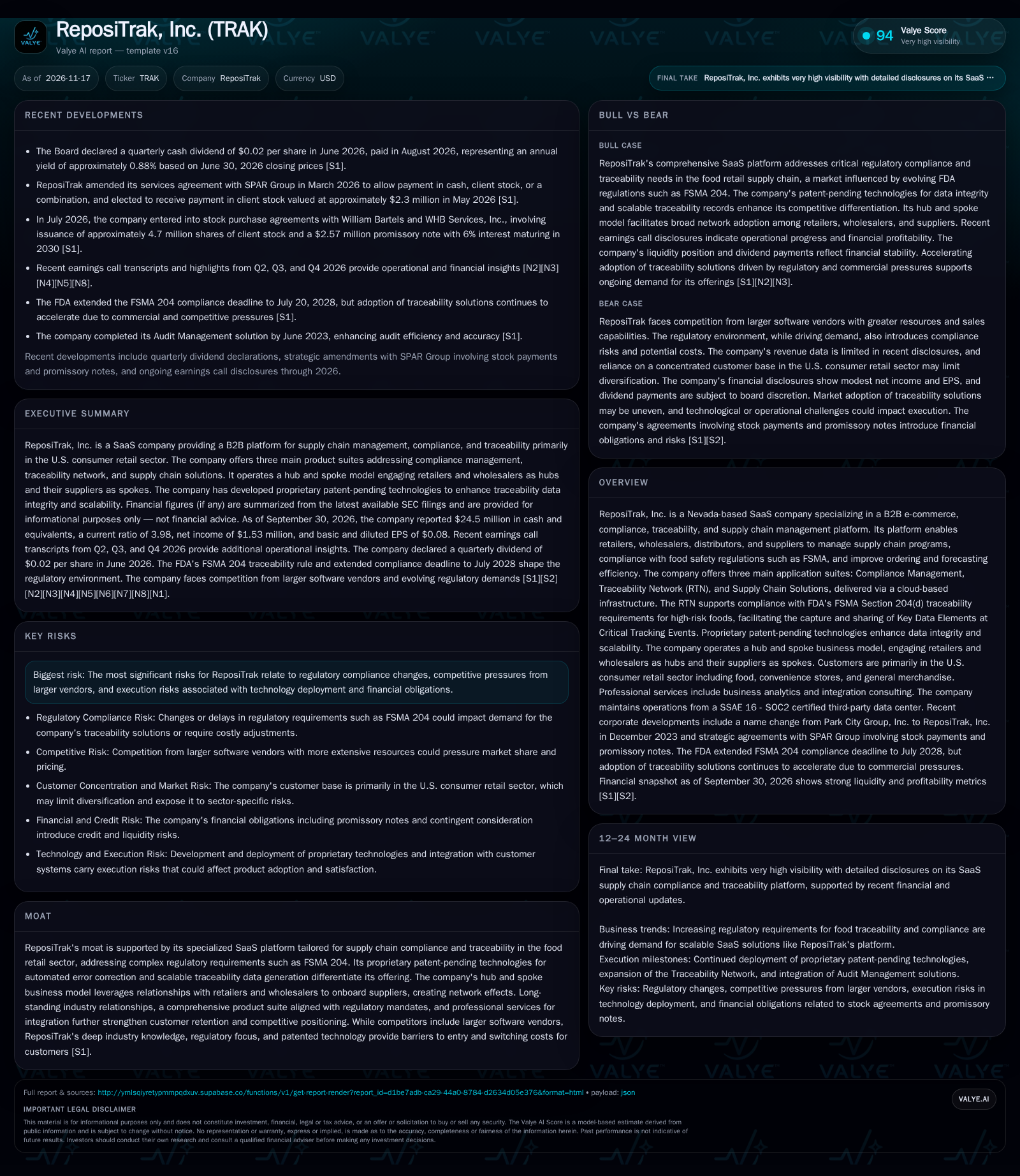
ReposiTrak delivers compliance and supply chain SaaS solutions to the U.S. retail sector, leveraging regulatory change and network effects to drive adoption. Commercial and regulatory forces could accelerate network build-out well before the FDA’s 2028 compliance deadline, making customer onboarding and retention the critical levers for the next phase.[S1] [S2]
ReposiTrak, Inc. is positioned at a strategic crossroads for U.S. food supply chain digitization and regulatory compliance. Its proprietary SaaS platform targets the growing need for traceability and document management in retail and food distribution, underpinned by the FDA’s FSMA 204 rule. While the compliance deadline has been delayed to 2028, both customer urgency and competitive pressures are driving faster adoption. Recent financial results show profitability and ample cash, but the company’s future turns on its ability to scale its network model and fend off competition from larger, more resource-rich software providers. The next 24 months will test whether ReposiTrak can turn regulatory momentum and network design into durable growth and margin expansion.
Regulatory Shifts, Network Expansion, and Financial Markers Define Today’s Landscape
ReposiTrak’s platform directly targets U.S. food retailers and suppliers facing the FDA’s FSMA 204(d) traceability requirements. The FDA extended the compliance deadline to July 2028, giving customers more time to comply, but commercial and competitive dynamics are reportedly pushing adoption ahead of this schedule.[S1]
The company has developed proprietary, patent-pending technologies that automate traceability record generation and error correction, a differentiator in a space where manual compliance processes are costly and error-prone.[S1]
ReposiTrak’s financials as of September 30, 2026 show $24.5 million in cash and equivalents, a current ratio of 3.98, and net income of $1.53 million with EPS of $0.08 for the quarter. The company declared a quarterly dividend, signaling a return of capital, but future payouts are subject to board discretion.[S2]
No single customer accounted for more than 10% of revenue in the latest fiscal year, suggesting some diversification within its U.S. retail and supplier base.[S1]
How Compliance SaaS and Network Effects Could Drive Profits in the Food Supply Chain
ReposiTrak’s revenue model is likely built around recurring SaaS licensing for its compliance, traceability, and supply chain management suites, with professional services (integration, analytics) providing incremental, possibly project-based, revenue streams. Pricing power may hinge on the complexity of compliance requirements and the ability to automate previously manual, labor-intensive processes.
The hub-and-spoke adoption model—onboarding major retailers and wholesalers as hubs, then driving supplier (spoke) adoption due to network participation requirements—could create compounding volume growth if network effects materialize. This structure may also lower customer acquisition costs on the supplier side once a critical mass of hubs is achieved.
Operating leverage is plausible: infrastructure costs for a cloud SaaS platform are largely fixed, while incremental customers and data volume add modest variable cost. However, onboarding, integration, and ongoing support for complex, compliance-driven customers may temper gross margin expansion unless productization and automation are strong.
The company reported cash and liquidity metrics for the period; these figures do not by themselves establish operating runway, investment capacity, financial flexibility, or financing capacity.
Can ReposiTrak Sustain an Edge Against Larger SaaS and Supply Chain Rivals?
ReposiTrak’s main defensive advantages are its regulatory specialization (with a focus on FSMA 204), proprietary error-correction and traceability tech, and a network model designed to could increase switching costs for suppliers once embedded into hub-driven workflows.[S1]
However, the company faces competition from broader enterprise SaaS vendors and specialized supply chain management platforms—many with deeper resources, larger sales teams, and established customer bases. These larger players can leverage integration with broader ERP or retail systems, potentially bundling compliance as part of a larger suite.
Switching friction for customers may increase as more suppliers join the ReposiTrak network and as compliance requirements intensify, but if competitors offer lower-cost or more integrated solutions, pricing pressure or churn could rise. Sustained differentiation will likely require continuous regulatory alignment and technical innovation.
ReposiTrak’s U.S.-centric customer base provides focus and regulatory depth, but limits international growth unless the platform is adapted for other food safety regimes.
If Network Effects Accelerate: How Early Adoption and Regulatory Urgency Could Compound Growth
A favorable scenario would see commercial and competitive pressures—such as retailer mandates or supply chain peer pressure—driving rapid adoption of ReposiTrak’s platform well before the July 2028 FSMA deadline. As more retailers/wholesalers mandate supplier participation, network effects could sharply increase the number of suppliers onboarded, expanding recurring revenue and raising switching costs.
Widespread adoption of proprietary traceability tech could position ReposiTrak as the potentially leading compliance standard for high-risk food traceability, attracting new industry verticals and adjacent markets.
Evidence supporting this scenario would include sharp increases in supplier onboarding rates, expansion of hub relationships, new partnerships in adjacent verticals, and consistently rising deferred revenue or contracted ARR (if disclosed).
Most Likely Trajectory: Steady Expansion as Compliance Deadlines Approach
The most plausible pathway is a measured ramp in adoption as the FSMA 204 deadline nears, with early-moving retailers and suppliers onboarding first, followed by a broader wave as regulatory enforcement looms. Revenue growth would be moderate but durable, with profitability supported by a recurring SaaS model and incremental margin gains from scale.
Competitive pricing pressure from larger software vendors could limit per-customer revenue growth, but the company’s regulatory expertise and customer service may sustain retention in its core segments.
Evidence would include a steady but not explosive increase in customer count (both hubs and spokes), modest but consistent revenue and net income growth, and ongoing product enhancements to meet evolving regulatory requirements.
What If Larger Vendors Undercut or Outpace ReposiTrak’s Compliance Push?
A negative outcome would result if larger, more integrated SaaS or supply chain platforms rapidly adapt to FSMA 204 and begin bundling compliance at attractive price points, eroding ReposiTrak’s differentiation and pressuring margins. Slow network build-out—if hubs are hesitant or suppliers resist onboarding—could leave ReposiTrak with subscale economics and limited operating leverage.
Execution risks around technology integration, customer onboarding, or data accuracy could lead to customer dissatisfaction or regulatory failures, triggering churn or reputational damage.
Financial warning signs would include stagnant or declining supplier onboarding rates, flat or shrinking revenue, margin compression, and rising customer churn (if disclosed), as well as unexpected increases in support or integration costs.
Milestones That Will Reveal Whether ReposiTrak Can Scale Its Compliance Network
Trends in total hubs (retailers/wholesalers) and spokes (suppliers) onboarded quarterly—especially acceleration ahead of the 2028 deadline—would help validate network effects.
Growth in recurring SaaS revenue and deferred revenue (if disclosed) would indicate traction and forward visibility.
Customer churn and retention rates, particularly among large hub customers, would signal the stickiness of the platform and switching friction.
Average onboarding and integration time for new suppliers—a reduction would suggest improved scalability and cost efficiency.
Gross and operating margin trends as the network expands, revealing whether operating leverage is materializing.
Adoption rates of the proprietary traceability features versus generic compliance modules, showing the commercial value of ReposiTrak’s tech differentiation.
Any new partnerships or expansion into adjacent markets or non-U.S. regulatory regimes, which could signal broader platform applicability.
Disclaimer: This is research-only, informational analysis and not investment advice. It may include AI-generated interpretation and general industry context. Always verify important details using primary sources.

Comments