
Interactive Strength Accelerates Product Integration Amid Acquisition Challenges
The May 2026 quarter reveals intensified integration difficulties and liquidity pressures as Interactive Strength expands its connected fitness portfolio through acquisitions.
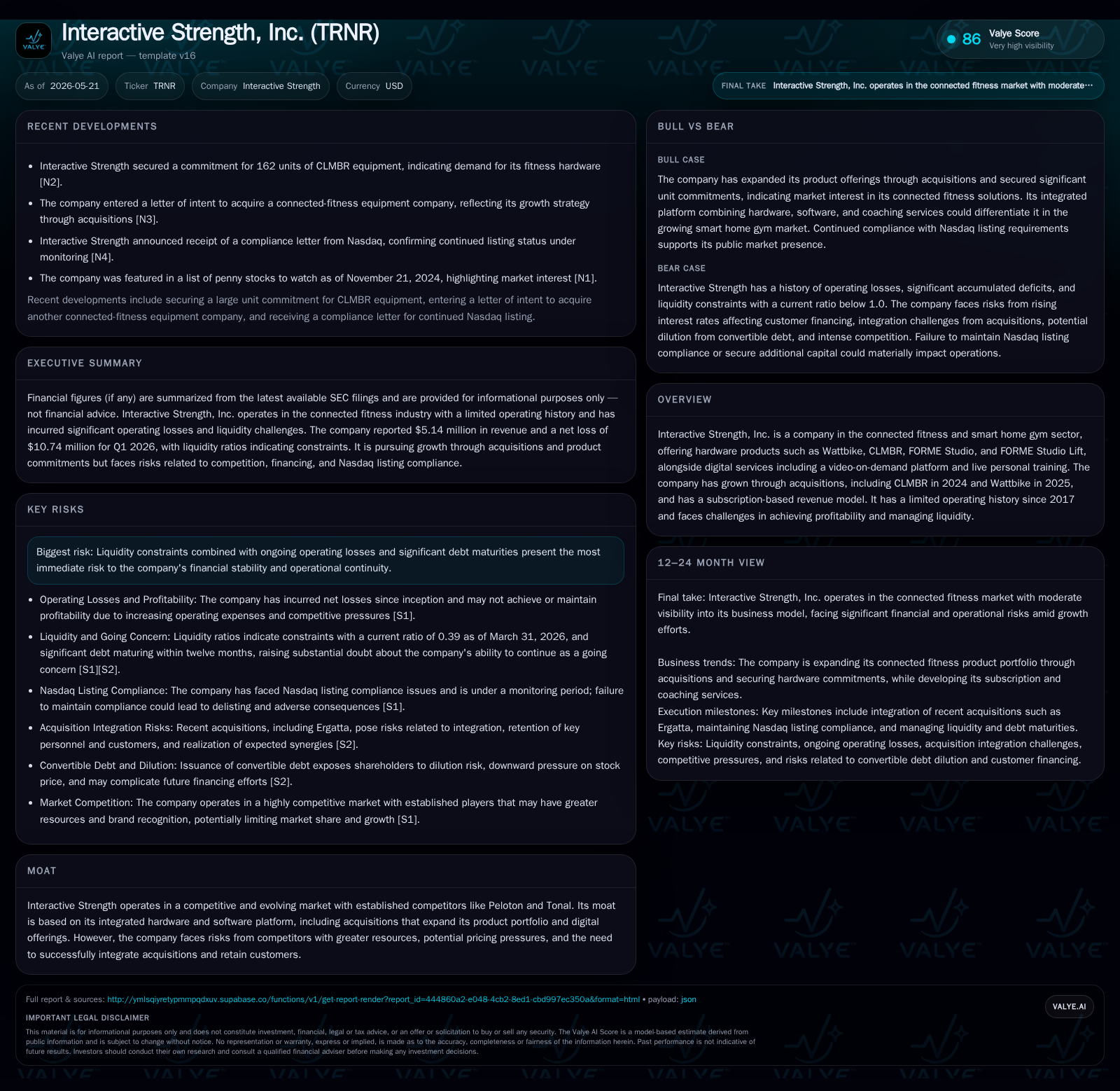
Interactive Strength's latest quarterly filing underscores the operational strain from integrating recent acquisitions like Ergatta amid ongoing liquidity constraints. The company’s business model focuses on a hardware-software fitness ecosystem combining multiple products under subscription revenue streams, though profitability remains elusive. Competitive pressures from established peers and financial leverage limit strategic flexibility. Near-term milestones hinge on successful acquisition integration and improving cash flow dynamics to sustain growth ambitions.
May 2026 Quarter Highlights: Integration Challenges and Liquidity Signals
Interactive Strength’s May 20, 2026 quarterly report sharply highlights the operational complexities emerging from its recent acquisition strategy. Management explicitly flags resource diversion caused by Ergatta’s integration, noting risks around difficulties percolating from technology unification, personnel cohesion, and customer retention issues unique to the acquired businesses [S2]. The company cautions that anticipated synergistic benefits remain uncertain, placing near-term pressure on operational efficiency. Concurrently, liquidity metrics reveal notable stress: the current ratio stands at a constrained 0.39 with current liabilities vastly outstripping current assets as of Q1-end March 31, 2026 [F1]. These figures underscore a critical working capital deficit complicating ongoing investment in sales, marketing, and R&D functions critical for scaling the platform.
Business Model and Product Portfolio: An Integrated Hardware-Software Fitness Offering
Interactive Strength operates in the connected fitness sector through a hybrid hardware-software business model. The company markets an array of smart equipment including Wattbike (acquired 2025), CLMBR (acquired 2024), FORME Studio series products, complemented by a subscription-based digital platform delivering video-on-demand workouts and live coaching sessions [S1]. Revenue stems primarily from upfront equipment sales combined with recurring subscription fees anchored in personalized training content. This multi-product ecosystem aims to lock customers into an integrated hardware-software experience creating switching costs via platform customization and content updates — an essential dynamic given the industry's evolution. Interactive Strength’s product quality is positioned around immersive user engagement leveraging cutting-edge fitness technology, although continuous upgrades are necessary to maintain relevance against fast-moving competitors.
Competitive Dynamics and Industry Positioning in Connected Fitness
TRNR contends in a fiercely competitive market featuring peers like Peloton and Tonal that benefit from broader brand recognition and deeper financial resources. While Interactive Strength’s moat derives from its portfolio diversity post-acquisition — spanning high-end bikes to mounted climbers plus studio solutions — it lacks scale advantages enjoyed by incumbents who dominate distribution channels and possess superior marketing heft [S1]. Pricing power appears limited as the firm grapples with consumer sensitivity in discretionary spending categories exacerbated by elevated competition. Customer retention hinges on delivering seamless software updates with engaging content while hardware reliability must continuously meet high expectations to prevent churn. The integration of acquisitions brings potential for value creation but simultaneously elevates switching risk if platform fragmentation undermines user experience.
Growth Strategy: Acquisition-Fueled Expansion Versus Organic Scaling
Interactive Strength’s growth blueprint heavily emphasizes acquiring complementary fitness brands to accelerate product breadth rapidly. Following the acquisition of CLMBR in early 2024 and Wattbike mid-2025, Ergatta was added recently to expand offerings further into connected rowing machines with live leaderboard features [S2][S8]. Such bolt-on deals aim for cross-selling synergies within a consolidated streaming platform to bolster average subscription revenue per user. However, management concedes challenges ranging from retaining key acquired personnel to harmonizing disparate technology stacks under one unified system. There is no guaranteed accretion from these acquisitions given integration complexity and possible lost customer contracts or brand dilution inherent in consolidation efforts.
Risks and Constraints: Liquidity, Integration, and Competitive Pressures
Urgent risks spotlighted include persistent liquidity shortages evidenced by a sub-1 current ratio of 0.39 as of March 31, 2026, indicating limited buffer against short-term obligations [F1]. Net debt stands at approximately $41.7 million after accounting for cash reserves near $4.7 million—accentuating leverage constraints that hinder funding new initiatives or buffering uneven operating cash flows [F1]. Ongoing operating losses underscore continued investment outlays surpassing revenue growth despite increasing scale. Convertible debt instruments issued add another layer of risk by threatening shareholder dilution upon conversion which can exert downward pressure on market valuation while complicating future financing maneuvers [S11]. Meanwhile, intense competition puts downward pressure on pricing strategies limiting margin expansion possibilities.
Key Milestones to Monitor: Execution Markers and Cash Flow Developments
Looking ahead, pivotal evaluation points include the pace at which Ergatta is fully operationalized within the corporate framework — resolving technological interoperability challenges will be critical for unified customer value propositions [S2][S3]. Metrics such as subscription count growth rates validated through digital engagement KPIs will serve as barometers for consumer adoption success beyond hardware sales cycles. Progress toward positive free cash flow or effective working capital management signals near-term health restoration opportunities amid borrowing constraints are also vital watchpoints. Refinancing activities or amendments linked to convertible debt instruments may influence covenant compliance risk profiles impacting credit access.
Concise Financial Overview: Latest Liquidity and Leverage Snapshot
As per the latest data through March 31, 2026, Interactive Strength holds roughly $4.74 million in cash equivalents facing total debt near $46.4 million reported at September-end prior year — positioning net debt close to $41.7 million [F1]. Current assets total approximately $14 million against current liabilities exceeding $36 million yielding a current ratio well below industry comfort thresholds [F1]. This stressed balance sheet reflects the tension between growth capital needs post-acquisitions juxtaposed against operational cash burn requiring urgent resolution to achieve sustainable margins.
This analysis is based solely on disclosed SEC filings and available company data without extrapolations or investment research views.
Disclaimer: This is research-only, informational analysis and not investment advice. It may include AI-generated interpretation and general industry context. Always verify important details using primary sources.

Comments