
United Fire Group Inc: From Profit Rebound to Growth Challenges in Commercial Lines Insurance
United Fire Group’s 2025 earnings recovery underscores underwriting discipline and agency strength amid tougher competitive and regulatory environment.
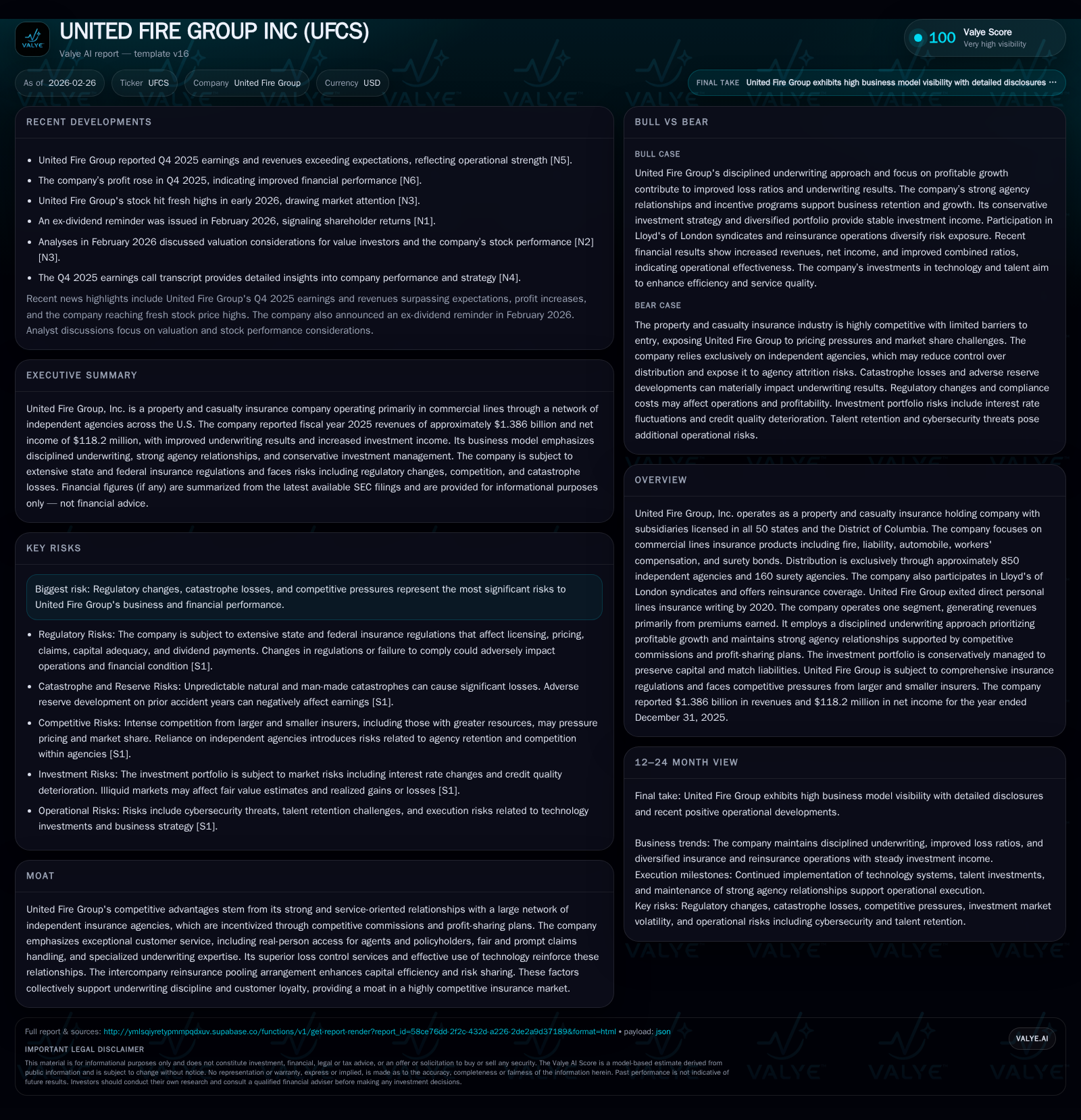
United Fire Group Inc (UFCS) delivered a robust financial rebound in 2025, with a 10.6% revenue increase and a nearly 91% rise in net income driven by disciplined underwriting and effective agency partnerships. While the commercial lines-focused insurer benefits from deep relationships with roughly 850 independent agencies and a conservative capital management framework including intercompany reinsurance pooling, growth prospects face headwinds from pricing competition, regulatory constraints, and catastrophe loss volatility. Capital returns remain steady via dividends with no buybacks post-2021, and ROE sits at around 12.6%. Future performance cues will center on premium trends, combined ratio direction, agency retention success, and reinsurance conditions.
Rising Revenues and Earnings: United Fire’s Strong 2025 Performance
In fiscal year 2025, United Fire Group demonstrated a marked recovery in both top-line growth and net profitability after a challenging prior-year environment. Total revenues increased by approximately 10.6% year-over-year to $1.39 billion [F1], driven primarily by higher net earned premiums reflective of disciplined underwriting efforts and selective rate adjustments. Net income nearly doubled, rising by 90.8% year-over-year to $118.2 million [F1], capturing enhanced underwriting margins alongside elevated net investment income as reported [S9]. This earnings acceleration followed a return to profitability after losses incurred in 2023.
Despite these gains, operating cash flow declined by over one-fifth to $269.7 million [F1], partially reflective of normal timing variances or investment repositioning versus the prior year’s elevated inflows. The company’s adjusted operating income narrative highlights improvements in loss ratios—specifically a reduction of the underlying loss ratio by about 1.6 points to approximately 56.3%, supported by favorable prior-reserve developments—and modest decreases in catastrophe loss impacts [S9]. Underwriting expense ratios also edged down slightly.
Quarterly commentary from late-2025 earnings calls emphasized that enhanced service delivery through the agency network and tightening risk selection were critical contributors to this profitable trajectory [N1][N2][N8]. However, management flagged ongoing challenges in maintaining sustained premium growth without compromising underwriting standards.
Underlying Drivers: Agency Partnerships, Underwriting Focus, and Product Mix
United Fire’s business model centers on commercial lines property and casualty insurance products marketed exclusively through an extensive network of approximately 850 independent property and casualty agencies complemented by about 160 surety-specialized agencies [S1][S4]. This distribution is distinctly selective; the company withdrew from direct personal line writing activities entirely by the end of 2020 to concentrate on its core competence [S20].
The insurer’s underwriting philosophy prioritizes profitable growth over volume or market share expansion — evident through rigorous delegated underwriting programs often executed via managing general agents (MGAs) for niche offerings such as marine specialty and professional liability coverages [S20]. This conveys a focused risk appetite tailored to middle-market businesses including construction, retail trade, services, manufacturing, and financial sectors.
Key differentiators lie in strong agency relationships fostered through competitive commission structures plus tiered profit-sharing incentives that reward top-performing agencies [S15]. These align agents’ interests closely with United Fire’s risk objectives—a classic retention lever for standalone regional carriers competing against larger national players. The company's claims handling emphasizes promptness coupled with real-person access ensuring policyholder confidence — all helping to mitigate churn within this agency-driven ecosystem.
Supporting capital efficiency is an intercompany reinsurance pooling arrangement combining financial resources across subsidiaries allowing flexibility in risk-taking not confined by individual subsidiary surplus constraints [S8][S20]. Additionally, engagement with Lloyd's of London syndicates via ownership of McIntyre Cedar Corporate Member lends capacity for specialty lines access while spreading risk exposures [S20][S21].
Industry Conditions and Competitive Pressures Impacting Growth Prospects
The broader property and casualty insurance industry backdrop is highly competitive with limited entry barriers outside regulatory hurdles [S4][S18]. United Fire contends principally with other insurers marketing through independent agencies plus firms utilizing exclusive agent systems or direct digital channels. Competitors range widely—from large multinational insurers with advanced technology platforms to regional mutual companies offering niche products.
The company openly acknowledges risks related to pricing competitiveness where aggressive discounting could erode margins or force withdrawal from less profitable segments [S4]. There is also heightened vigilance around agency network retention risks; independent agencies typically represent multiple insurers which intensifies intra-agency competition for prime placements.
Regulatory challenges remain persistent including state-specific rate filing requirements that can delay rate adjustments essential for covering inflationary claim cost trends [S10][S11]. Moreover, the unpredictability of catastrophe losses amplified by climate change effects injects volatility into underwriting results despite geographic diversification efforts [S14]. Economic and social inflation influencing claim severity especially within commercial other liability lines adds further reserve strengthening pressures noted as a continuing hurdle [S14].
From a technological angle, rival firms' increasing use of data analytics might challenge United Fire's current underwriting models if it lags peers in adopting predictive tools or operational automation [S4]. Yet the company balances tech investments with maintaining personalized agent support—an analogue distinguishing factor but one that demands calibration going forward.
Capital Deployment and Shareholder Returns: Dividends, Buybacks, and ROE Analysis
United Fire has maintained a consistent dividend payout policy recently declaring a $0.20 quarterly cash dividend per share early in 2026 [S3][N5], signaling ongoing commitment to returning steady income streams to shareholders without disrupting capital adequacy.
Notably absent have been share repurchases since at least fiscal year 2022 reflecting management prudence amid uncertain macroeconomic insurance cycle conditions [F1]. This restraint aligns with an emphasis on preserving solvency margin strength especially given exposure to potentially large catastrophe events.
The company posted equity of approximately $941 million at FY-end 2025 supporting net income of $118 million translating roughly into a return on equity near 12.6%—a credible figure within the regional P&C carrier peer set balancing profitability with conservative capitalization norms [F1]. Operating cash flow remains robust though declined year-over-year reflecting business growth dynamics or investment portfolio repositioning rather than operational distress.
Capital allocation strategy is complemented by reliance on intercompany reinsurance pooling which augments capital efficiency effectively leveraging group-wide surplus rather than siloed balance sheets; this mechanism enables calibrated risk-taking underpinned by shared premium and loss allocations among subsidiaries [S8][S21].
Navigating Risk Exposures: Catastrophes, Regulation, and Technological Advances
Risk factors explicitly acknowledged encompass inherent catastrophe loss volatility exacerbated by natural disasters such as hailstorms and hurricanes frequently occurring during second half calendar months impacting insured portfolios disproportionately [S14][S18]. Dedication toward geographic diversification coupled with selective new business production caps in high-risk regions aims to contain these spikes.
Regulatory exposures extend beyond traditional rate approval complexities into evolving data privacy mandates plus cyber risk concerns requiring continual expenditure on cybersecurity infrastructure though no material breaches have yet been reported [S12]. The firm carries cyber liability insurance coverage mitigating some potential losses should incidents occur.
Reserving uncertainties are also pivotal; the balance sheet includes over $1.9 billion in gross reserves for unpaid claims as of end-2025 where long-tail liability exposure exists especially under construction defect claims noted for their delayed reporting patterns potentially impeding precise loss forecasting [S24][S14]. Actuarial judgment paired with analytics derived from proprietary data supplemented by industry trends continues as cornerstone for pricing adequacy though unexpected developments remain possible.
Technological investments focus predominantly on enhancing agent servicing platforms aiming not at replacing human relationships but bolstering interaction quality; however sustaining this hybrid model will require agility given sector-wide digitization acceleration among competitors [S15][N1].
Forward-Looking Considerations: What Investors Should Monitor Next
Absent explicit numeric guidance beyond Q4 commentary [N1][N2], observers will want to track several indicators anchoring United Fire's future trajectory:
- Premium growth momentum especially within targeted geographic or niche segments,
- Trends in combined ratio components encapsulating loss ratio progress versus expense management,
- Indicators around agency retention rates given heavy dependence on independent distribution channels,
- Evolving conditions in reinsurance markets affecting capacity costs which influences net risk appetite,
- Expansion or contraction within Lloyd's syndicate participations that may unlock incremental specialty line opportunities.
Innovation via MGA partnerships or new delegated product launches could offer incremental growth levers if managed without diluting underwriting discipline standards ensuring consistent profitability over cycles.
Summary Table: Historical Financial Performance Trends (2022–2025)
Historical performance (annual)
| FY | Rev ($mm) | Net ($mm) | CFO ($mm) | Rev YoY | Net YoY |
|---|---|---|---|---|---|
| 2025 | 1386 | 118 | 270 | +10.6% | +90.8% |
| 2024 | 1253 | 62 | 340 | +14.4% | +308.6% |
| 2023 | 1095 | -30 | 172 | +11.7% | -297.6% |
| 2022 | 980 | 15 | -1 |
Source: SEC companyfacts cache [F1].
Capital returns and efficiency (annual)
| FY | Div ($mm) | Buybacks | ROE% |
|---|---|---|---|
| 2025 | 16 | 12.6 | |
| 2024 | 16 | 7.9 | |
| 2023 | 16 | 0 | -4.0 |
| 2022 | 16 | 0 | 2.0 |
Source: SEC companyfacts cache [F1].
Revenue figures are presented in millions USD; dividends reflect total annual payments; all YoY changes computed sequentially where applicable.
This analysis is based solely on disclosed company filings, recent earnings commentary, official SEC reports, and reputable market news sources up to February 26, 2026. It refrains from offering investment advice or predictive forecasts beyond reported data and company disclosures.
Disclaimer: This is research-only, informational analysis and not investment advice. It may include AI-generated interpretation and general industry context. Always verify important details using primary sources.

Comments