
Universal Health Services Q4 Performance Highlights Reimbursement Shifts and Capital Priorities
UHS demonstrates significant earnings growth while navigating Medicaid reimbursement reforms and prioritizing capital deployment.
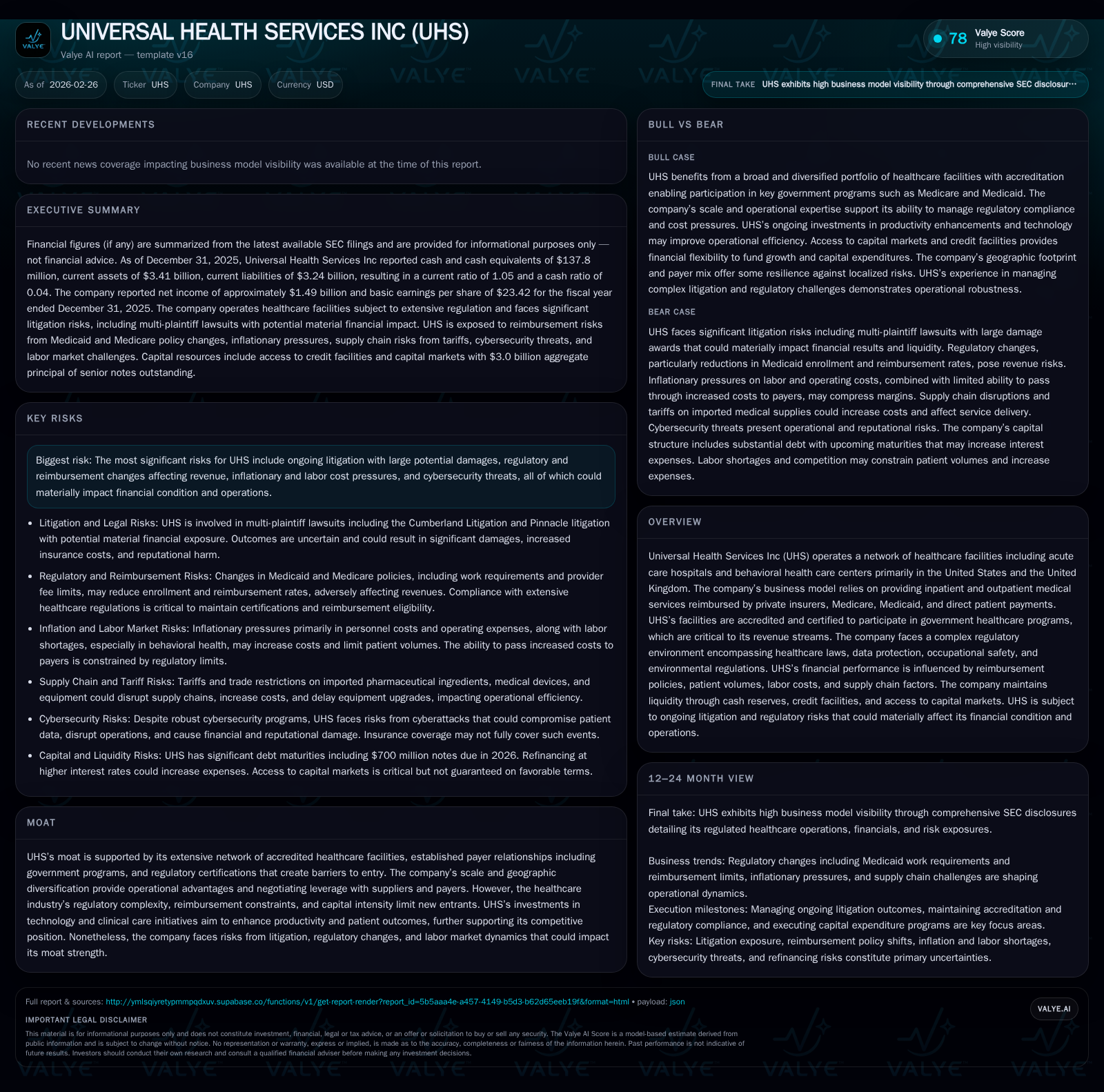
Universal Health Services Inc (UHS) reported robust financial results with net income growing 30.4% year-over-year supported by revenue gains and operational scale. Nonetheless, new Medicaid legislation enacted in mid-2025 is projected to reduce Medicaid revenues by up to $480 million annually by 2032, pressuring future earnings. Cost inflation and labor market tightness add additional margin headwinds, but UHS maintains a strong balance sheet with prudent capital allocation focused on strategic share repurchases, dividends, and sustained capex to enhance its facility network. Forward monitoring of regulatory developments and litigation risks remains critical.
Historical Financial Growth and Key Drivers
Universal Health Services Inc has demonstrated solid financial momentum through recent years culminating in FY2025's strong performance [F1]. Revenue increased by 6.7% year-over-year to reach $12.64 billion, fueled principally by operational scale gains across its acute care hospitals and behavioral health centers both domestically and internationally. Operating income grew even more substantially at an 18.6% clip to nearly $2 billion, showcasing improved operating leverage amid rising patient volumes and reimbursement rates.
Net income accelerated sharply by 30.4% to approximately $1.49 billion in FY2025 compared with the prior fiscal year [F1]. This double-digit earnings growth outpaced top-line expansion due partly to disciplined cost management despite offsetting inflationary pressures that emerged later in the reporting period.
Operating cash flow declined by about 9.8%, falling to roughly $1.86 billion [F1]. This reflects working capital timing effects alongside elevated capital expenditures which increased 7.6% year-over-year to approximately $1.02 billion invested into facility upgrades and capacity expansion [F1]. These investments support accreditation compliance essential for government program participation.
Historical performance (annual)
| FY | Net ($mm) | CFO ($bn) | OpInc ($mm) | Capex ($mm) | Net YoY |
|---|---|---|---|---|---|
| 2025 | 1489 | 1.9 | 1994 | 1015 | +30.4% |
| 2024 | 1142 | 2.1 | 1682 | 944 | +59.1% |
| 2023 | 718 | 1.3 | 1175 | 743 | +6.2% |
| 2022 | 676 | 1.0 | 1004 | 734 |
Source: SEC companyfacts cache [F1].
Capital returns and efficiency (annual)
| FY | Buybacks ($mm) | FCF ($mm) | ROE% |
|---|---|---|---|
| 2025 | 968 | 849 | 20.5 |
| 2024 | 671 | 1123 | 17.1 |
| 2023 | 547 | 525 | 11.7 |
| 2022 | 833 | 262 | 11.4 |
Source: SEC companyfacts cache [F1].
Equity capital reached approximately $7.28 billion at end-2025 supporting a return on equity of roughly 20.5%, indicating efficient use of shareholders’ funds within a highly regulated environment [F1].
Impact of Recent Regulatory Changes on Revenue Streams
The "One Big Beautiful Bill Act" enacted July 4, 2025 introduces work/community service requirements for Medicaid eligibility alongside limits on provider fees used for federal matching funds [S1][S2][S17]. Provider fee caps will freeze at 6% for states without prior Medicaid expansion while declining annually from FY2028 to a floor near 3.5% by FY2032 for states with expansion.
UHS estimates these changes will reduce annual net Medicaid revenues by approximately $432 million to $480 million by fiscal year 2032 [S1][S2][S17]. Given Medicaid revenue contributions exceeding $100 million annually from multiple key states such as Texas and California, these constraints represent substantial headwinds.
The legislation also terminates enhanced ACA premium tax credits post-2025 potentially lowering insurance exchange enrollment [S1][S2]. While a House-passed bill proposes a three-year extension under Senate review as of early-2026, uncertainty persists affecting patient coverage dynamics.
These factors collectively require UHS to adjust risk management strategies across diverse state programs.
Operational Challenges: Inflation, Labor Costs, and Supply Chain Implications
UHS faces margin pressure from wage inflation impacting clinical staff costs—its largest expense category across U.S. and UK operations—as well as rising supply chain costs amid ongoing global disruptions [S13][N3]. Cybersecurity investment needs driven by stringent data protection regulations further elevate operating expenses [S17].
Heightened litigation exposure from malpractice claims adds insurance cost burdens influencing overall profitability [S19]. Effective management of these factors is critical amid persistent inflationary environments.
Balance Sheet Strength and Capital Structure Overview
UHS maintains financial resilience supported by credit facilities amended in September 2024 extending maturities through 2029 including a revolving credit facility up to $1.3 billion and a Tranche A term loan up to $1.2 billion [S4][S5][S6].
As of December 31, 2025:
- The Tranche A term loan had about $1.16 billion outstanding with scheduled quarterly repayments through mid-2029 maturing September 26, 2029 [S5].
- Revolving credit availability stood near $965 million after letters of credit adjustments [S10].
- Total debt approximated $4.8 billion versus cash & equivalents near $138 million indicating sound liquidity given operating cash flows [F1][S18][S21].
Upcoming maturities such as the September-2026 senior notes are expected to be refinanced at higher interest rates reflective of current market conditions [S10], but all covenants remain met ensuring continued access to capital markets [S21].
Capital Allocation Strategy: Dividends, Share Repurchases, and Capex
In FY2025, free cash flow approximated $849 million after subtracting capital expenditures from operating cash flow supporting both shareholder returns and growth investments [F1].
Dividend payments remained steady at around $0.20 per share quarterly indicating consistent income distribution discipline [S11]. Share repurchases totaled about $968 million during the year under an authorized program expanded by the Board in October 2025 [F1][S11], signaling confidence in valuation while reducing share count.
Capital expenditures surpassed one billion dollars focusing on hospital infrastructure improvements, technology upgrades including electronic health records systems, and selective expansions preserving accreditation standards pivotal for reimbursement eligibility [F1][N5][S28].
This balanced approach underscores UHS’s intent to maintain competitive positioning while rewarding shareholders responsibly.
Forward-Looking Insights: Market Position and Areas to Monitor
Although explicit guidance is limited in filings or news post-FY2025 release date (February ’26), key issues warrant monitoring:
- Timing and magnitude of Medicaid provider fee reductions starting FY2028 will influence margin pressure extent [S17].
- Federal decisions on ACA subsidy extensions may impact insured patient volumes especially within behavioral health segments reliant on exchange populations [N1][N2][S17].
- Litigation outcomes including those related to Cumberland Hospital could impose material financial implications if unfavorable settlements or judgments occur [S19][N3].
- Labor market dynamics necessitate ongoing productivity improvements possibly aided by technology investments targeting clinical workflow efficiencies [N3][F1].
- Regulatory shifts such as diminished agency deference may increase Medicare/Medicaid policy interpretation risks requiring agile compliance capabilities inherent in large integrated providers like UHS [S13][S24][S17].
UHS’s extensive network scale combined with payer diversification—including sizable Medicaid portfolios—and rigorous accreditation positioning provide durable competitive advantages despite external uncertainties.
Disclaimer: This report is based solely on publicly available SEC filings and news sources without offering investment advice or recommendations concerning Universal Health Services Inc securities or operations.
Disclaimer: This is research-only, informational analysis and not investment advice. It may include AI-generated interpretation and general industry context. Always verify important details using primary sources.

Comments