
Universal Health Realty Income Trust’s Flat Revenue and Declining Profitability Amid Tenant Concentration and Regulatory Pressures
Specialized healthcare REIT with steady revenues but facing risks from tenant dependence and evolving Medicaid policies.
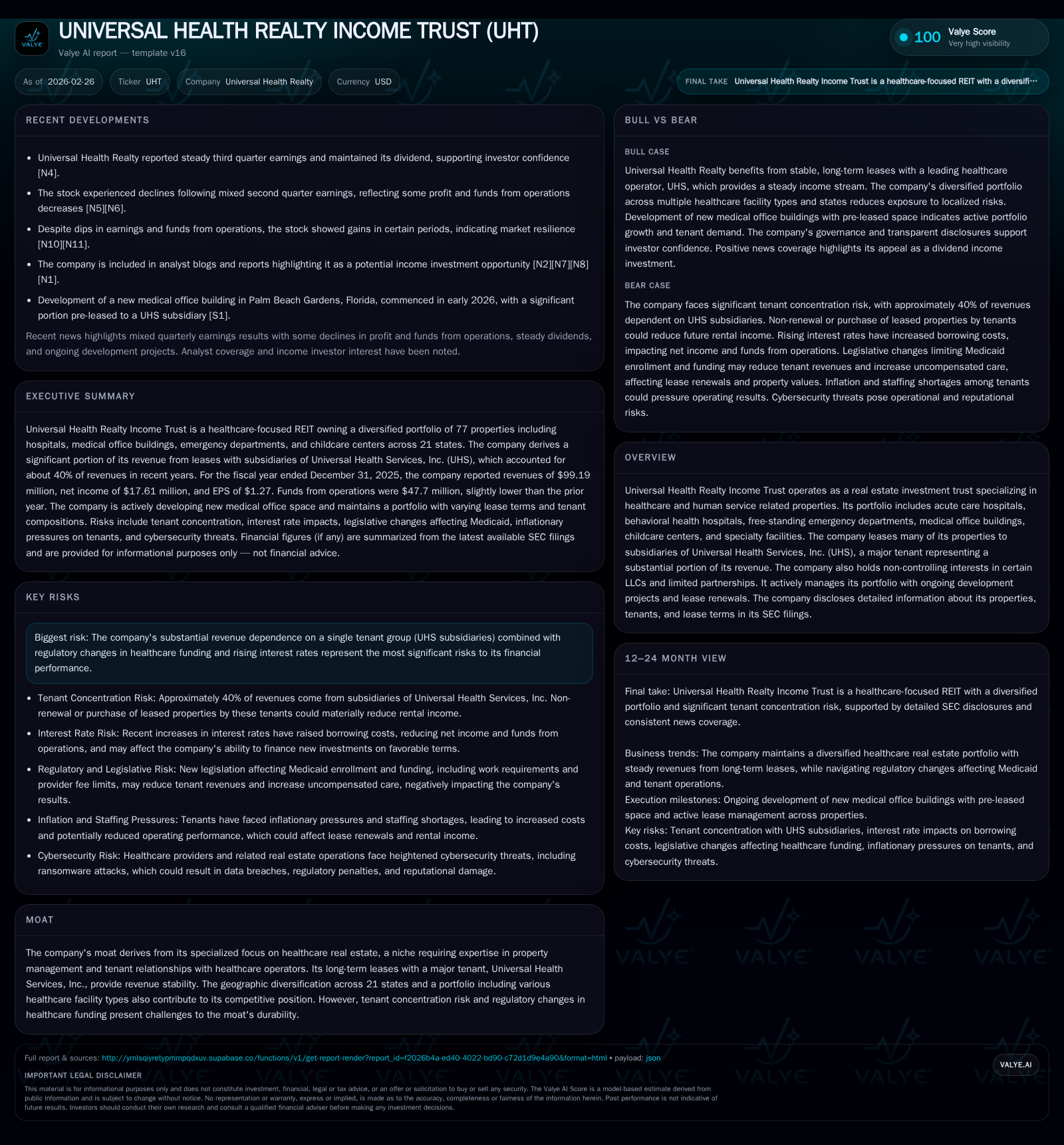
Universal Health Realty Income Trust (UHT) operates a niche portfolio of healthcare-related real estate leased predominantly to Universal Health Services subsidiaries, which account for roughly 40% of revenues. From 2022 through 2025, the trust saw modest revenue growth decelerate to near stagnation with operating income and net income declining in 2025. Legislative shifts on Medicaid funding and recent interest rate increases weigh on future profitability and leasing dynamics. While cash flow remains robust relative to capex, concentrated tenant risk and sector regulatory uncertainty could constrain growth and asset values.
Company Overview
Universal Health Realty Income Trust (UHT) is a specialized real estate investment trust focusing exclusively on healthcare-related properties including acute care hospitals, behavioral health hospitals, free-standing emergency departments (FEDs), medical office buildings (MOBs), childcare centers, specialty facilities, and vacant land holdings across the United States. Founded in 1986, UHT operates primarily through long-term triple-net leases where tenants handle most property-level expenses.
Substantial revenues derive from leasing properties to subsidiaries of Universal Health Services, Inc. (UHS), its principal tenant group representing about 40% of consolidated revenues consistently over recent years [S1][S11]. This concentrated relationship affords some stability but embodies clear renewal and tenant concentration risks.
As of February 2026, the company manages seventy-seven distinct properties in twenty-one states, highlighting geographic diversity but a focused healthcare real estate niche that demands specialized asset management capabilities [S10]. The portfolio mix includes six hospital facilities (three acute care and three behavioral health), four FEDs, sixty-one MOBs—including those held via unconsolidated LLCs/LPs—alongside four childcare centers and one vacant specialty facility [S10].
Historical Performance
Financially, UHT has exhibited modest expansion with measured improvements in top-line revenue but pressure on profitability metrics more recently:
Historical performance (annual)
| FY | Rev ($mm) | Net ($mm) | CFO ($mm) | OpInc ($mm) | Rev YoY | Net YoY |
|---|---|---|---|---|---|---|
| 2025 | 99 | 18 | 49 | 35 | +0.2% | -8.4% |
| 2024 | 99 | 19 | 47 | 37 | +3.6% | +24.9% |
| 2023 | 96 | 15 | 43 | 31 | +5.5% | -27.0% |
| 2022 | 91 | 21 | 47 | 31 |
Source: SEC companyfacts cache [F1].
Capital returns and efficiency (annual)
| FY | Div ($mm) | FCF ($mm) | ROE% |
|---|---|---|---|
| 2025 | 41 | 41 | 11.6 |
| 2024 | 40 | 39 | 10.7 |
| 2023 | 40 | 35 | 7.7 |
| 2022 | 39 | 33 | 9.2 |
Source: SEC companyfacts cache [F1].
Revenues have ticked gradually upwards driven by lease escalations and incremental property additions but growth stalled sharply in the latest period with only a marginal increase of $0.18 million or +0.2% year-over-year in FY2025 [F1]. Operating income contracted by a notable margin (-5.5%) due largely to increased interest expense following several years of rising benchmark rates that inflated borrowing costs for an already leveraged capital structure [S1][S11]. Net income declined by over eight percent reflecting these pressures alongside some property-level depreciation adjustments recorded during the year that partially offset segment revenue gains [S14][F1].
Cash flow from operations steadily improved despite volatility in earnings reflecting strong underlying rent collections weighted by long-term lease agreements featuring rent escalators tied often to CPI indices or fixed annual steps common to healthcare REITs [F1]. Capital expenditure levels have stabilized around $7-8 million annually as development projects have replaced prior higher investment cycles; notably unchanged between FY2023 and FY2025 indicating continued but disciplined allocation towards new property creation or refurbishment rather than acquisitive surges [F1][S12]. Dividend payments remain consistent near $40 million per annum signaling ongoing commitment to yield maintenance aligned with the trust’s distribution policies despite fragile profit trends.
Growth Prospects
Future growth outlook hinges heavily on lease renewals and expansions within the existing portfolio as well as the ability to capitalize on development opportunities within the healthcare infrastructure space:
Tenant Retention and Lease Renewals: With UHS subsidiaries accounting for approximately two-fifths of revenue consistently (40%,40%,41% for fiscal years ending December ’25 through ’23), successful negotiation of lease renewals beyond current terms is critical [S1][S11]. Failure by UHS affiliates to renew would sharply reduce rental income unless substitution arrangements yield equivalent returns.
New Developments: Recent ground lease agreements such as the Palm Beach Gardens Medical Plaza I MOB development (~$34 million cost) front an avenue for expanding rentable assets backed by pre-leased commitments covering approximately three-quarters of space from UHS-affiliated tenants under flexible master leases—fueling potential modest organic growth upon completion slated for late fourth quarter of ‘26 [S12].
Regulatory Environment: Newly enacted federal legislation introducing work/community service requirements for Medicaid eligibility under the “One Big Beautiful Bill Act,” coupled with reductions in provider fee thresholds that fund supplemental state Medicaid payments, threaten lower reimbursements for healthcare providers operating these properties hence pressuring tenants’ revenue bases directly impacting UHT’s lease affordability risk profile; additionally premium tax credit eliminations beyond ’25 add unpredictability regarding insurance enrollments which may reduce patient volumes nationwide affecting operators like UHS making rent obligations more fragile [S1][S2][S22][S28].
Forecasts & Milestones
Although UHT has not provided explicit quantitative future financial guidance in its latest filings or press releases as of February ‘26 closing period ([N1],[S3]), key performance indicators to monitor include:
- Renewal status of material leases with UHS subsidiaries particularly those hospital facilities expiring within the next few years.
- Completion timing and occupancy ramp-up at Palm Beach Gardens Medical Plaza I project.
- Legislative outcomes concerning brokered EPTC subsidies extension which remains under Congressional debate impacting midyear earnings outlook.
- Interest rate trajectory influencing cost of debt servicing along with potential refinancing opportunities or constraints.
Analysts should also keep an eye on disclosed impairment tests results given recent recognition events signaling tighter margins on select assets [S14][F1].
Returns & Capital Allocation
From a returns standpoint, approximate return on equity (ROE) based on latest full-year data stands near an estimated ~11.6%, calculated as net income relative to ending equity balances reported at year-end ’25 ($152m equity; $17.6m net profit) [F1], reflecting moderate profitability tempered by persistent macroeconomic challenges.
Operating cash flow remained healthy at approximately $49 million supporting dividend distributions exceeding $41 million annually—a robust payout ratio characteristic among specialized REITs prioritizing stable yield streams albeit posing sustainability questions if cash flows decline unexpectedly due to tenant risks or regulatory pressures.
Capital expenditures remain disciplined around ~$7-8 million per year allocated mainly toward leasehold improvements linked with development pipeline activity rather than broad acquisition blitzes noted elsewhere in healthcare REIT subsectors emphasizing medical office campus expansions or ambulatory surgery centers.
Notably absent are meaningful share repurchases during recent years pointing to a capital allocation preference prioritizing dividends and development investments over buybacks given market uncertainties around interest rate volatility and tenant credit profiles [F1].
Sector Context Analysis
Healthcare real estate represents a distinctive REIT niche requiring deep operator relationships as leases often involve complex long-duration contracts assessing healthcare policy dynamics including Medicare/Medicaid reimbursement regimes vital to tenants’ financial solvency.
Tenant UHS’s business fundamentals are thus directly interlinked with regulatory shifts such as Medicaid enrollment caps or payment cuts that ripple upstream affecting rental crispness within landlord portfolios like UHT’s.
Interest rate sensitivity is heightened given extensive leverage used for property acquisitions/developments amid capital-intensive nature of high-spec hospital infrastructures necessitating careful treasury management strategy employing hedges or swap/cap instruments detailed in disclosures ([S1]).
Conclusion Summary
Universal Health Realty Income Trust occupies a defensible yet precarious position anchored by specialized healthcare real estate leased majorly to a dominant operator intertwined with evolving political-healthcare funding landscapes that introduce both recurring revenue resilience and concentrated existential risks. The stagnating revenue growth paired with decreasing profitability metrics reflects mounting headwinds from financing costs and partial impairments during ‘25 alongside legislative reforms potentially suppressing tenant revenue growth intrinsic to maintaining robust rent rolls long term. Nonetheless stable operational cash flows buttress dividend commitments while ongoing developmental efforts underpin modest expansion prospects contingent upon favorable lease renewals amid uncertain Medicaid program reforms. Investors should track legislative outcomes firsthand affecting Medicaid fees and insurance subsidies closely given their outsized impact on tenant health status which cascades into asset performance at this specialized trust.
Disclaimer: This is research-only, informational analysis and not investment advice. It may include AI-generated interpretation and general industry context. Always verify important details using primary sources.

Comments