
Unisys Corp Confronts Revenue Decline and Rising Losses Amid Strategic Transformation and Debt Constraints
Unisys continues to navigate declining revenue and negative net income while pursuing growth in AI-driven IT solutions amid operational challenges and financial leverage.
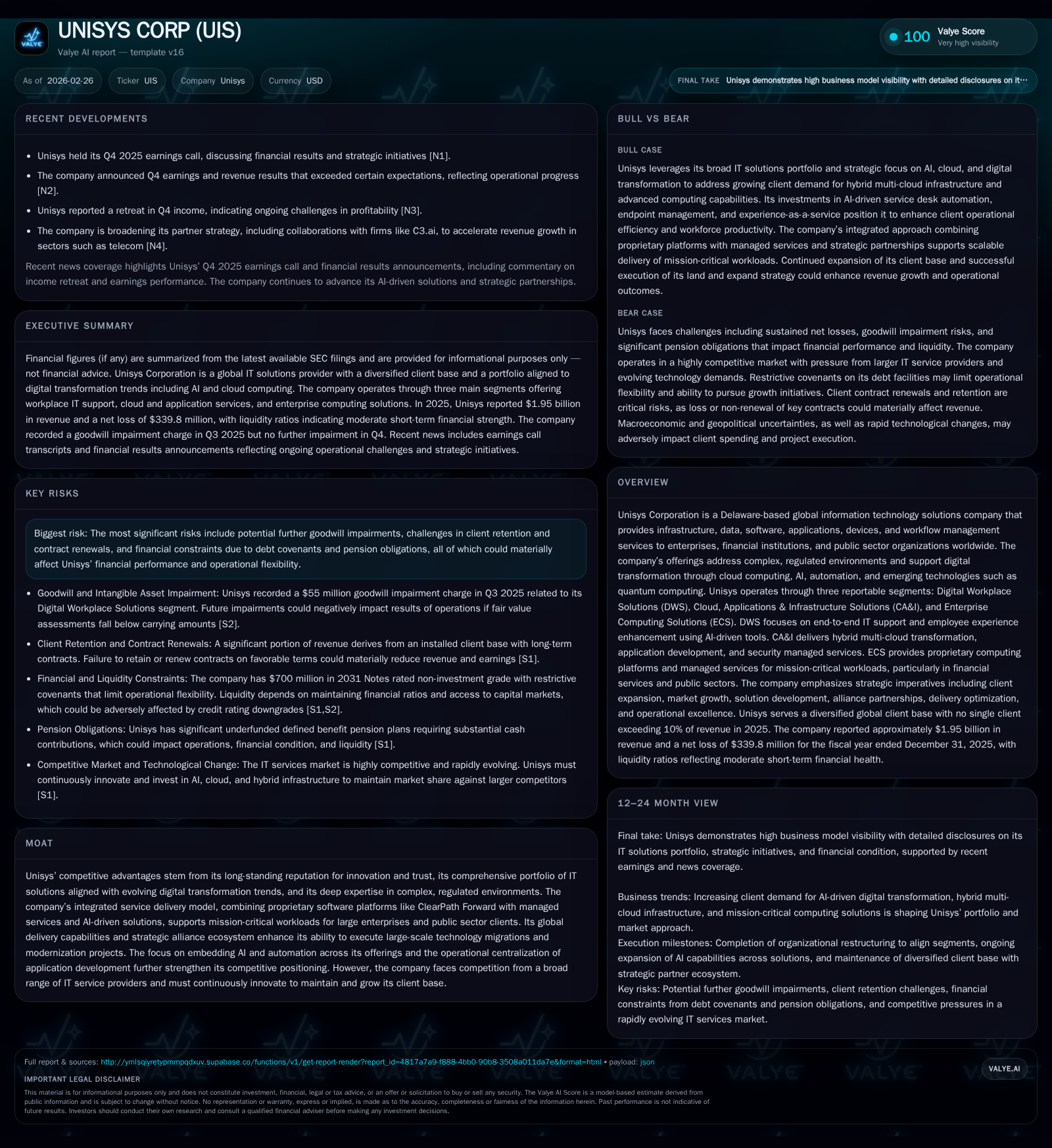
Unisys Corporation (UIS) reported a slight decline in revenue to $1.95 billion in 2025 with operating income falling nearly 20%, while net losses deepened notably to $340 million. The company faces pressures from legacy contracts, goodwill impairments, and restrictive debt covenants that limit financial flexibility. Growth prospects hinge on expanding AI-enabled cloud and hybrid multi-cloud services, leveraging proprietary computing platforms, and scaling industry-specific digital transformation offerings. Despite investments in emerging technologies and operational centralization, Unisys generated negative free cash flow in 2025, pointing to ongoing execution risks as it balances innovation with financial discipline.
Historical Performance
Unisys’ revenue showed a modest decline over the past few years from approximately $2.02 billion in 2023 to $1.95 billion in 2025, a drop of roughly 2.9% year-over-year [F1]. Operating income was volatile but declined by 19.4% in 2025 compared to the prior year. Net losses expanded significantly driven primarily by non-cash goodwill impairment charges impacting profitability negatively [F1][S2].
Historical performance (annual)
| FY | Rev ($bn) | Net ($mm) | CFO ($mm) | OpInc ($mm) | Rev YoY | Net YoY |
|---|---|---|---|---|---|---|
| 2025 | 2.0 | -340 | -140 | 79 | -2.9% | -75.7% |
| 2024 | 2.0 | -193 | 135 | 97 | -0.3% | +55.1% |
| 2023 | 2.0 | -431 | 74 | 77 | +1.8% | -306.3% |
| 2022 | 2.0 | -106 | 13 | 52 |
Source: SEC companyfacts cache [F1].
Capital returns and efficiency (annual)
| FY | FCF ($mm) | ROE% |
|---|---|---|
| 2025 | -170 | 120.2 |
| 2024 | 119 | 68.2 |
| 2023 | 53 | 283.7 |
| 2022 | -18 | 721.1 |
Source: SEC companyfacts cache [F1].
Operating cash flows swung from positive in prior years to negative territory in fiscal 2025 alongside rising capital expenditures reflecting investments aimed at modernization efforts [F1].
Business Overview
Unisys Corporation operates primarily through three segments: Digital Workplace Solutions (DWS), Cloud Applications & Infrastructure Solutions (CA&I), and Enterprise Computing Solutions (ECS). The company has a legacy dating back to its formation in 1986 and origins extending further [S4][S8]. It focuses on providing complex IT solutions for mission-critical workloads especially across regulated industries including financial services, public sector, healthcare, and travel.
The firm’s proprietary ClearPath Forward software platform underpins critical workloads with consulting services emphasizing secure environments compliant with stringent regulations [S26][S27]. AI-driven automation is increasingly embedded across the portfolio to enable client digital transformations amidst growing technological complexity.
Global delivery capabilities support rapid technology migrations including hybrid multi-cloud strategies paired with security managed services tailored for compliance-sensitive clients [S4][S6]. Strategic alliances complement internal capabilities to broaden solution reach.
Drivers of Past Growth
Growth historically relied heavily on an installed client base under long-term contracts which provided recurring revenue but also exposed the company to risks related to contract renewals and client attrition [S20].
Expansion of AI-infused workplace tools in DWS improved employee experience; CA&I grew through cloud-native application development combined with security operations; ECS remained focused on high-intensity transaction processing engines supporting regulated workloads [S4][S6].
Investments also targeted emerging technologies such as quantum computing infrastructure management, aiming to broaden addressable markets [S4]. However, transitioning legacy licenses like ClearPath Forward into SaaS models introduced short- to medium-term cash timing challenges [S20].
Challenges and Risks in Historical Execution
A significant goodwill impairment charge of $55 million was recorded during Q3 FY2025 related to the Digital Workplace Solutions segment reflecting asset value reassessments due to market conditions [S2]. The risk of additional impairments remains.
Competitive pressures arise from large global systems integrators and cloud-native pure plays targeting hybrid multi-cloud spaces as well as traditional outsourcing firms leading to pricing pressure [S21].
Regulatory compliance costs are rising due to evolving global AI regulations such as the EU’s AI Act proposals along with cybersecurity threats targeting critical IT infrastructure despite extensive controls [S13][S17][S23]. These factors have increased operating expenses weighing on margins.
Financial Position and Capital Allocation
As of year-end 2025, Unisys had total indebtedness of approximately $742 million mainly composed of senior secured notes due 2031 carrying a high coupon rate (~10.625%) [F1][S10][S18]. Restrictive covenants limit dividends, share repurchases, and additional indebtedness constraining capital return or refinancing options [S15][S18].
The company generated negative operating cash flow of approximately -$140 million leading to free cash flow deficits after capital expenditures of about -$170 million for fiscal year 2025 [F1]. Negative equity stood near -$283 million reflecting accumulated losses exceeding invested capital.
No recent share buybacks were executed; dividend payments remain restricted by credit agreements underscoring priority on deleveraging over shareholder distributions [F1][S10][S12].
Future Growth Prospects
Unisys aims to grow through a "land and expand" sales strategy—securing initial client engagements often via advisory or short-term projects followed by expanding relationships across solutions and geographies [S7][S9].
The Digital Workplace Solutions segment integrates AI-driven tools enhancing employee experience synergizing with automation-led managed services aligned with rising cloud adoption trends influenced by generative AI developments [N1][N2][S4].
Cloud Applications & Infrastructure targets hybrid multi-cloud architectures incorporating security-managed platforms delivered via proprietary automation frameworks supporting regulated environments [S26][S27][N1].
Enterprise Computing Solutions continue modernization efforts around ClearPath Forward products targeting financial services and travel sectors while exploring next-generation computing including quantum infrastructure management—a nascent but potentially transformative area [S4][N1].
Growth investments are selective balancing organic development with alliance partnerships enabling rapid scaling of standardized architectures adaptable across verticals aimed at operational efficiency gains through workforce centralization and process automation [S6].
Constraints on Growth Prospects
Maintaining long-standing installed base contracts remains uncertain; client consolidation or dissatisfaction could depress revenues causing margin erosion [S20]. Pricing pressure from competitors with deeper pockets or specialized cloud-native expertise poses ongoing challenges.
Transitioning ClearPath Forward towards SaaS delivery involves upfront spending that delays positive cash flows creating tension between growth investment needs versus servicing debt obligations [S20].
Regulatory uncertainties around emerging global AI governance add compliance overhead costs while cybersecurity risks remain elevated potentially disrupting operations or incurring remediation expenses [S13][S17][S23].
Financial leverage limits capacity for absorbing shocks without impacting operational investments or credit ratings where further downgrades would increase borrowing costs adversely affecting liquidity and growth options [F1][S10][N7].
Disclaimer: This is research-only, informational analysis and not investment advice. It may include AI-generated interpretation and general industry context. Always verify important details using primary sources.

Comments