
Marriott Vacations Worldwide Navigates Profitability Challenges Amid Steady Revenue Growth
Marriott Vacations reported modest revenue growth in fiscal 2025 but faced significant net losses and cash flow pressures amid elevated leverage and credit challenges.
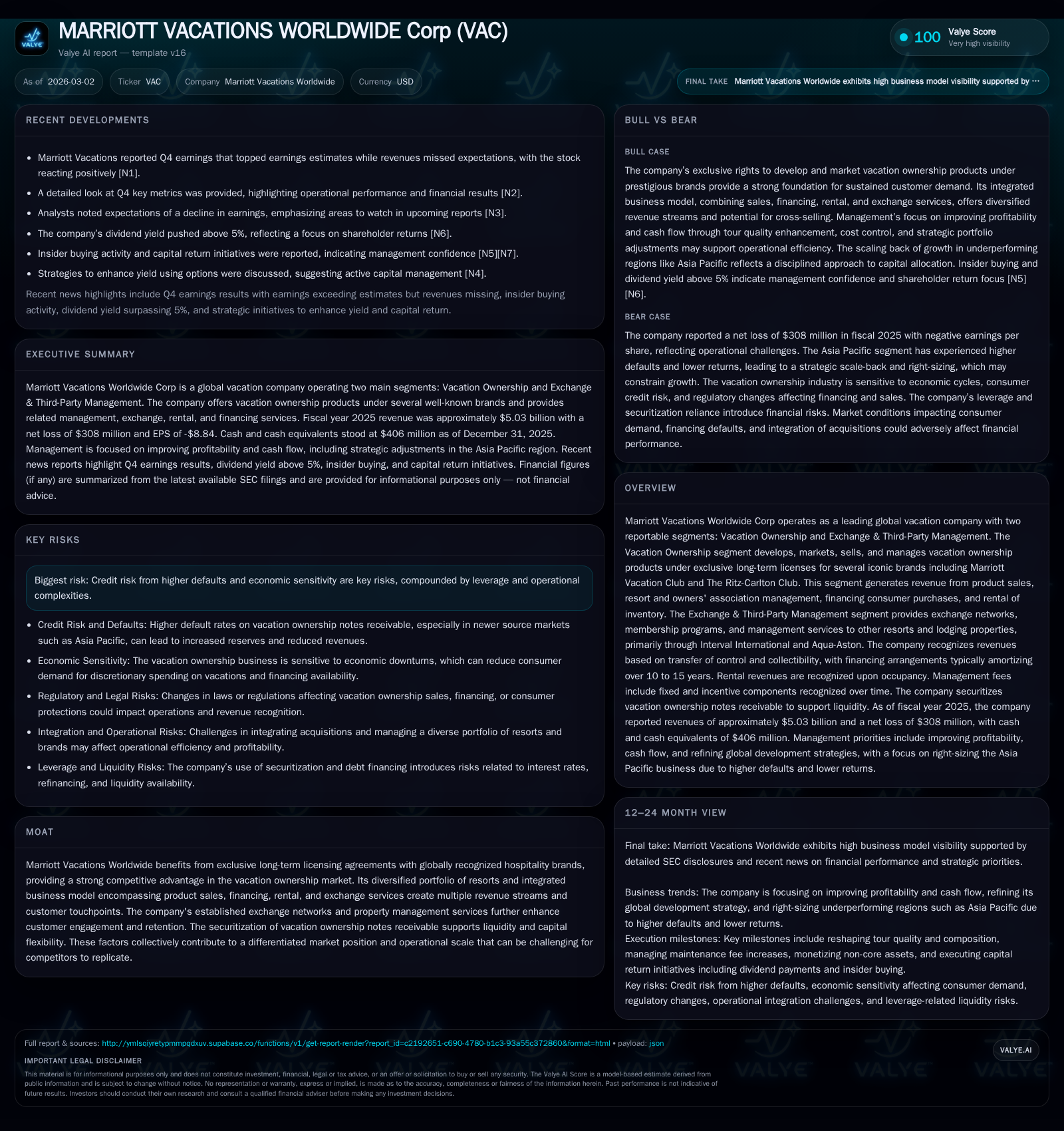
In fiscal 2025, Marriott Vacations Worldwide generated $5.03 billion in revenue, a 1.3% increase year-over-year, supported by its licensed vacation ownership brands and exchange services. However, the company posted a net loss of $308 million compared to net income of $218 million in 2024, driven by higher credit losses and margin pressures. Operating cash flow declined sharply by over 86%, reflecting timing effects and credit quality issues within its securitized vacation ownership notes receivable portfolio. The company’s leverage remained elevated at approximately 4.2x net debt to adjusted EBITDA despite refinancing efforts extending debt maturities. Capital returns continued with approximately $110 million in dividends and $61 million in share repurchases during the year, with $322 million authorization remaining under the current buyback program.
Revenue Growth during Modest Expansion
Marriott Vacations Worldwide Corp reported fiscal year 2025 revenues of approximately $5.03 billion, representing a 1.3% increase over the prior year's $4.97 billion [F1]. This growth was primarily driven by the Vacation Ownership segment’s sales of vacation ownership interests (VOIs) across its licensed portfolio including Marriott Vacation Club, The Ritz-Carlton Club, Westin Vacation Club, Sheraton Vacation Club, Hyatt Vacation Club, and fractional products under the St. Regis brand [S1]. Additionally, the Exchange & Third-Party Management segment contributed recurring fee-based revenues through membership programs, exchanges via Interval International, rental transactions, property management services, and other related offerings [S1].
Business Segments: Diversified Revenue Streams
The company operates two primary reportable segments: Vacation Ownership and Exchange & Third-Party Management [S1]. The Vacation Ownership segment generates revenue through four main channels: direct sales of VOI products often financed over long terms; resort and owners’ association management fees; rental income from inventory; and interest income from consumer financing loans [S1]. The Exchange & Third-Party Management segment delivers fee-based revenue from membership exchange programs and third-party resort management contracts primarily through Interval International and Aqua-Aston platforms [S1]. These complementary segments provide diversified revenue streams combining transactional sales with recurring fee income.
Profitability Pressures Resulting in Net Loss
Despite top-line growth, Marriott Vacations experienced a substantial downturn in profitability with net income moving from a positive $218 million in FY2024 to a loss of $308 million in FY2025—a negative swing exceeding 241% year-over-year [F1]. This reversal reflects increased credit losses associated with rising defaults on vacation ownership notes receivable within its securitized loan portfolio [N4][S3]. Inflationary cost pressures and higher servicing expenses further compressed margins during an economic environment challenging consumer financing repayment capacity [N4].
Operating Cash Flow Decline Driven by Credit and Working Capital Dynamics
Operating cash flow declined sharply to $28 million in FY2025 from $205 million in FY2024—a drop exceeding 86% [F1]. This contraction was largely due to timing-related fluctuations in collections on financed sales coupled with voluntary repurchases of defaulted notes that reduce near-term cash inflows [S6][S7]. The securitization strategy packages retail loans into asset-backed securities (ABS) providing upfront liquidity but exposing cash flows to variability based on borrower payment performance triggers embedded within these structures [S4][S14]. Despite these challenges, as of December 31, 2025, all securitized pools remained compliant with performance parameters [S14].
Capital Structure and Leverage
As of fiscal year-end 2025, Marriott Vacations maintained a net corporate debt leverage ratio of approximately 4.2x net debt to adjusted EBITDA [S4], reflecting multiple debt instruments including term loans (~$788 million), senior unsecured notes due in 2028 ($350 million), 2029 ($500 million), and newly issued 2033 senior unsecured notes ($575 million) which refinanced maturing convertible notes due January 2026 ($575 million) [S6][S9].
The company’s revolving corporate credit facility was amended during the year increasing borrowing capacity to $800 million with an extended maturity date now set for March 2030; no borrowings were outstanding at year-end [S6][S7]. Interest rate risk is managed partly through fixed-rate instruments comprising roughly 85% of total corporate debt post interest rate swap agreements hedging variable exposures [S15]. Multiple term securitizations completed during the year raised approximately $908 million in non-recourse funding collateralized solely by vacation ownership loan pools [S14][S27].
Shareholder Returns: Dividends and Buybacks
Marriott Vacations continued capital returns despite financial headwinds with dividends paid totaling roughly $110 million during FY2025 consistent with prior years. Quarterly dividends were declared at $0.80 per share early in 2026 subject to board approval and compliance with debt covenants [F1][S5][S13][S28].
Share repurchase activity was measured with approximately $61 million spent acquiring shares during FY2025 leaving about $322 million available under current authorizations managed through Rule 10b5-1 plans offering flexibility amid market conditions [F1][S5][N6][S13]. Insider buying activity has been noted but not at levels indicating aggressive accumulation [N6].
Strategic Outlook: Managing Credit Risk Amid Economic Pressures
Looking forward, management’s focus remains on addressing heightened credit risk tied to consumer note defaults exacerbated by economic pressures impacting buyer profiles—especially within emerging markets such as Asia Pacific where growth efforts have been scaled back including deferment or cancellation of certain resort expansion projects [N4][S28]. Liquidity appears sufficient supported by securitization capabilities combined with disciplined underwriting improvements emphasizing buyer credit quality assessed via FICO scores and conversion rates favoring direct Marriott channel sales which typically yield better pricing power [S28].
Historical Financial Performance Summary
Historical performance (annual)
| FY | Rev ($bn) | Net ($mm) | CFO ($mm) | Capex ($mm) | Rev YoY | Net YoY |
|---|---|---|---|---|---|---|
| 2025 | 5.0 | -308 | 28 | 57 | +1.3% | -241.3% |
| 2024 | 5.0 | 218 | 205 | 57 | +5.1% | -14.2% |
| 2023 | 4.7 | 254 | 232 | 118 | +1.5% | -35.0% |
| 2022 | 4.7 | 391 | 522 | 65 |
Source: SEC companyfacts cache [F1].
Capital returns and efficiency (annual)
| FY | Div ($mm) | Buybacks ($mm) | FCF ($mm) |
|---|---|---|---|
| 2025 | 110 | 61 | -29 |
| 2024 | 107 | 56 | 148 |
| 2023 | 106 | 286 | 114 |
| 2022 | 99 | 701 | 457 |
Source: SEC companyfacts cache [F1].
Note: Year-over-year percentages are calculated where data is available.
This analysis is based exclusively on recent SEC filings and verified news sources without speculative commentary on unannounced strategic initiatives or forward-looking projections beyond disclosed information. Financial metrics align strictly with annual statements ending December 31 each year.
Investors should monitor upcoming quarterly earnings releases for insights on margin trends, credit quality progress, refinancing activities, and capital return adjustments as key milestones shaping near-term outlooks.
Disclaimer: This is research-only, informational analysis and not investment advice. It may include AI-generated interpretation and general industry context. Always verify important details using primary sources.

Comments