
Vale’s 2025 Financials Highlight Volume Growth Amid Price and Cost Pressures
Vale S.A. delivered modest revenue growth in 2025 driven by volume increases in iron ore and base metals, offsetting declines in average realized prices and rising freight costs.
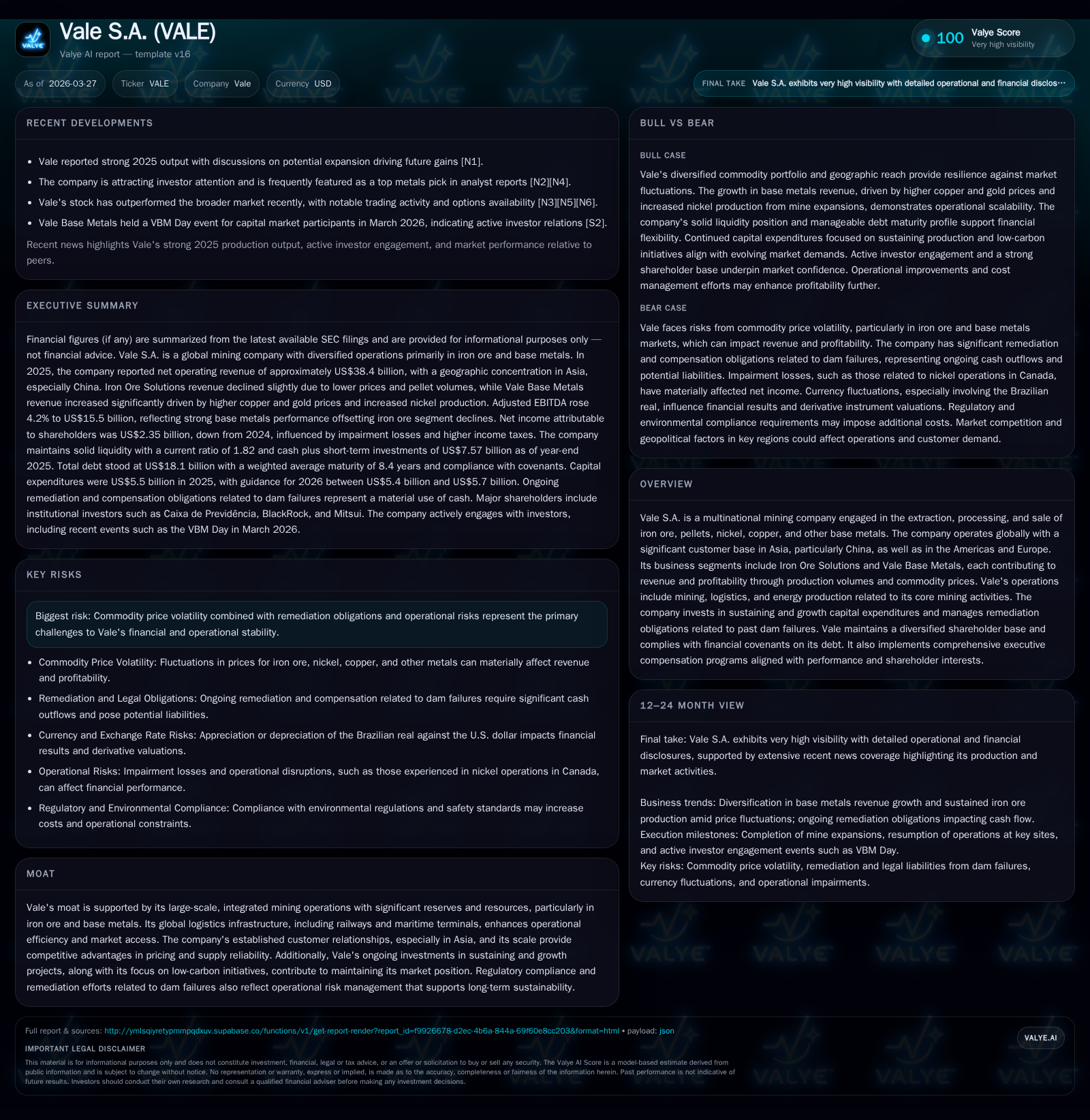
In 2025, Vale's revenue rose slightly to $38.4 billion, supported by higher iron ore fines sales volumes despite lower prices and a sharp drop in pellet sales. The company faced increased cost pressures from elevated spot freight rates, which impacted margins. Significant impairments related to Canadian nickel assets affected net income. Capital expenditures focused on sustaining and expanding key iron ore projects. Vale maintained liquidity with $7.6 billion in cash and strong operating cash flow of $8.8 billion, while paying nearly $5.9 billion in dividends. Revenue concentration remains heavily weighted towards Asia, particularly China, with Europe gaining share amid a decline in the Americas. Ongoing remediation obligations from dam failures present financial risks alongside a stable debt profile supported by committed credit facilities.
2025 Financial Overview
Vale reported consolidated net operating revenue of approximately $38.4 billion for the year ended December 31, 2025, representing a slight increase from the prior year's $38.1 billion [S1][S4]. This moderate growth was primarily driven by a near 5% increase in iron ore fines volumes to about 273 million metric tons, partially offset by a significant decline of roughly 14% in iron ore pellet volumes as customer preferences shifted [S1]. Average realized prices softened with iron ore fines declining by 3.2% to $92 per metric ton and pellets falling by approximately 13.5% to $134 per metric ton [S1].
The base metals segment experienced volume growth across key products: nickel volumes rose circa 11.6%, copper volumes also increased by approximately 11.6%, and copper produced as a nickel co-product rose about 15.6%. However, average nickel prices dropped nearly 9%, partially balanced by a roughly 10% increase in copper prices year-over-year [S1].
Cost pressures were significant due to elevated spot freight rates impacting both iron ore and base metals logistics costs—adding around $783 million and $552 million respectively—resulting in total cost of goods sold increasing by approximately 2.8% compared to the previous year [S4][S21]. Research and development expenditures declined by about 12%, reflecting reduced exploration activities primarily within base metals operations [S21].
Significant impairment charges totaling about $4.6 billion were recognized related primarily to Canadian nickel operations, including goodwill write-offs and asset impairments, which considerably affected net income results for the year [S1]. Operational stoppage expenses decreased substantially due to full ramp-up at Vargem Grande mines, lowering associated costs by over one-third [S1]. Other operating expenses declined moderately owing mainly to reduced litigation provisions.
Historical performance (annual)
| FY |
|---|
| 2025 |
| 2021 |
| 2020 |
| 2018 |
Source: SEC companyfacts cache [F1].
Capital returns and efficiency (annual)
| FY | Div ($bn) |
|---|---|
| 2025 | 5.9 |
| 2021 | 7.6 |
| 2020 | 3.4 |
| 2018 | 0.2 |
Source: SEC companyfacts cache [F1].
Note: Detailed recent financial figures are sourced primarily from SEC filings as historical XBRL data is limited.
Geographic Revenue Distribution
Asia continued as Vale’s dominant market, accounting for approximately 66.9% of total revenues in 2025 with China alone representing about half of total sales at roughly $19.4 billion or 50.5% share—stable relative to prior years [S4]. Revenue exposure from Japan diminished from around 8% to about 6%, while other Asian markets expanded their contribution.
The Americas region's share declined from approximately 14.7% to near 13%, driven largely by lower Brazilian revenue contributions amid changing demand dynamics [S4]. Conversely, Europe gained prominence with revenues increasing close to 28%, led by Germany and other European countries that together accounted for almost 15% of total revenues versus under 12% previously [S4]. Revenues from Rest-of-World regions (Middle East, Africa, Oceania) contracted slightly from around 7% down to just above 5%, underscoring regional concentration risks tied predominantly to Asia.[S4]
Product Segment Highlights
The Iron Ore Solutions segment benefited from volume gains in fines (+4.9%) which partially offset the steep decline in pellet sales (-14.4%), reflecting shifts in steelmaking raw material consumption patterns [S1][S4]. Pricing pressures were notable especially for pellets which saw a sharp drop.
Base Metals volumes advanced moderately with nickel increasing over 11% and copper similarly growing; however, pricing headwinds persisted particularly for nickel which fell nearly 9%. The impairment losses related principally to Canadian nickel assets suggest challenges regarding asset valuation or future profitability expectations within this segment [S1].
Elevated spot freight rates contributed significantly to cost inflation impacting margin profiles across product lines given the integrated nature of Vale’s supply chain including inland logistics and maritime transport components [S4][S21].
Capital Expenditure Focus
Capital expenditures totaled approximately $5.5 billion for the year focused on both sustaining operations and growth initiatives such as the Serra Sul +20 Mtpy iron ore expansion anticipated for late-2026 startup along with crusher upgrades targeting compact ores at Minas Gerais sites [S6][S21]. Investments also included enhancements within Base Metals highlighted by the Onça Puma second furnace upgrade expected online in H2-2025 and initial development on Bacaba project aimed at mid-decade capacity additions.
Liquidity and Debt Position
Vale ended the year with strong liquidity supported by cash and equivalents of about $7.6 billion compared with roughly $5 billion at the end of prior year alongside robust operating cash flows totaling approximately $8.8 billion for fiscal year 2025 [S9][S22]. Total debt increased moderately reaching about $18.1 billion encompassing both short- and long-term borrowings including recent bond issuances mainly denominated in U.S dollars maturing well beyond the near term.
Debt maturities are well staggered with only around $323 million due during calendar year 2026 while significant amounts mature after 2029 providing refinancing flexibility supported further by three committed revolving credit facilities aggregating near $5 billion accessible through coming years enabling efficient working capital management amid market volatility [S5][S7][S22]. Financial covenants remain comfortably met ensuring credit profile stability.
Shareholder Returns
In line with its dividend policy aligned with Brazilian corporate governance requirements, Vale distributed nearly $5.9 billion in dividends during fiscal year 2025 demonstrating ongoing commitment toward shareholder remuneration amid operational challenges [S11][S18]. No shares were repurchased under the Board-approved buyback program during this period indicating capital allocation priorities favoring project investments and remediation obligations.
Risks and Remediation Obligations
Legacy remediation liabilities stemming from dam failures including Brumadinho continue to represent significant financial exposures with cash outflows exceeding $1.1 billion during the period reflecting ongoing settlement payments and operational risk management efforts documented extensively in filings [S8][S12][S14].
Commodity price volatility remains a critical factor influencing earnings quality as evidenced by pricing declines impacting iron ore pellets and nickel segments alongside impairment recognition highlighting sensitivity across core product portfolios.
Additional legal proceedings encompass environmental claims, securities litigation primarily in the U.S., indigenous community settlements, and corporate governance reviews adding complexity to risk profiles requiring sustained oversight [S12][S13][S16][S17][S23].
Outlook Considerations
Key upcoming milestones include commissioning major capacity expansions such as Serra Sul expected late-2026 which could enhance production capabilities against global steel demand trends particularly driven by emerging markets industrialization cycles [N12][N1].
Evolving demand patterns across Asia—with China remaining pivotal—and growing European market share necessitate continuous assessment alongside operational efficiency improvements leveraging Vale’s vertically integrated supply chain infrastructure.
The scheduled VBM Day investor event focusing on Base Metals signals enhanced engagement aimed at clarifying strategic priorities amid sector volatility while maintaining transparency regarding remediation efforts underscoring risk mitigation communication importance for investors monitoring capital allocation dynamics moving forward [N2][N4][N12][S2].
This analysis integrates data through early 2026 primarily sourced from official SEC filings supplemented by recent market commentary without speculative forecasts or investment advice.
Disclaimer: This is research-only, informational analysis and not investment advice. It may include AI-generated interpretation and general industry context. Always verify important details using primary sources.

Comments