
Veeco Instruments Faces Profit Contraction Amid Merger Uncertainty
Veeco’s fiscal 2025 saw robust revenue growth offset by significant profit declines amid market pressures and merger complexities.
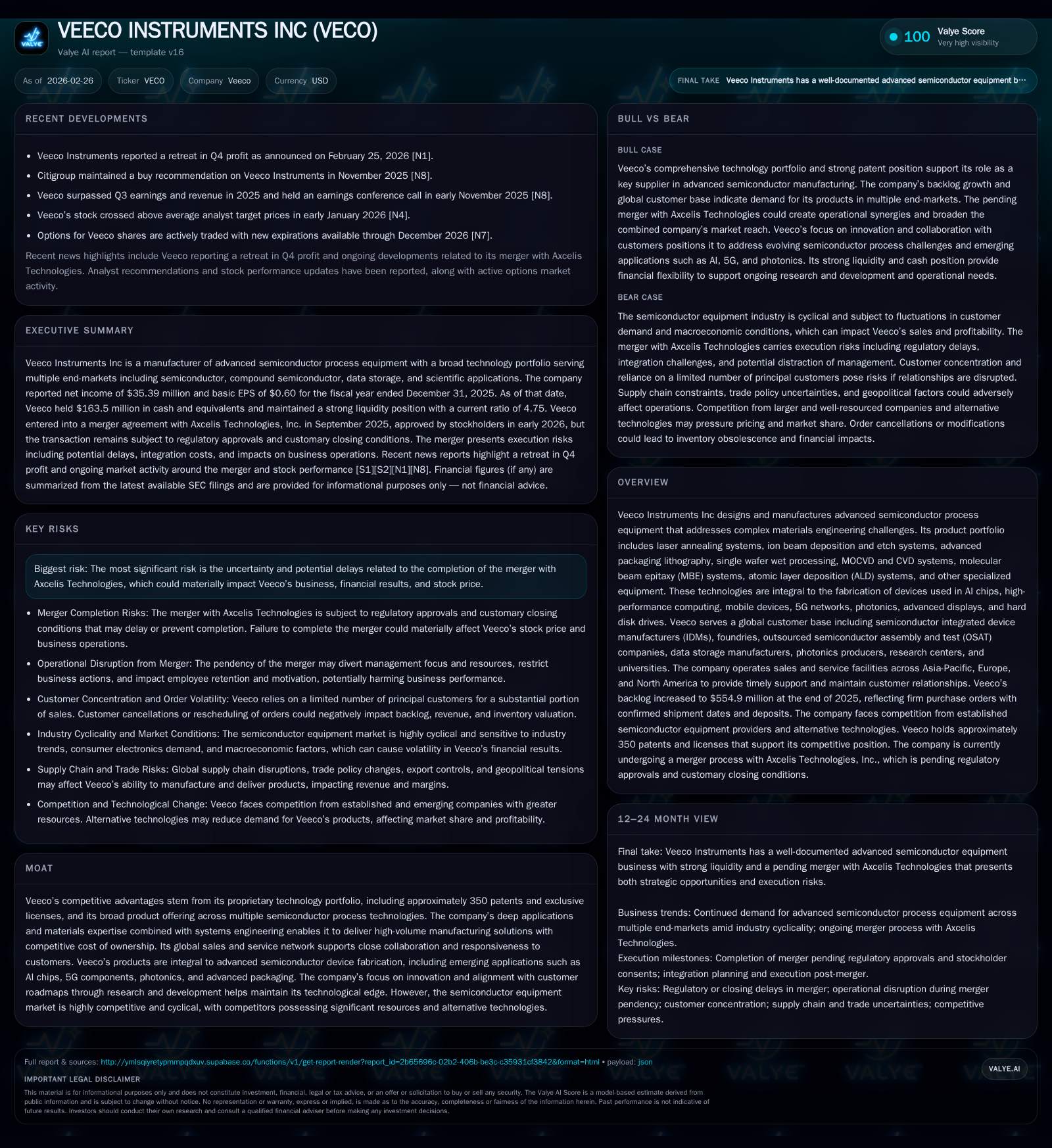
Veeco Instruments reported a notable 53.2% year-over-year revenue increase in fiscal 2025, driven by advanced semiconductor equipment demand for AI chips, 5G, and photonics applications. However, operating income declined by nearly 47% and net income halved due to intensified competition, supply chain challenges, and pricing pressures. The pending merger with Axcelis Technologies introduces regulatory uncertainties and potential financial impacts that compound operational risks. Despite free cash flow generation and a solid liquidity position, Veeco faces a delicate balancing act between innovation investments and capital discipline amid cyclical industry dynamics.
Historical Growth Trajectory and Key Drivers
Veeco Instruments demonstrated strong revenue acceleration culminating in fiscal 2025's $143.4 million top line—a 53.2% increase compared to the prior year’s $93.6 million [F1]. This growth reflects demand for Veeco’s semiconductor process technologies including MOCVD systems for compound semiconductors, atomic layer deposition (ALD), ion beam technologies, and lithography solutions tailored for AI chips, high-performance computing, and photonics devices [S1]. The company’s broad portfolio covers laser annealing systems, molecular beam epitaxy (MBE), single wafer wet processing, and chemical vapor deposition (CVD), supporting critical fabrication steps across diverse end-markets.
Operating income has shown variability inherent in capital equipment sectors characterized by long development cycles and customer qualification timelines [F1]. Sales gains are linked to product innovation aligned with customers’ roadmaps for AI processor efficiency improvements, advanced packaging methods like fan-out wafer-level packaging (FOWLP), and new materials integration essential for RF filters supporting 5G infrastructure deployment.
Historical performance (annual)
| FY | Net ($mm) | CFO ($mm) | OpInc ($mm) | Capex ($mm) | Net YoY |
|---|---|---|---|---|---|
| 2025 | 35 | 69 | 36 | 16 | -52.0% |
| 2024 | 74 | 64 | 67 | 18 | +342.7% |
| 2023 | -30 | 62 | 70 | 28 | -118.2% |
| 2022 | 167 | 108 | 60 | 25 |
Source: SEC companyfacts cache [F1].
Capital returns and efficiency (annual)
| FY | FCF ($mm) | ROE% |
|---|---|---|
| 2025 | 53 | 4.0 |
| 2024 | 46 | 9.6 |
| 2023 | 34 | -4.5 |
| 2022 | 84 | 28.9 |
Source: SEC companyfacts cache [F1].
Note: Fiscal years correspond to calendar years ending December 31; amounts in USD millions; YoY percentages calculated where prior data is available.
Market Dynamics Impacting Profitability
Despite strong revenue growth in FY2025, operating income declined significantly (-46.7%) to $35.7 million alongside a net income drop of over half (-52%), reflecting margin pressures from rising costs and competitive factors [F1]. The semiconductor industry’s cyclicality strongly influences Veeco’s order timing and shipment schedules [S5][S12]. Inflation-driven input cost increases combined with supply chain constraints have pressured manufacturing efficiency and limited pricing flexibility amid competition from lower-cost regions [S20].
Geopolitical tensions—particularly US-China export restrictions—have added complexity through licensing delays affecting access to China’s semiconductor market, increasing competitive pressures as domestic Chinese producers receive governmental support [S10][S15][S26].
Technological adaptation challenges persist as Veeco addresses shortening customer qualification periods within typical sales cycles exceeding twelve months plus volume ramp phases [S19][S20]. Continuous innovation on ALD tools for enhanced uniformity at smaller nodes and MOCVD platforms for GaN power electronics remain critical to meet evolving customer demands under aggressive timelines [S21].
Merger Status and Risks
Veeco is engaged in a pending merger with Axcelis Technologies announced in late September 2025 [S1][S18], approved by stockholders but awaiting regulatory clearances including antitrust approvals under the Hart-Scott Rodino Act [S2][S3]. Delays or failure of the merger could materially affect business operations and share price.
Termination clauses include a $77.5 million fee payable if Axcelis withdraws after a board recommendation change or other fixed reimbursements if termination arises from stockholder disapproval or breaches by Veeco [S2]. Transaction costs are accruing from legal and advisory services already.
Debt covenants constrain financial flexibility during this period of cyclicality and transaction-related expenses, potentially limiting operational cash flow maneuvering prior to deal closure [S13][S25]. Equity dilution post-merger will reduce existing shareholders’ voting power.
Outlook: Opportunities Amid Challenges
While explicit forward guidance is limited, growth prospects hinge on increased adoption of semiconductor devices for AI chips, advanced packaging formats supporting heterogeneous integration for mobile electronics and data centers, as well as compound semiconductor applications in photonics sensors for autonomous driving systems [N2][S1].
Risks remain from geopolitical trade restrictions potentially limiting Asia-Pacific sales channels (~85% of revenues), economic softness affecting spending by key IDM/foundry clients, supply chain vulnerabilities including reliance on single-source suppliers, and forecasting difficulties due to long sales cycles [N2][S15].
Backlog stood at approximately $555 million entering FY2026 signaling continued demand but requiring close monitoring alongside merger regulatory developments.
Capital Allocation and Returns
Veeco generated approximately $53.3 million of free cash flow in FY2025 derived from operating cash flow ($69.5M) less capital expenditures ($16.2M), reflecting positive cash generation amid reduced investment spending (-10.6% YoY), possibly reflecting budget caution ahead of merger completion or macroeconomic uncertainties [F1].
Return on equity approximates a modest ~4%, consistent with margin pressures combined with reinvestment needs typical of technology equipment firms navigating innovation cycles under cost inflation headwinds [F1].
The company has not paid dividends recently nor conducted significant share repurchases since earlier years; capital deployment remains conservative amid strategic repositioning including transaction-related contingencies [F1][S28].
Financial Position: Liquidity and Leverage
Veeco’s balance sheet exhibits substantial liquidity with $163 million in cash & equivalents at fiscal year-end contributing to a current ratio near 4.75x based on current assets versus current liabilities—providing ample short-term funding capacity even amid cyclical stresses or merger transition uncertainties [F1].
Debt includes $230 million principal convertible senior notes due in 2029 plus an undrawn revolving credit facility totaling $250 million offering further flexibility but subject to covenants restricting additional debt or liens that may limit strategic options during ongoing adjustments or downturns [S13][S25].
Convertible note terms imply contingent liquidity demands upon conversion events or covenant breaches necessitating vigilant treasury management given market volatility.
Sector Positioning: Technology Trends
Veeco differentiates through an extensive patent portfolio (~350 U.S./international patents) underpinning its advanced toolset deployed across multiple segments including MOCVD for GaN semiconductors used in power electronics & RF devices as well as ALD enabling ultra-thin film depositions critical for advanced logic device fabrication demanding atomic level precision control over layer uniformity [S1].
Ion beam deposition/etching technologies complement core offerings providing nanoscale surface engineering vital for yield enhancement at Tier-1 fabs.
Advanced packaging lithography optimized for sub-300mm fan-out wafer-level packaging meets growing consumer electronics demands requiring low total cost of ownership amid competitive pressure [S21].
Close R&D collaboration with customers throughout design-to-production phases supports agility against compressed product lifecycles defining the evolving semiconductor ecosystem.
Disclaimer: This is research-only, informational analysis and not investment advice. It may include AI-generated interpretation and general industry context. Always verify important details using primary sources.

Comments