
Veea Inc.'s Edge-Cloud Innovation Gears Up for Market Expansion
Veea reports continued operational progress amid Nasdaq listing adjustments, leveraging its patented edge-cloud platform to target underserved markets and AI-driven applications.
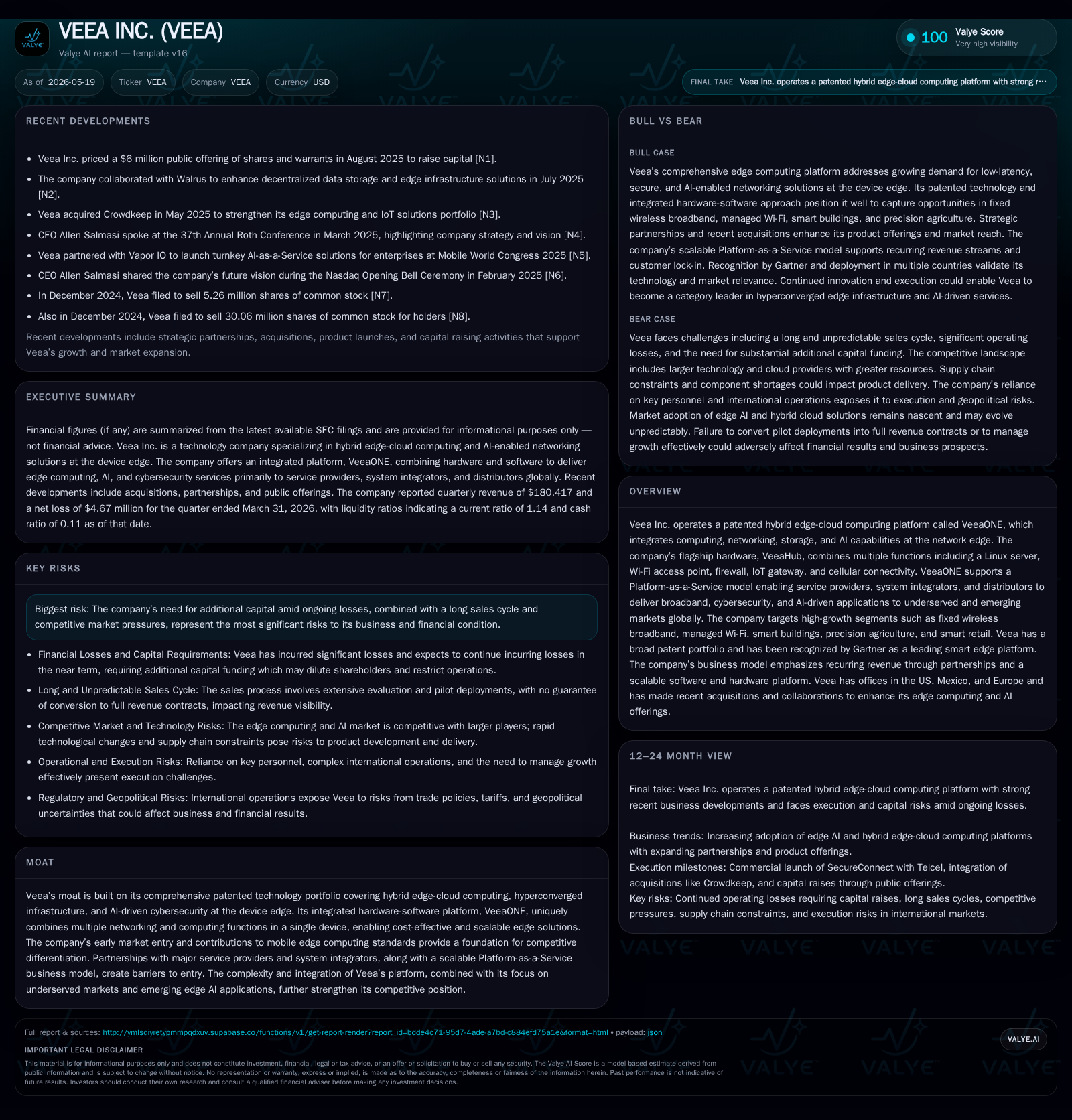
In its latest 10-Q filing dated May 15, 2026, Veea Inc. completed a transfer of its Nasdaq listing from the Global Market to the Capital Market to maintain trading continuity while addressing bid price compliance deadlines. The company continues to advance its VeeaONE hybrid edge-cloud platform featuring its VeeaHub device, integrating multiple network and compute functions with embedded AI at the network edge. Focused on recurring revenue through service provider and system integrator partnerships, Veea targets fast-growing segments such as fixed wireless broadband and smart buildings in emerging and underserved markets. Despite significant operating losses and ongoing capital needs, Veea preserves a competitive moat via a broad patent portfolio and platform integration, with growth catalysts centered on strategic deployments like Mexico’s AirLynx network rollout. Key risks include capital raising challenges, long sales cycles, and evolving regulatory demands.
Recent Quarterly Operating Update and Nasdaq Listing Transition
Veea Inc.’s latest quarterly report filed on May 15, 2026 ([S2]) confirms a key operational development: the company formally transferred its Nasdaq listing from the Global Market to the Capital Market effective April 9, 2026. This move follows an extended period of failure to meet the minimum bid price for continued listing on the higher-tier exchange ([S3]). The transfer secures uninterrupted trading under the symbols "VEEA" and "VEEAW", while granting Veea an additional 180 calendar days—until September 30, 2026—to regain compliance with Nasdaq's minimum bid price rule. Although this transfer does not immediately affect day-to-day trading, it reflects regulatory challenges that underscore the importance of upcoming operational milestones to sustain investor confidence.
This change matters as it places Veea into a segment of public companies with more lenient listing criteria but potentially less visibility among institutional investors accustomed to the Global Market tier. Moreover, it underscores near-term pressures surrounding stock price performance that may influence capital raising ability and overall market perception while Veea pursues growth initiatives.
VeeaONE Platform: Integrated Hardware-Software Edge Innovation
At the core of Veea’s business is the patented VeeaONE platform: a hybrid edge-cloud computing solution integrating multiple networking and computational functions into single devices branded as VeeaHub ([S1], [S7]). The VeeaHub hardware converges a Linux-based server environment running secured Docker containers with high-performance Wi-Fi access points supporting mesh networking, advanced firewalls for enterprise-grade cybersecurity, IoT gateways facilitating device connectivity, NVMe storage modules for local data retention, and embedded cellular connectivity spanning 4G/5G technologies.
This hyperconverged architecture is significant because it addresses key market demands for performing computing and AI inferencing directly at the device edge rather than centralized cloud data centers—reducing latency, preserving data privacy under sovereignty laws, improving bandwidth efficiency by filtering data locally, and boosting reliability with "always-on" availability necessary for mission-critical applications.
Technologically differentiated by an expansive patent portfolio encompassing approximately 123 patents across 26 families ([S1]), Veea's platform extends beyond commodity edge routers or isolated compute units. Its unified hardware-software stack called VeeaWare allows seamless orchestration and multi-tenant cloud management providing service providers flexibility in deploying AI-enabled applications like computer vision models for surveillance or inventory management.
Veea’s platform also supports scalable hybrid deployments balancing workload distribution between edge nodes and public clouds with elastic scaling capabilities alongside air-gapped security features where sensitive operations require isolation from internet-accessible clouds ([S20]). This comprehensive product design thus caters to evolving IT/OT convergence trends where networks must fuse operational technology sensors with traditional information technology systems securely.
Business Model Fundamentals: Recurring Revenue Through Ecosystem Partners
Veea monetizes primarily via a Platform-as-a-Service (PaaS) approach centered on developing a robust partner ecosystem comprising mobile network operators (MNOs), multiple system operators (MSOs), internet service providers (ISPs), managed service providers (MSPs), system integrators (SIs), and major distributors focused on telecommunications or security technology segments ([S7]).
Revenue stems from sales of integrated hardware products like VeeaHub combined with subscription services including managed Wi-Fi networks augmented by proprietary AI-powered cybersecurity features delivered under SecureConnect™ branding ([S19]). The subscription model enables predictable recurring revenues by embedding differentiated software solutions—such as loss protection algorithms or computer vision analytics—tailored via developer portal tools that allow partners to customize applications locking in customers through switching costs.
This model targets broadband delivery improvements especially in emerging markets or underserved rural regions where traditional infrastructure is costly or unreliable; managed Wi-Fi offerings for smart building automation requiring IT/OT integration; precision agriculture solutions applying edge inferencing for asset tracking and yield optimization; plus smart retail use cases enhancing inventory visibility or surveillance effectiveness. All these verticals leverage multiaccess edge computing combined with standardized mobile edge computing (MEC) frameworks focusing on low latency and localized AI application deployment ([S7], [S19]).
Key client adoption dynamics involve lengthy sales cycles typical in enterprise B2B contexts due to complex organizational decision-making processes involving finance approval, technical pilots often provided at low/no cost initially for evaluation purposes ([S9]).
Industry Structure and Competitive Positioning in Hybrid Edge Markets
The hybrid edge-cloud computing market is characterized by increasing adoption of integrated infrastructure combining computing power with network capabilities distributed closer to end-users—a shift motivated by latency-sensitive applications in IoT, AI inferencing at scale, Industry 4.0 automation needs, and enhanced cybersecurity driven by IT/OT convergence. Within this landscape, barriers to entry are steep due to technical complexity requiring substantial R&D investment reflected in expansive patent portfolios protecting proprietary hyperconverged designs (, [S1], [S14]).
Capacity constraints arise from dependence on contract manufacturers primarily based in Asia (Taiwan and China) for chipsets and device assembly — exposing supply chain risks potentially from geopolitical tensions ([S17]). Switching costs reinforce client retention because once deployed within multi-tenant environments with customized AI apps integrated into operational workflows, migration to alternative platforms involves significant reengineering effort encompassing software adaptation and hardware replacement ([S7], ).
Competitors span large-scale cloud hyperscalers expanding into edge services offering modular solutions but often lack fully integrated hardware-software-plus-security stacks at device edge level. Smaller niche players may provide components but have limited full-stack platforms or patented innovations compared to Veea’s portfolio. This positions Veea favorably within specialized underserved emerging market segments requiring turnkey solutions addressing connectivity plus AI security simultaneously.
Growth Drivers: Expanding Emerging Market Deployments and AI Application Adoption
Veea’s most tangible growth catalyst derives from commercial partnership deployments like Mexico’s AirLynx initiative in collaboration with StarGroup—a satellite-based pay-TV operator deploying fixed wireless broadband services together with bundled Pay TV ([S1]). Post proof-of-concept success completed in early 2025,[StarGroup intends expanding AirLynx Networks across more than hundred villages and small towns within twelve months capturing large incremental subscriber bases previously unserved or underserved by broadband infrastructure.
Additionally, global demand is rising structurally for fixed wireless access alternatives enabled by hybrid edge-cloud platforms capable of lowering operational expenses through automation while delivering differentiated cybersecurity features tailored by customer vertical business needs ([S19]).
Edge AI adoption remains another fundamental driver: domain-specific computer vision models used in smart buildings for loss prevention or common area surveillance exemplify how software innovations developed through partner portals can effectively lock customers into ecosystem continuity reducing churn risk while spurring further upsell opportunities via continuous app introduction (, [S19]).
Scalability through SaaS/PaaS delivery eases geographic expansion across Americas, EMEA, APAC regions focusing on segments where digital transformation accelerates including retail chains upgrading footprint analytics or precision agriculture players demanding real-time asset intelligence.[Emerging market penetration combined with validated use case verticalization underpins medium-term addressable market growth potential despite near-term execution headwinds.]
Risks and Constraints: Capital Requirements, Sales Cycles, and Regulatory Compliance
The company acknowledges sustained operating losses funded through equity/debt financing raising dilution risk if additional capital is required ([S1],[S8],[S11]). With no current borrowing capacity under credit lines additionally underscored by $14.75 million debt outstanding versus cash around $1.7 million as per latest balance sheet data ([F1]), liquidity constraints pose real runway limitations impacting R&D scale-up or commercialization velocity if fundraising stalls.
Long sales cycles spanning many months influenced by complex multi-level customer evaluations hinder visibility into timely order conversion affecting revenue recognition patterns ([S9],[S21]). These cycles expose execution risk especially when tied to pilot deployments not guaranteed to convert into full contracts.
Regulatory risks amplify complexity; evolving international trade policies imposing tariffs or export controls introduce supply chain uncertainties prevalent given manufacturing dependencies country-level geopolitical tensions impact component sourcing timing/costs ([S29],[S27]). Additionally cyberattack vulnerabilities inherent to distributed edge networks necessitate ongoing cybersecurity investments; any realized breaches could damage reputation significantly reducing customer trust ([S14],).
Compliance costs related to emerging environmental social governance standards plus stringent data protection rules (cross-border privacy concerns) further elevate operating expenses potentially constraining margins without commensurate pricing power increases.[Moreover failure to adequately manage anti-corruption or anti-bribery laws exposes company to legal liabilities harming financials or reputation.]
Management's limited experience managing public company obligations paired with increased administrative burdens diverts attention from growth-focused activities ([S26],). Talent competition remains fierce especially attracting engineers skilled both in cloud-edge hybrid technologies essential for product advancement ( e.g., CPUs/GPUs/TPUs specialization). Loss of key personnel could delay roadmap realization.
Key Milestones to Watch: Stock Price Compliance, Product Development Signals, Partner Rollouts
The September 30 deadline looms as a critical test point determining if Nasdaq minimum bid price rules will be satisfied sustaining Capital Market listing status without further de-listing threats ([S3]). Observers should monitor share price trends alongside volume metrics reflecting demand/supply fundamentals influencing liquidity.
Execution progress on AirLynx network expansions throughout Mexican rural locations provides concrete operational traction markers gauging scalable volume ramp potential beyond initial deploy phases ([S1]). Successful transition from pilot programs into steady-state paying subscribers materially affects revenue trajectory validation.
Innovations stemming from ongoing R&D efforts aimed at augmenting platform capabilities particularly advancing agentic AI inferencing efficiency at the Device Edge stand as potential differentiators informing competitive positioning going forward ([S20],). Announcements signaling new products or enhancements alongside announced partnerships can validate ecosystem growth velocity critical for SaaS upsell strategies.
Veea maintains approximately $1.7 million in cash equivalents at December 31, 2024 alongside total debt touching nearly $14.75 million as recorded through Q1 ending March 31, 2025 leading to an estimated net debt position north of $13 million with current assets approximating $17 million balanced against current liabilities about $15 million yielding a current ratio of about 1.14—a slim but positive liquidity cushion suitable for near-term working capital adequacy but necessitating prudent cash management ([F1]).
The company's operating loss exceeded $18 million during the latest reported period highlighting substantial negative free cash flow levels characteristic of an early-stage hardware-plus-software innovator seeking scalable commercial traction rather than immediate profitability.[This financial posture implies ongoing dependency on external funding sources raising dilution risks consistent with stated risk disclosures].
In sum financial metrics provide context framing operational ambitions within clear capital constraints calling attention to execution discipline essential until scaling effects can improve margin structures substantially.
This analysis is based exclusively on publicly filed documents as referenced without speculation beyond cited sources noted herein. It aims solely to present an informed business overview absent any investment research view or valuation judgment.
Disclaimer: This is research-only, informational analysis and not investment advice. It may include AI-generated interpretation and general industry context. Always verify important details using primary sources.

Comments