
Venu Holding Advances Venue Development Amid Early-Stage Cash Burn
Venu Holding Corp is progressing its amphitheater rollout and municipal partnerships while navigating ongoing financial deficits and capital needs.
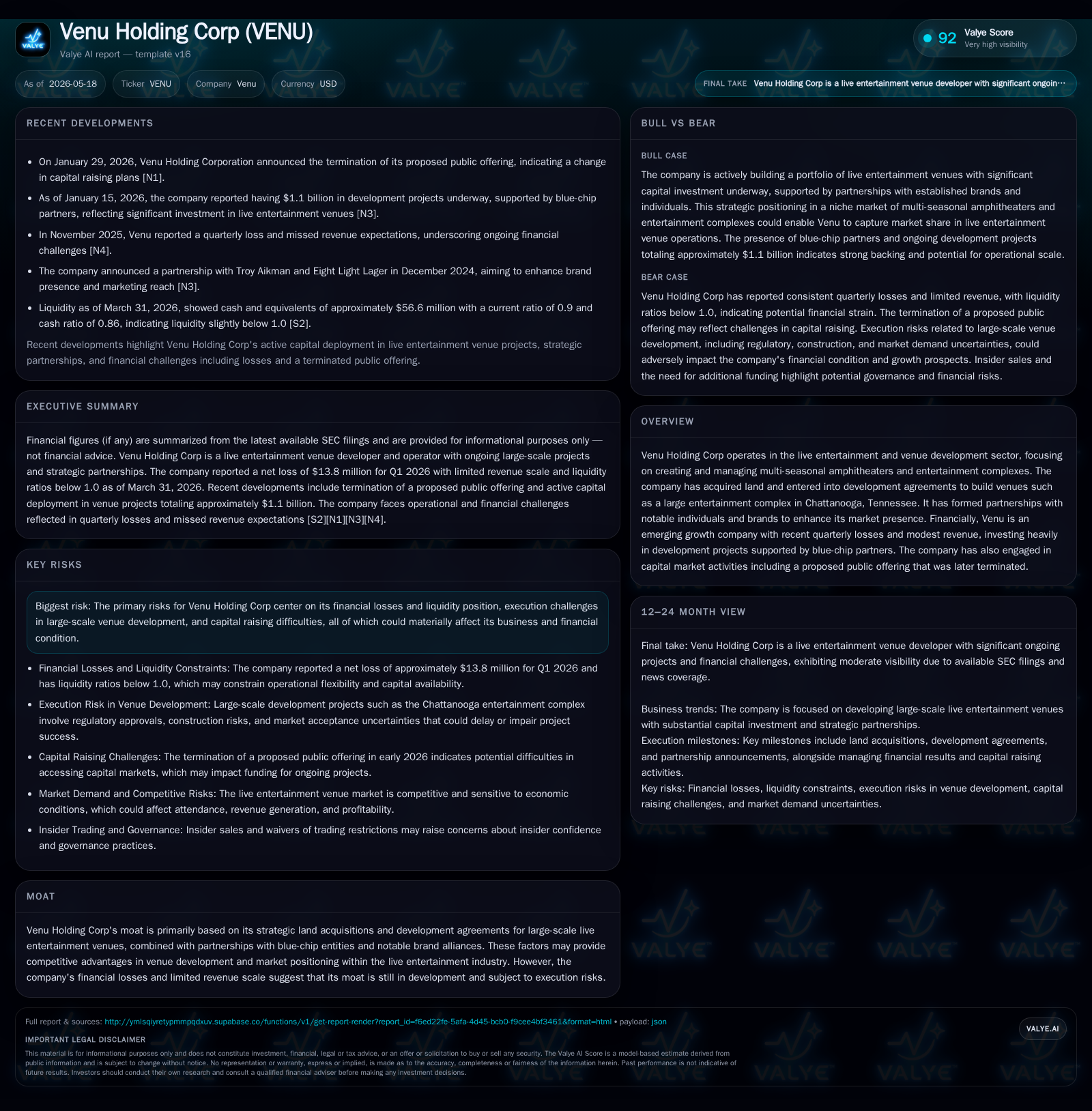
Venu Holding Corp’s latest quarterly report reveals continued investment in live entertainment venue development amid modest revenue and sizeable net losses. The company remains focused on growing through strategic land acquisitions, public-private partnerships, and pre-sale monetization of naming rights and suites. While near-term liquidity remains adequate, Venu faces execution risks tied to project timelines and capital market access. Key growth drivers include the upcoming launch of The Sunset at Broken Arrow in fall 2026 and the planned Chattanooga entertainment complex. Investors should monitor venue openings, sponsorship sales, and financing developments for indications of operational traction.
Quarterly Operating Update: Progress and Challenges
In its 10-Q filing dated May 15, 2026 [S2], Venu Holding Corp disclosed first-quarter financial results that reflect the early-stage nature of its growth strategy. Revenue remained modest at approximately $719,000 for the quarter ended March 31, 2026 [F1], driven primarily by operations at existing venues in Colorado and Georgia. Despite revenue generation, Venu continued to incur substantial net losses driven by ongoing investments in venue development, staffing, marketing, and administrative expenses aligned to future openings.
A highlight from recent disclosures includes the strategic acquisition of a 15-acre property in Chattanooga, Tennessee for $20 million intended for a new multi-season amphitheater complex [S15]. This transaction is contingent upon finalizing development agreements with local government entities and securing associated funding incentives—critical steps expected before year-end closing [S25]. Previously announced expansions such as The Sunset at Broken Arrow are scheduled to open by Fall 2026, adding tangible near-term operational footprints [S2].
Concurrently, Venu has aborted a recently proposed public offering but maintains access to capital including debt financing arrangements to fund development projects—emphasizing ongoing liquidity management challenges characteristic of emerging hospitality companies [S3]
Business Model and Venue Ecosystem
Venu operates as a vertically integrated entertainment holding company combining venue ownership with hospitality services designed to create immersive live music experiences merged with upscale dining. Its revenue streams derive from multiple sources: ticket sales from concerts and events; pre-sales of naming rights and corporate sponsorships; luxury suite sales under its Luxe FireSuites brand; food & beverage concessions; and real estate development income linked to venue properties [S1]
Customer segmentation is multifaceted—municipal governments facilitate land deals often incentivized through tax increment financing or other economic development tools; consumers drive event attendance; corporate partners secure branding exposure; and suite owners contribute via fractional ownership or lease contracts resembling triple-net lease structures used for enhanced hospitality experiences.
Venue capacity ranges from intimate indoor music halls seating roughly 1,400 guests to expansive outdoor amphitheaters exceeding 8,000 seats. This portfolio mix permits deployment across diverse demographic markets while balancing utilization rates seasonally. Pricing power emanates from premium positioning within growth regions underserved by comparable entertainment infrastructure. Venu’s ecosystem is thus structured on contractual pre-sales that reduce funding risk while leveraging partnerships that unlock land cost advantages—a crucial competitive edge given high fixed capital requirements.
Industry Dynamics and Competitive Positioning
Within the live entertainment sector, barriers to entry are substantial due to the need for sizable land parcels in strategically favorable locations combined with regulatory approvals generally requiring concerted municipal collaboration. Venu’s approach to securing sites through public-private partnerships provides unique leverage helping navigate these hurdles with economic incentives that stimulate ancillary local development [S1].
The industry remains fragmented geographically but experiences structural tailwinds as consumer spending shifts back toward experiential entertainment post-pandemic cycles. However, competition exists from established regional amphitheaters tied to large entertainment firms or municipalities owning facilities outright.
Venu’s moat is embryonic but anchored in its ability to assemble land cheaply through negotiated municipal co-investment arrangements paired with an ecosystem capable of selling premium offerings (e.g., naming rights) before construction begins—a model less common among smaller independents lacking these alliances. Nevertheless, the absence of scale relative to historic regional players leaves Venu vulnerable to execution risks during rollout phases.
Growth Catalysts: Venue Rollout and Strategic Partnerships
Key drivers anticipated over the next 12–24 months center on opening new venues like Sunset Broken Arrow in Oklahoma (targeted Fall 2026) alongside progress on the Chattanooga complex slated for post-acquisition development commencement [S2][S15]. Pipeline prospects in Texas complement geographic expansion plans supporting a broader footprint.
Pre-sale efforts remain pivotal—these include early commitments for naming rights deals by corporate sponsors and suite ownership transactions representing upfront cash inflows that directly fund construction phases [S1]. Strategic alignment with entertainment industry leaders offers enhanced booking capabilities essential for driving event frequency and quality programming.
Successful execution of these projects will be measured via milestones such as finalizing municipal development agreements per property acquisition contingencies; hitting predefined thresholds on suite presales; generating positive cash flow once venues are operational; and expanding sponsorship revenue capturing consumer engagement trends.
Risks and Constraints: Financial Health and Execution Sensitivities
The company's financial profile reveals a continued pattern of negative earnings reflecting upfront investments required for venue development before achieving operational breakeven [F1][S1]. As of Q1-end 2026, cash reserves stood near $56.6 million offset by total debt around $66.5 million yielding net debt roughly $10 million—a leverage position manageable short term but constraining if expansions extend beyond planned funding horizons without accrual of operating income [F1].
With a current ratio approximating 0.9 ([F1]), working capital tightness signals potential liquidity pressure particularly if construction or opening schedules encounter delays or unexpected cost overruns occur. Moreover, incremental capital raising may entail dilution or refinancing under less favorable terms due to prevailing market volatility referenced in risk disclosures [S1].
Operationally, large-scale projects carry inherent complexities such as permitting hurdles, supply chain disruptions affecting materials procurement for venue builds, labor availability constraints in regional markets targeted for expansions, and unpredictability around consumer demand shifts that could impair revenue ramp-up curves.
Forward-Looking Indicators: What to Monitor Next
Stakeholders should closely watch forthcoming quarterly reports for updates on revenue progression linked to newly opened venues including Sunset BA’s operational ramp-up. Additional clarity is expected regarding closing of real estate acquisitions pending fulfillment of municipal partnership conditions notably in Chattanooga (including securing tax incentive funding). Progression on sponsorship sales velocity alongside suite presales will serve as practical gauges of market acceptance and early cash flow generation.
Event scheduling calendars illustrating booked shows at new facilities will provide early signals about demand traction relative to capacity planning assumptions.
Financial Overview: Latest Liquidity and Capital Structure
As reported at March 31, 2026 [F1], Venu Holding retained cash reserves approximating $56.6 million against gross debt near $66.5 million resulting in modest net leverage around $10 million. This balance sheet posture underscores reliance on continued access to capital markets or additional debt financing rounds described by management strategies [S1], and reflects meaningful cash buffers established through prior equity raises completed earlier this year netting over $80 million proceeds inclusive of over-allotments [S19].
It aims solely to provide an informed evaluation without investment research views or price forecasts.
Financial position in context
As of 2026-03-31, companyfacts shows $57mm in cash and equivalents and $67mm of total debt [F1]. The same snapshot implies net debt of roughly $10mm, keeping balance-sheet context relevant but secondary to the operating story [F1]. Current assets of $60mm and current liabilities of $66mm imply a current ratio near 0.9x for 2026-03-31 [F1].
Disclaimer: This is research-only, informational analysis and not investment advice. It may include AI-generated interpretation and general industry context. Always verify important details using primary sources.

Comments