
Loan Artificial Intelligence Corp.: Acquisition-Driven Reinvention Meets Acute Operational Fragility
With zero revenue, no current assets, and its fate tied to a pending AI tech acquisition, Loan Artificial Intelligence Corp. embodies a high-stakes bet on transformation. The company’s ability to shift from shell status to operating platform hinges on closing the Hong Technology deal and overcoming acute funding and execution risks.
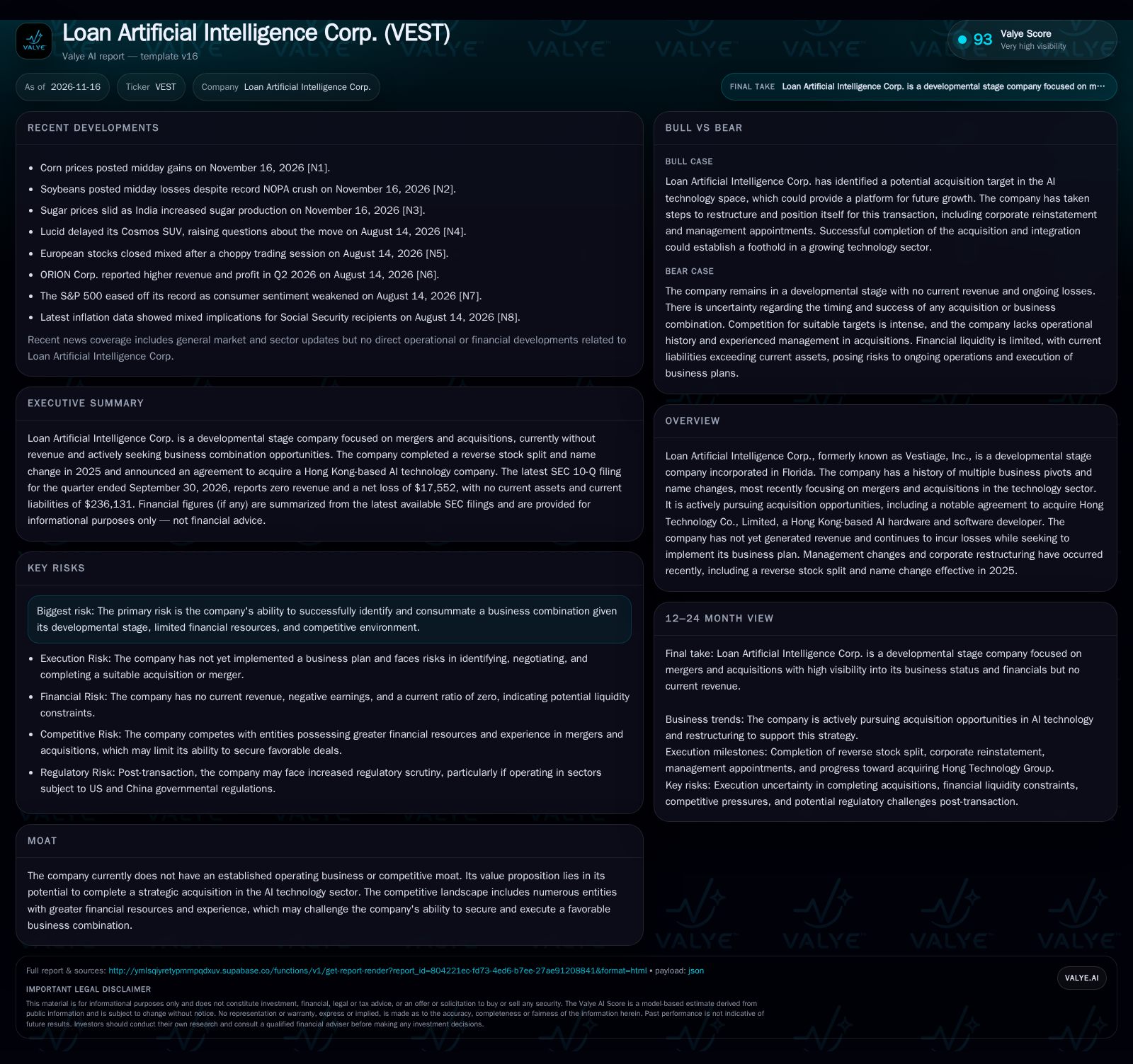
Loan Artificial Intelligence Corp., a developmental stage shell, reported zero revenue and a net loss of $17,552 last quarter while holding no current assets against $236,131 in current liabilities. Its future depends on consummating the acquisition of Hong Technology Co., Limited, a Hong Kong-based AI hardware and software firm, for which it recently received audited financials—an essential procedural step.
Loan Artificial Intelligence Corp. is a shell company in the purest sense: no revenue, no operating business, and no liquidity to meet its immediate obligations. Its entire thesis now revolves around a single, high-risk transaction—the proposed acquisition of Hong Technology Co., Limited, a Hong Kong-based AI hardware and software developer.
Acquisition Progress and Acute Liquidity Stress Define Present Reality
Loan Artificial Intelligence Corp. remains a developmental stage shell with no revenue and a net loss of $17,552 for the quarter ended September 30, 2026 [S2]. The company holds no current assets and reports $236,131 in current liabilities, resulting in a current ratio of zero [S2].
The company’s only material operational step is its agreement to acquire Hong Technology Co., Limited, a Hong Kong-based AI technology company. Audited financial statements for Hong Technology Group’s 2023 and 2024 fiscal years have been received, satisfying a key precondition for moving the acquisition forward [S1]. However, no revenue-generating activity or operating business exists as of the latest filings [S1] [S2].
Potential Economics of a Platform Pivot: AI Hardware and Software Integration
At present, Loan Artificial Intelligence Corp. has no revenue streams, cost structure, or operating leverage. Its financials are characterized by minimal expenses and recurring quarterly losses, typical of a shell entity [S2]. The company’s economics would fundamentally change only if the Hong Technology acquisition closes and integration succeeds.
If the deal proceeds, the business model would likely center on selling AI hardware and software solutions. In the AI sector, hardware (such as edge devices or custom chips) typically involves upfront sales with moderate gross margins, while software—especially if delivered as a subscription or platform—can offer higher margins and recurring revenue potential. The mix between hardware and software, pricing strategies, and customer verticals would determine the new entity’s revenue visibility, gross margin, and capital requirements.
Transitioning from shell to operator would also introduce fixed costs (R&D, sales, support, compliance) and capital needs for working capital, inventory, and potential product development. Long-term viability would depend on whether the acquired business can generate sufficient gross profit to cover these new fixed costs and support growth investments.
Beyond the immediate post-acquisition integration, the scalability of the combined AI hardware and software platform will critically influence long-term economics. If the company can leverage modular hardware designs and cloud-based software delivery, it may achieve economies of scale and improve gross margins over time. However, this depends on successfully balancing capital expenditures for hardware production with recurring software revenue growth. Additionally, the company’s ability to innovate and rapidly iterate product offerings in response to evolving AI applications will affect its competitive positioning and profitability. The interplay between upfront hardware sales and subscription-based software services will shape cash flow profiles and investment cycles.
From Shell to AI Contender: Barriers and Battlefields in a Crowded Sector
Loan Artificial Intelligence Corp. currently has no operating moat, no established customer relationships, and no proprietary assets. Its value proposition rests entirely on the pending Hong Technology acquisition, which would position it in the highly competitive AI hardware and software market.
The AI sector is dominated by incumbent technology firms with deep R&D budgets, established distribution, and global reach. Barriers to entry include technical expertise, intellectual property, customer trust, and ecosystem lock-in. Even if Hong Technology’s products are differentiated, the combined entity would face formidable rivals across both hardware and software categories, including platform providers, chip makers, and vertical AI specialists.
Switching costs and customer retention in AI are typically driven by integration depth, software stickiness, and long-term support contracts. To build a defensible position, the company would need to demonstrate unique value—such as proprietary algorithms, specialized hardware, or integration into critical workflows. Without these, it risks being marginalized by larger or more agile competitors with greater financial and operational resources.
A Successful Acquisition Unlocks a Viable AI Platform
The most favorable scenario is that Loan Artificial Intelligence Corp. completes the Hong Technology acquisition, seamlessly integrates it, and rapidly transitions to a revenue-generating AI platform. If Hong Technology’s products have established market fit and the combined entity can secure immediate contracts or partnerships, Loan AI could achieve positive cash flow and begin scaling.
Evidence that would confirm this scenario includes public disclosure of deal closing, onboarding of Hong Technology’s management and technical teams, customer wins or contract announcements, and subsequent revenue recognition. Early signs of recurring software revenue, robust gross margins, and successful product launches would further validate the upside path.
This scenario would require overcoming the current liquidity crisis—possibly via bridge financing or raising capital concurrent with the acquisition. The company would also need to demonstrate operational discipline, rapid go-to-market execution, and the ability to compete against established AI players.
Incremental Progress Amid Funding Pressure and Execution Hurdles
The most plausible path is a protracted acquisition process in which Loan Artificial Intelligence Corp. continues to incur losses while negotiating, finalizing, and attempting to fund the Hong Technology transaction. Progress may be incremental: additional due diligence, regulatory filings, and sporadic updates, but with no revenue or operational activity until the deal closes.
This scenario would be confirmed by continued public filings referencing the pending deal, modest increases in short-term liabilities, and efforts to raise bridge financing or restructure obligations. If the acquisition stalls or if the company fails to secure adequate funding, the shell may remain dormant or face creditor pressure.
Falsifying evidence would include withdrawal from the acquisition, public statements about failed negotiations, or legal/financial developments that preclude deal completion. Until the transaction closes and integration begins, the company is likely to remain in a holding pattern with acute liquidity risk.
Deal Failure or Funding Shortfall Forces Dissolution or Prolonged Dormancy
In the adverse scenario, the Hong Technology deal collapses or the company fails to raise sufficient funds to close and integrate the acquisition. With no operating business and liabilities exceeding assets, Loan Artificial Intelligence Corp. could face forced dissolution, creditor action, or indefinite shell status.
This outcome would be confirmed by public withdrawal from the acquisition, default notices, or regulatory filings indicating inability to meet obligations.
Even if the shell persists, ongoing losses and management turnover could erode any remaining strategic optionality, leaving the company unable to participate meaningfully in the AI sector.
Milestones That Will Determine the Fate of Loan AI’s Platform Ambitions
Disclosure of definitive closing terms and completion date for the Hong Technology acquisition would be the first major inflection point.
Appointment and retention of experienced management and technical leadership from Hong Technology would help test integration and execution capacity.
Initial customer contracts, partnerships, or commercial pilots—if disclosed—would indicate early market acceptance and revenue potential.
Public filings regarding regulatory approvals or cross-border transaction hurdles could materially impact deal timing and feasibility.
A useful metric would be monthly cash burn and current liability trends to gauge runway and near-term funding needs.
Disclosure of product roadmap, technology differentiation, or intellectual property portfolio post-acquisition would clarify competitive positioning.
Monitoring the company’s capital structure evolution post-acquisition will be essential to understanding its potential financial flexibility. Metrics such as debt-to-equity ratio, access to credit lines, and timing of capital raises will indicate whether the company can sustain operational growth and weather market volatility. Furthermore, tracking integration milestones—like system interoperability, unified branding, and consolidated reporting—will provide insight into execution effectiveness. The pace at which recurring revenue streams develop, especially from software subscriptions or service contracts, will help assess the transition from a transactional hardware seller to a platform-oriented business model. Lastly, observing customer retention rates and contract renewal terms will shed light on competitive positioning and product-market fit.
Disclaimer: This is research-only, informational analysis and not investment advice. It may include AI-generated interpretation and general industry context. Always verify important details using primary sources.

Comments