
Venture Global's Financial Surge and LNG Project Expansion in 2025
Assessing how Venture Global’s recent financial performance and strategic project development shape its growth trajectory and capital structure dynamics.
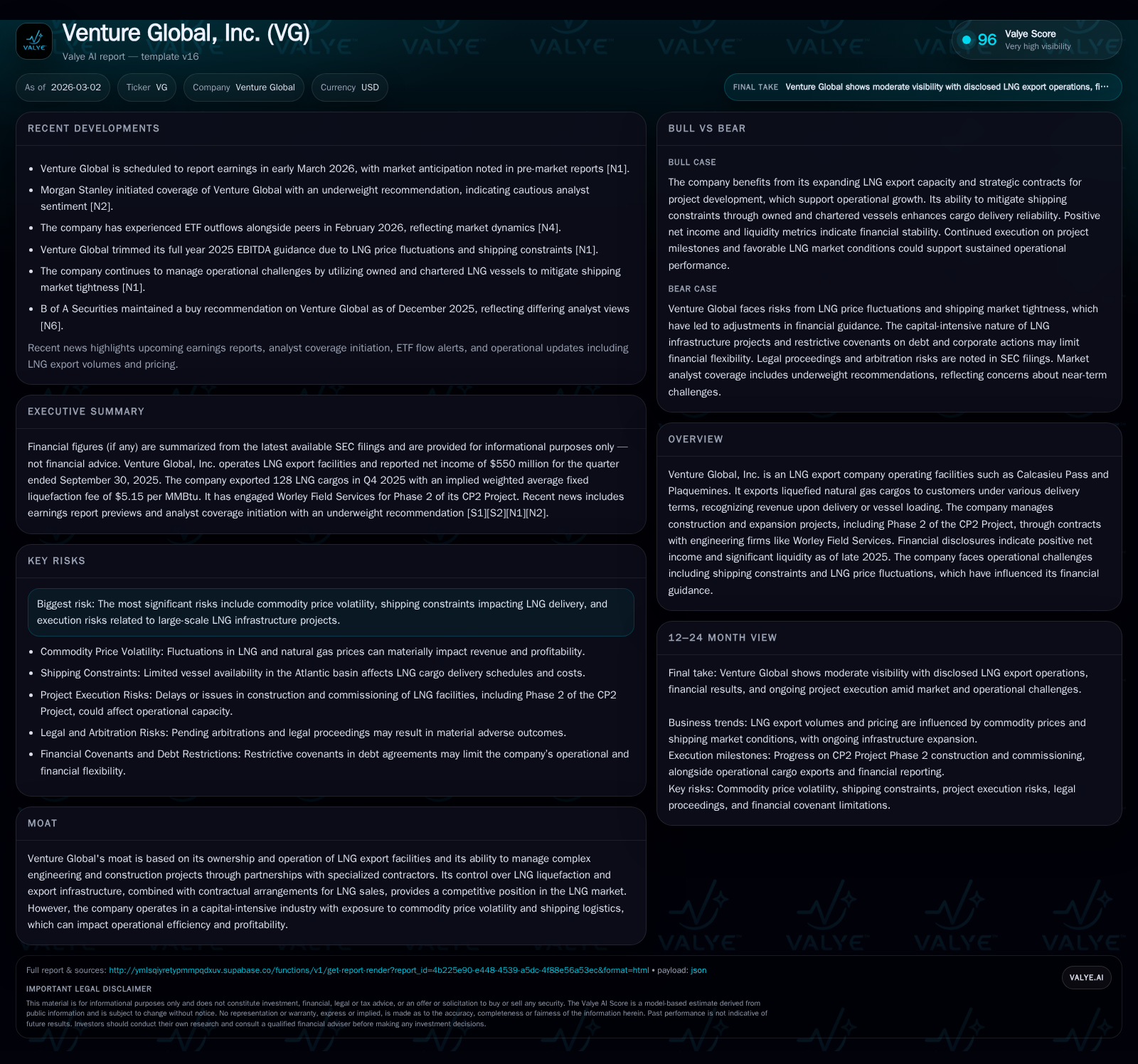
Venture Global, Inc. posted a net income of $2.73 billion in 2025 driven by robust LNG export operations from its Calcasieu Pass and Plaquemines facilities. The company advanced construction on the Calcasieu Pass Phase 2 project, contracting Worley Field Services for complex EPC activities, signaling growth in liquefaction capacity. While revenue recognition varies by contract delivery terms, shipping constraints and commodity price volatility continue to pose operational risks. The issuance of senior secured notes enhances liquidity but includes covenants restricting financial flexibility. Despite significant capital expenditures resulting in negative free cash flow, Venture Global maintains strong profitability indicated by a 40.5% ROE. Market sentiment includes cautious outlooks with analyst downgrades reflecting supply-chain and pricing uncertainties.
Strong Financial Performance in 2025 Reflects LNG Market Execution
Historical performance (annual)
| FY |
|---|
| 2025 |
Source: SEC companyfacts cache [F1].
Venture Global demonstrated notable financial momentum in fiscal year 2025, driven primarily by its LNG export activities from two principal facilities: Calcasieu Pass and Plaquemines. The company reported operating income of approximately $5.16 billion and net income of $2.73 billion as of December 31, 2025 [F1]. This level of profitability corresponds to an estimated return on equity of about 40.5%, signaling robust earnings relative to shareholder equity despite the capital-intensive nature of the LNG sector.
Operationally, Venture Global exported a total of 128 cargoes during the year, shipping around 478 TBtu of LNG. These deliveries were split between Calcasieu Pass (38 cargos) and Plaquemines (90 cargos), evidencing both facilities' vital roles within the company's portfolio [S24]. Despite supply chain challenges, particularly vessel availability constraints within the Atlantic basin, utilization of owned and chartered vessels helped mitigate some distribution bottlenecks [S24].
The company's current ratio near year-end stood at approximately 0.93 (current assets of $4.04 billion against current liabilities of $4.34 billion), indicating slight short-term liquidity tension that is not unexpected given ongoing large-scale capital commitments [F1].
Project Development Highlights: Calcasieu Pass Phase 2 and Plaquemines
A pivotal driver of anticipated growth is the advancement of infrastructure projects designed to expand liquefaction capacity—the most notable being the Calcasieu Pass Phase 2 (CP2) expansion. On January 30, 2026, Venture Global CP2 LNG, LLC entered into an engineering, procurement, and construction (EPC) contract with Worley Field Services Inc., assigning them comprehensive responsibility including design integration, procurement coordination for items outside existing vendor agreements, supervision of subcontractors, installation oversight, power plant construction, quality compliance, commissioning tests, warranty obligations, and invoice reconciliation [S20].
This engagement reflects a sector-standard approach—where major EPC contractors ensure seamless integration among various suppliers’ equipment packages while guaranteeing operational readiness upon completion.
Plaquemines continues to be a key export facility but less detail was disclosed about specific expansions there during this period; however, it remains central to Venture Global’s broader strategic footprint offering diverse geographic exposure within the Gulf Coast LNG corridor [S6].
Revenue Recognition Nuances Under Diverse Contract Delivery Terms
Revenue timing is nuanced due to heterogeneous contractual terms between Free on Board (FOB) sales where revenue recognition occurs when LNG is loaded onto vessels at export terminals versus Delivered Ex-Ship (DES), Delivered Place Unloaded (DPU), or other delivered terms where revenue recognizes only upon cargo delivery at destination ports [S13].
This segmentation complicates quarterly earnings comparability because shipments under DES/DPU contracts can span multiple reporting periods depending on maritime transit durations—exemplified in Q4 2025 by one DES cargo exported but accounted for in subsequent quarters [S13]. Sector insiders recognize such revenue recognition distinctions as material to understanding cash flow timing and working capital dynamics.
Navigating Shipping Constraints and Commodity Volatility Risks
Despite strong export volumes overall, the company confronted shipping constraints limiting vessel availability across Atlantic routes during late-2025 quarters, which pressured both cargo scheduling flexibility and liquefaction fee realizations—evidenced by a weighted average fixed liquefaction fee dropping to approximately $5.15 per MMBtu in Q4 from earlier levels [S24]. Commodity price volatility further complicated guidance accuracy by impacting hedging assumptions and revenues tied to Henry Hub price fluctuations.
Operationally, these factors contribute risk premiums embedded in contracts but also translate into challenges maintaining steady throughput—and these headwinds have been flagged repeatedly as key risk variables in regulatory filings including arbitration outcomes affecting related SPAs (Sales Purchase Agreements) [S7][N3].
Capital Structure Developments: Senior Secured Notes and Debt Covenants
To underpin expansion activities while maintaining funding flexibility, Venture Global closed offerings aggregating $3 billion in senior secured notes split between $1.75 billion maturing in 2030 at an interest rate of 6.125% and $1.25 billion maturing in 2034 at an interest rate of 6.5% [S8][S10]. These notes are secured by collateral overlapping with prior term loans and revolving credit facilities forming a borrowing base.
Notably, the indentures impose standard maintenance covenants restricting restricted payments such as dividends or buybacks, incurrence of additional liens or indebtedness without consent, asset sales limitations outside prescribed parameters, merger restrictions requiring approvals, limitations on affiliate transactions, hedging requirements adherence, along with mandates for account maintenance specific to project subsidiaries involved in collateral pools [S5][S8][S10]. Redemption options include make-whole provisions until specified call dates allowing prepayment flexibility aligned with industry norms.
Such covenant structures aim to preserve asset quality shielding creditor interests but constrain management discretion on capital return initiatives while debt balances remain elevated.
Evaluating Cash Flow Dynamics and Free Cash Flow Challenges
While EBITDA-type profitability metrics are strong reflecting operational scale-up success—and net income surged—the cash flow narrative reveals pressures consistent with early-stage infrastructure buildouts.
Free cash flow calculated as operating cash flow minus capital expenditures showed a negative total of nearly $6.8 billion as capex vastly exceeded cash generated from operations over the latest fiscal year end period [F1]. This large investment outlay underscores that despite reported profitability from ongoing liquefaction fees receipt, substantial commissioned asset additions alongside pipeline infrastructure expansions are yet consuming significant resources.
Liquidity remains adequate aided by strong cash balances upwards of $2.35 billion at year-end combined with credit facilities; however ongoing capex demands require prudent funding oversight.[F1]
Outlook and Market Expectations: What to Monitor in Upcoming Quarters
Explicit quantitative guidance for future quarters has not been recently updated beyond a narrowed full-year Consolidated Adjusted EBITDA range around $6.18–$6.24 billion reflecting tightened expectations resultant from shipping tightness and price variance considerations [S28].
Attention should focus on critical milestones such as CP2 commissioning timelines under Worley’s EPC contract delivering new liquefaction capacity—a determinative event for scaling output—and managing arbitration resolutions regarding long-term SPA contracts which have potential implications for revenue stability amidst incurred counterparty disputes [N3][N5][N4].
Morgan Stanley recently initiated coverage framing an underweight stance citing risks associated with supply chain bottlenecks and commodity pricing pressures suggesting investor caution despite strong top-line projected growth potentials [N4]. This sentiment highlights market sensitivity toward execution risk inherent to large LNG infrastructure enterprises.
Dividend Policy, Buybacks, and Return on Equity Considerations
No dividends or share repurchase programs have been announced or highlighted within recent disclosures suggesting reinvestment prioritization geared toward capital project funding rather than shareholder distributions at this stage [F1][S1]. This aligns logically given the scale of ongoing capex commitments outlined above.
Nevertheless, the high ROE near 40.5% signals efficient use of equity capital generating substantial returns relative to shareholder base even absent capital return mechanisms thus far reported—illustrative that core assets are profitable amid growth expenditure phases rather than eroding shareholder value through dilution or idle cash holdings [F1].
Disclaimer: This analysis is based solely on publicly available information provided through SEC filings and reputable news sources up to early March 2026. It should not be construed as investment advice or recommendation but as an analytical summary intended for informational purposes only.
Disclaimer: This is research-only, informational analysis and not investment advice. It may include AI-generated interpretation and general industry context. Always verify important details using primary sources.

Comments