
Vine Hill Capital Investment Corp. II’s Strategic Positioning in the Blank Check Arena
Vine Hill Capital Investment Corp. II remains poised to leverage its seasoned management team and capital structure as it pursues its initial business combination within the SPAC market.
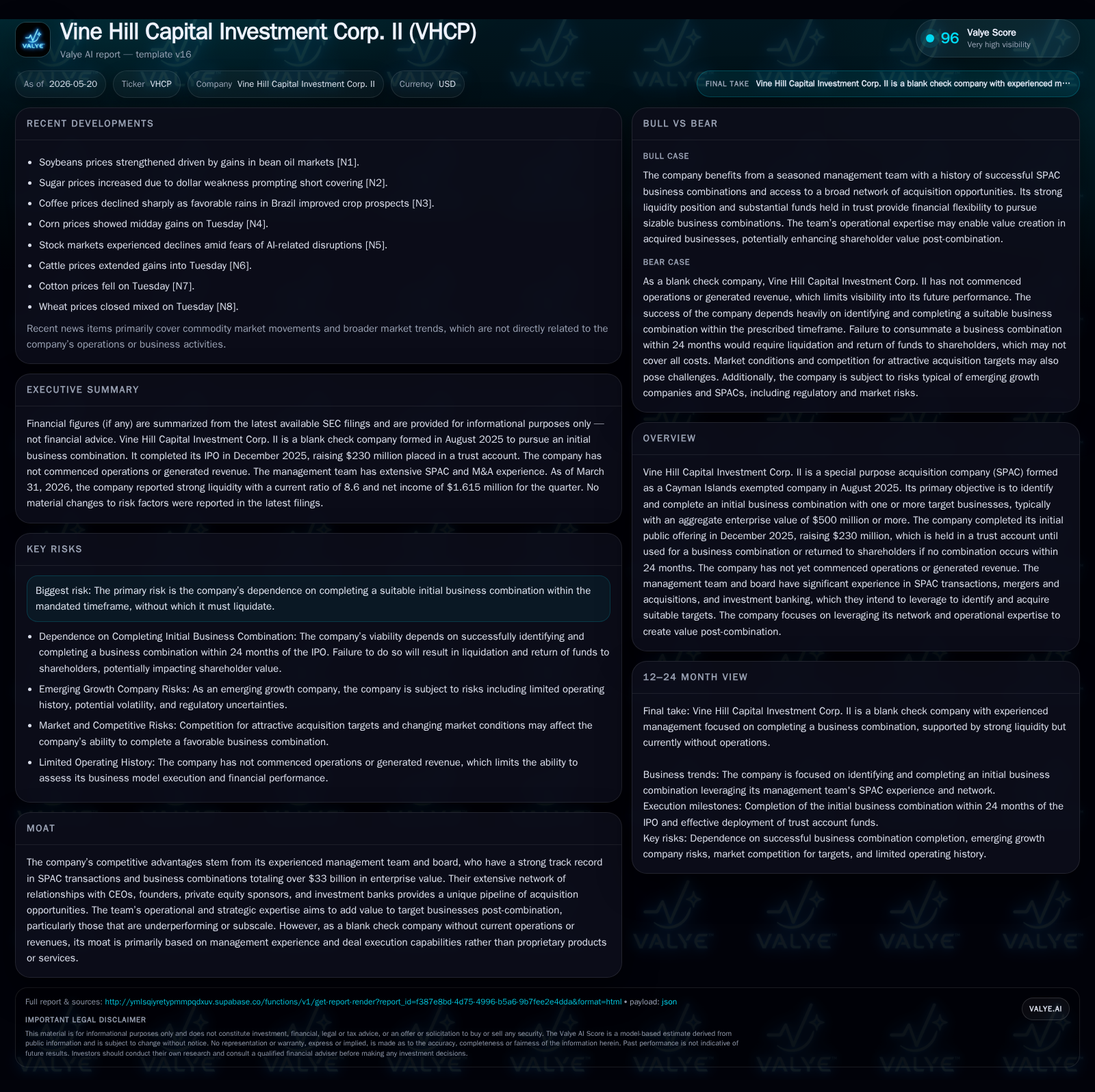
Vine Hill Capital Investment Corp. II, a Cayman Islands-based special purpose acquisition company launched in August 2025, continues to hold $230 million in trust pursuant to its December 2025 IPO as it seeks an initial merger or acquisition target valued at $500 million or more. The latest quarterly filing confirms no operational revenues but strong liquidity and nominal debt, underscoring the firm’s dependence on successful deal execution within a 24-month timeframe. The company’s competitive strengths center on its management’s proven track record totaling over $33 billion in SPAC-related enterprise value and an expansive network facilitating quality deal flow. Market dynamics such as rising directors' and officers’ insurance costs and shareholder redemption risks remain watchpoints alongside regulatory factors shaping transaction feasibility.
Latest Quarterly Filing Update: Status and Implications
Vine Hill Capital Investment Corp. II’s most recent operational disclosure, filed in its May 14, 2026 10-Q [S2], presents a status quo picture typical for special purpose acquisition companies (SPACs) in their pre-combination phase. The entity has not commenced any operations nor generated revenue since formation. All capital raised—$230 million net proceeds from the December 2025 IPO—is held securely in a trust account dedicated exclusively to future deployment toward the initial business combination or returned to shareholders if no qualifying transaction is completed within the stipulated window [S1]. The quarterly filing confirms no material change to risk exposures disclosed at IPO. There is nominal debt reported as of late September 2025 ($25,000) with current assets around $2.62 million against liabilities of roughly $305,000 yielding a healthy current ratio near 8.6 [F1], signaling strong liquidity and financial flexibility during this search phase.
This aligns with Vine Hill II’s core mandate: prudently managing capital until identifying and consummating an acquisition with an enterprise value threshold not less than $500 million. Maintaining trust account integrity remains paramount since these funds effectively anchor shareholder value, barring redemptions linked to proposed business combinations. There has been no indication yet of nearing deal announcement or definitive agreements as per recent filings, underscoring the ongoing diligence process.
SPAC Business Model Overview: Capital Structure and Deal Thesis
Formed as a Cayman Islands exempted company in August 2025 and conducted its IPO by December that year, Vine Hill II’s essential business model revolves around raising funds through the issuance of Class A ordinary shares bundled into units—each consisting of one share plus warrants—and holding these funds in a segregated trust account [S1]. Sponsor commitments come via founder shares at nominal cost initially with incentives including private placement warrants designed to align interests upon deal completion.
Revenue is not derived from operations but contingent on successfully identifying one or more acquisition targets meeting the size criterion (≥$500 million enterprise value). Upon consummation of the initial business combination, Vine Hill II transitions into an operating entity via merger or reorganization with the target company. This unlocks shareholder equity participation in ongoing cash flows and growth prospects stemming from acquired businesses’ underlying assets and operations.
Financial incentives embedded include deferred underwriting commissions payable only upon deal closure as well as potential cash considerations allocated to targets for working capital or corporate purposes as negotiated during transactions [S1]. The model inherently carries execution risk based on timing constraints (24 months from IPO) and risk-return asymmetry shaped by redemption mechanics where shareholders may elect out prior to combination close, thus impacting net deal proceeds.
Management Expertise and Strategic Moat
Vine Hill II’s principal distinguishing asset lies in its management team and board whose collective experience spans SPAC transactions representing over $33 billion in aggregate enterprise value [S1]. This depth ensures an established pipeline anchored by longstanding relationships across private equity sponsors, founders, CEOs, and investment banks—a critical advantage given the highly competitive landscape for suitable targets.
Unlike traditional companies relying on product intellectual property or tangible assets for moats, Vine Hill II's strategic differentiation lies in its execution capabilities and access. The operators' credibility enhances negotiating leverage when sourcing deals including affiliated opportunities or joint ventures with aligned sponsors or executives.
Post-merger operational support targeting underperforming or subscale firms reflects a strategic angle designed to add measurable value beyond mere financial engineering. This operational expertise potentially accelerates integration benefits which are key differentiators among blank check peers aiming to avoid purely financial arbitrage outcomes.
Competitive Landscape: SPAC Sector Dynamics and Peer Benchmarking
The broader SPAC industry faces notable challenges impacting companies like Vine Hill II. A pressing factor described in the annual report relates to escalating directors’ and officers’ (D&O) liability insurance premiums that have tightened dramatically following recent market-wide shifts [S1]. Reduced availability and costlier coverage complicate transaction structuring by increasing expenses post-business combination while also raising risks for executive retention.
Furthermore, competitive pressure for compelling acquisition targets remains intense amid fluctuating market sentiment surrounding SPAC vehicles generally. While direct peer valuation metrics are limited due to lack of disclosed data, this environment elevates execution risk since attractive standalone targets are scarce relative to demand.
Governance complexities also arise from discretionary shareholder approval mechanisms; Vine Hill II may proceed with combinations absent majority vote depending on legal jurisdiction or exchange requirements—adding unpredictability about investor engagement outcomes.
Growth Drivers: Deal Pipeline and Value-Add Potential
The key growth driver for Vine Hill II is timely identification and closure of attractive initial business combinations meeting enterprise value thresholds with favorable terms [S1]. Given management’s active research efforts into multiple prospective targets—including possible affiliated entities—the quality of sourced pipeline is expectedly solid though undisclosed currently.
Successful deal completion will transform Vine Hill II from a capital vehicle into a diversified operating platform benefiting from operational improvements led by seasoned executives targeting accretive growth post-combination.
Flexibility inherent in pursuing mergers, share exchanges, asset acquisitions, reorganizations, or joint ownership structures enhances pipeline breadth and mitigates structural constraints limiting deal types. Additionally, leveraging sponsor networks can enable co-investment opportunities enhancing post-combination scale effects.
Risks and Growth Constraints: Time Deadlines, Market Conditions, and Regulatory Factors
A defining constraint remains the statutory two-year window post-IPO within which an initial business combination must close; failure triggers mandatory liquidation requiring return of trust proceeds less permitted expenses leading to total investment write-off risk [S1]. Market conditions influencing this timeline include heightened D&O insurance costs causing transaction delays or escalating expenses adversely impacting economics.
Another layer of complexity arises from redemption rights exercisable by public shareholders potentially reducing cash available at closing thereby forcing renegotiations or less favorable terms [S1]. Moreover, conflicts inherent where underwriters engaged as M&A advisors hold deferred commissions create tension between advisory objectivity versus fee realization incentives
Lastly, governance arrangements allowing Vine Hill II discretion over seeking shareholder votes could foster dissent among investors uneasy with opaque decision-making frameworks potentially precipitating reputational risks despite compliance with Cayman Islands legal provisions.
Milestones to Monitor: Initial Business Combination Progress and Shareholder Considerations
Near-term indicators worthy of attention include any public announcements regarding definitive agreements toward an initial business combination given proximity typically signals impending shareholder engagement events [S1]. The specifics around redemption mechanisms—whether through tender offers or mandatory repurchases—as well as terms surrounding cash consideration allocations will be critical determinants framing investor appetite.
Securing sufficiently comprehensive D&O insurance at economically viable levels remains another milestone impacting deal certainty post-announcement [S1]. Timing of shareholder meetings if held voluntarily underlines governance transparency prospects directly influencing trading performance following proxy solicitation windows.
Although no such disclosures have occurred recently per filings reviewed through May 2026, readiness protocols embedded within current filings suggest management is positioned for prompt updates when appropriate pursuit materializes [S2]
Financial Snapshot: Liquidity Position and Capital Allocation Framework
Despite operating without revenues or active constituents beyond sponsor equity interests currently, Vine Hill II’s balance sheet exhibits strong liquidity preservation consistent with conservative trust account stewardship [F1]. As of March 31, 2026, current assets stood at approximately $2.62 million against liabilities near $305,000 alongside minimal total debt amounts recorded previously ($25,000), indicating negligible leverage pressures [F1].
Net income positive at just over $1.6 million through this period reflects minimal non-operating gains rather than substantive earnings tied to business activities given blank-check status [F1]. This financial profile supports uninterrupted operating capability across administrative functions required during search phase while safeguarding principal invested capital earmarked for acquisitions.
The allocation framework mandates strict segregation between funds reserved for merger deployment versus those used for fees or taxes ensuring investor protections common in well-structured SPACs continue intact until transformative deal closure occurs.
Disclaimer: This analysis is provided solely for informational purposes based on publicly available information including SEC filings as of May 2026. It does not constitute investment advice or research views regarding securities issued by Vine Hill Capital Investment Corp. II or any other entity.
Disclaimer: This is research-only, informational analysis and not investment advice. It may include AI-generated interpretation and general industry context. Always verify important details using primary sources.

Comments