
VICI Properties Enhances Portfolio Stability with Long-Term Triple-Net Leases
VICI Properties leverages a distinctive triple-net lease model and premium gaming assets to sustain steady growth and navigate sector-specific challenges.
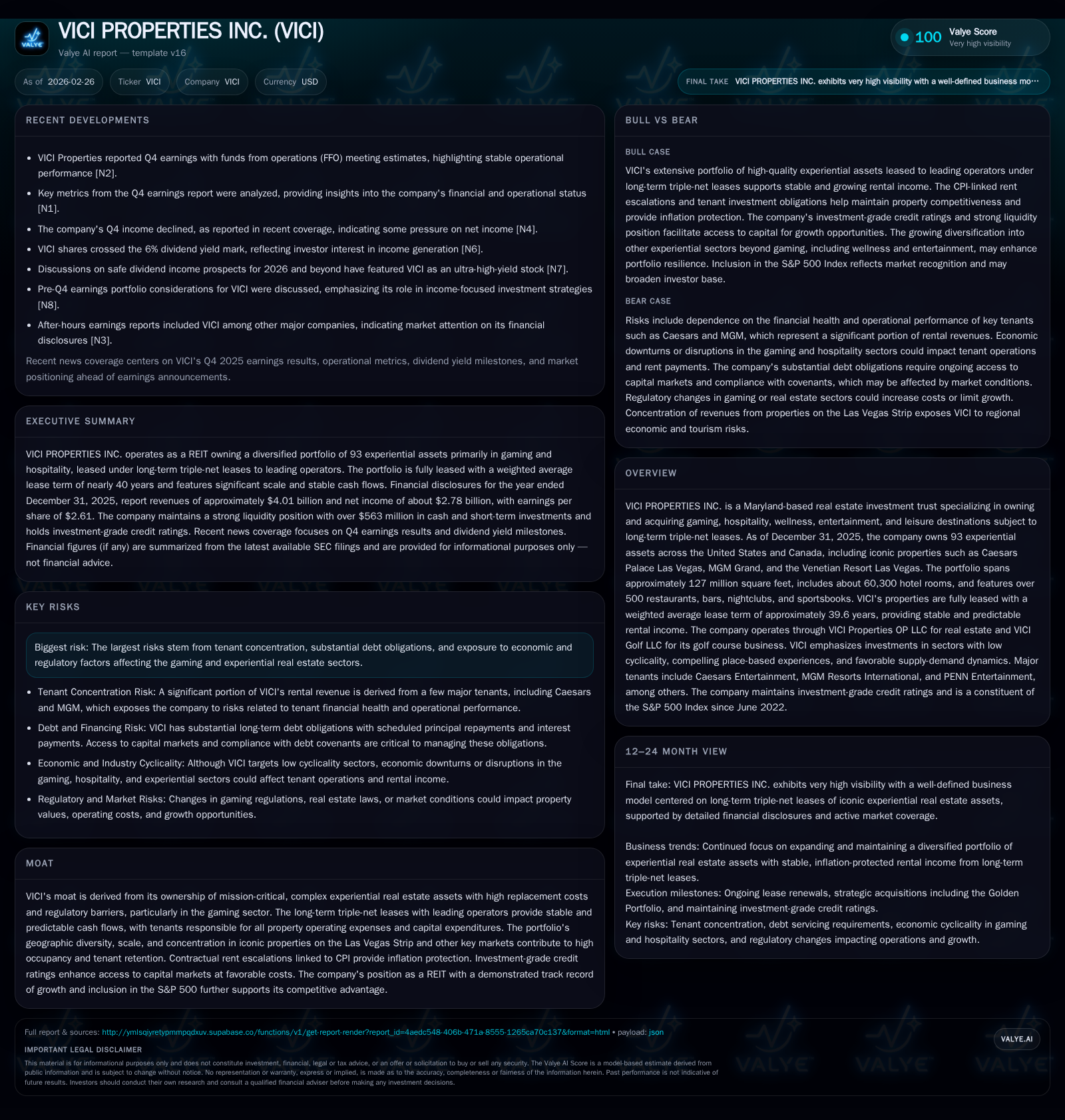
VICI Properties Inc., through ownership of iconic gaming and experiential real estate under long-term triple-net leases, has demonstrated robust revenue and net income growth up to 2025. Its portfolio, including landmark Las Vegas properties, underpins predictable cash flows with tenant responsibility for capital expenditures and operational costs. The company’s capital strategy balances significant debt obligations with investment-grade credit ratings, supporting dividend payouts and expansion plans. Key risks include tenant concentration and upcoming debt maturities, which merit monitoring alongside lease renewal trends and capital markets access.
Robust Growth Fueled by Premier Gaming and Experiential Assets
VICI Properties has expanded its top-line consistently over recent years, leveraging a dominant position as a REIT owning marquee gaming and hospitality assets across North America. Revenue climbed from approximately $2.60 billion in fiscal year (FY) 2022 to about $4.01 billion by FY 2025—a compound acceleration notably supported by acquisitions such as the consolidation of MGM Grand/Mandalay Bay properties [F1]. Net income tallied nearly $2.78 billion in 2025, representing stable growth amid a challenging operating environment for experiential real estate [F1].
The portfolio includes iconic properties like Caesars Palace Las Vegas and The Venetian Resort Las Vegas encompassing more than 127 million square feet of experiential real estate including roughly 60,300 hotel rooms and over 500 venues such as restaurants and sportsbooks [S1]. This scale lends broad market exposure with geographic diversity across urban destination markets.
Triple-Net Lease Model Secures Predictable Income Streams
A cornerstone of VICI’s financial resilience is its long-term triple-net lease agreements under which tenants bear all operating costs—property taxes, insurance, maintenance, and capital expenditures—transferring expense volatility away from the landlord. These leases have an average weighted lease expiry (WALE) of approximately 39.6 years when including extension options, providing long-duration income stability seldom matched in commercial real estate sectors [S1][S27].
Additionally, most leases incorporate rent escalation clauses linked to consumer price index (CPI) measurements with caps aligned per contract specifics. Approximately fifteen out of seventeen major leases feature CPI-linked escalations ranging from fixed annual increases of 1-2% or combinations thereof—offering protection against inflationary pressures [S27].
Portfolio Expansion and Diversification Into New Experiential Sectors
While core gaming properties constitute the bulk of VICI’s holdings, the company has strategically invested in complementary experiential real estate sectors including wellness centers (e.g., Canyon Ranch), golf course operations near flagship assets (four championship courses including two near the Vegas Strip), family entertainment venues such as Great Wolf Resorts, and bowling centers via Lucky Strike Entertainment [S1][N13].
Further, through partnerships like the Partner Property Growth Fund initiative at Venetian Capital Investment, VICI positions itself to support tenant-led value enhancement projects that may convert loan investments into property ownership opportunities over time, facilitating pipeline expansion beyond traditional gaming footprints [S21][N13]. This multi-pronged approach helps mitigate sector seasonality and concentrate risk.
Capital Structure Focused on Access and Flexibility Amid Market Conditions
VICI reported roughly $17.1 billion in outstanding debt at December 31, 2025, comprised primarily of senior unsecured notes issued between 2019 and April 2025 along with a $2.5 billion revolving credit facility maturing in February 2029 that includes extension options subject to customary conditions [S4][S14][S25]. The note maturities are staggered but notably include $500 million due September 2026 and $1.25 billion due December 2026—with subsequent maturities spread through mid-century reflecting deliberate liability management that limits liquidity risk concentration [S9][S16].
Interest rates on debt average approximately 4.41% weighted with certain forward-starting interest rate swaps settled prior to year-end reducing cash flow volatility from market rates; no outstanding derivatives remained at end-2025 [S16][S22]. Governance documents impose customary covenants restricting additional indebtedness but allow flexibility aligned with REIT distribution requirements.
Maintaining investment-grade ratings enables favorable borrowing terms despite macroeconomic uncertainties tied to REIT sectors or broader market cycles [S14]. VICI regularly evaluates optimal funding sources balancing debt issuance against equity offerings under an ATM program that netted over $375 million in proceeds during FY 2025 [S19].
Dividend Yield Attraction Supported by Strong Cash Flows and Returns
Operating cash flow increased to approximately $2.51 billion in FY 2025 from about $2.38 billion in FY 2024 (+5.4%), supporting dividend payments exceeding $1.85 billion during the period—a payout well-covered by operational free cash flow after minimal corporate capital investments given tenant expense pass-throughs [F1][S29]. Capital expenditures remain nominal relative to size (~$3 million last reported), underscoring the pure landlord role of VICI under triple-net structures.
The approximate return on equity stands near a consistent 10%, mirroring metrics around the company's initial public offering period—a strong indicator of capital efficiency within its asset class niche [F1]. Dividends currently present yields above six percent range noted by analysts as attractive among institutional income-focused investors amidst lower interest rate backdrops [N7][N8].
Risks From Tenant Concentration and Debt Maturity Profile
Principal risk factors include a client concentration wherein Caesars Entertainment accounts for substantial rental revenue share alongside other major gaming operators whose financial health directly influences lease stability [S1][S27]. Regulatory shifts governing casino operations or economic downturns impacting leisure spending could pressure tenant cash flows.
The considerable outstanding debt balance with notable maturities clustered in second half of calendar year 2026 necessitates successful refinancing or repayment strategies to avoid liquidity stress scenarios despite diversified creditors and investment-grade status [S14][S16][S18]. Monitoring covenant compliance amid evolving economic cycles remains imperative.
Key Metrics Highlighting Financial and Operational Performance (2017–2025)
Historical performance (annual)
| FY | Rev ($bn) | Net ($bn) | CFO ($bn) | Rev YoY | Net YoY |
|---|---|---|---|---|---|
| 2025 | 4.0 | 2.8 | 2.5 | +4.1% | +3.6% |
| 2024 | 3.8 | 2.7 | 2.4 | +6.6% | +6.6% |
| 2023 | 3.6 | 2.5 | 2.2 | +38.9% | +124.9% |
| 2022 | 2.6 | 1.1 | 1.9 |
Source: SEC companyfacts cache [F1].
Capital returns and efficiency (annual)
| FY | Div ($mm) | ROE% |
|---|---|---|
| 2025 | 1853 | 10.0 |
| 2024 | 1753 | 10.1 |
| 2023 | 1584 | 10.0 |
| 2022 | 1219 | 5.1 |
Source: SEC companyfacts cache [F1].
The table reflects strong revenue momentum particularly post-2022 acquisition activity alongside steady net income gains rooted in contractual lease earnings insulated from operating expense volatility by tenant expense pass-throughs.
Market Expectations and Strategic Indicators to Monitor
Looking ahead through late FY 2026 and beyond, attention centers on how effectively VICI navigates maturing debt instrument refinancing amidst fluctuating capital market conditions—a determinant for upkeep of cost-efficient financing profiles [N1][N4]. Lease renewals especially those involving marquee tenants will materially influence forward rent trajectories while tenant decisions on value-add initiatives funded through the Partner Property Growth Fund represent leverage points for incremental portfolio growth separate from traditional acquisitions [N13][S21].
Capital allocation choices between dividends versus share repurchases warrant observation given current high yield appeal contrasted against refinancing needs; discretionary share repurchase programs reported remain modest relative to dividend commitments but offer flexible shareholder return levers if liquidity permits [N3][S29]. Monitoring these parameters alongside broader economic factors affecting leisure spending will indicate sustainability of VICI’s stable growth trajectory.
This report synthesizes publicly available data without offering investment recommendations or price targets. It aims solely to provide an analytical overview grounded in verified financial disclosures and sector context.
Disclaimer: This is research-only, informational analysis and not investment advice. It may include AI-generated interpretation and general industry context. Always verify important details using primary sources.

Comments