
Visium Technologies Pursues Strategic Expansion Amid Financial Strains
Visium advances its proprietary cybersecurity platform and strategic acquisitions as it navigates significant liquidity challenges and operational restructuring.
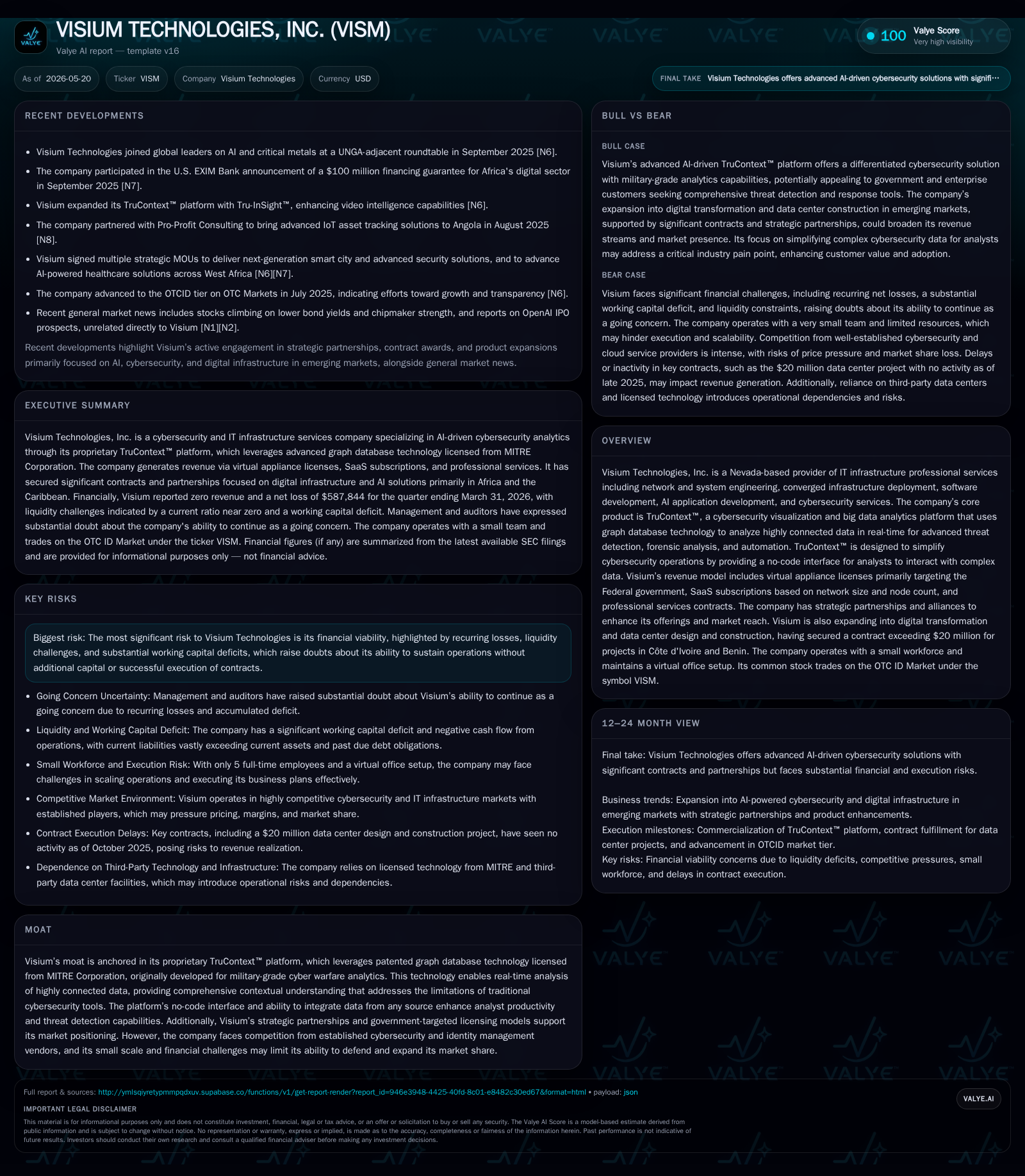
In its latest quarterly filing dated May 20, 2026, Visium Technologies disclosed ongoing financial pressures highlighted by substantial working capital deficits and negative cash flow, underscoring near-term liquidity constraints. Concurrently, the company is actively pursuing strategic growth through the formation of PTNA Acquisition Corp., a vehicle designed to facilitate acquisitions in AI, cybersecurity, and alternative energy sectors. Visium's core strength lies in its TruContext™ platform—an advanced cybersecurity analytics tool built on patented graph database technology licensed from MITRE Corporation—targeting primarily federal government clients via a licensing and SaaS model. However, scale limitations, intense competition from established cybersecurity vendors and cloud providers, and execution risks weigh on growth prospects. Key upcoming milestones include closing acquisition deals under PTNA and advancing delayed data center contracts, which will be critical indicators for operational momentum.
Latest Quarterly Operating Overview and Strategic Update
Visium Technologies’ May 20, 2026 Form 10-Q filing does not provide explicit current liquidity metrics; however, companyfacts data as of March 31, 2026 shows current liabilities of approximately $6.8 million against current assets near $12,540 [F1], translating into a zero current ratio—a critical solvency red flag. Cash equivalents totaled about $8,247 at fiscal year end March 2026 [F1], highlighting severe cash-flow constraints exacerbated by recurring net losses detailed in prior annual disclosures.
In tandem with its liquidity considerations, Visium accelerated structural transformation by establishing PTNA Acquisition Corp., a Delaware C-Corporation subsidiary created specifically to conduct arm’s-length mergers and acquisitions in the agentic AI, cybersecurity, and alternative energy domains [S3][S22]. PTNA is architected as a bankruptcy-remote vehicle to insulate Visium’s core business from legacy obligations while unlocking flexibility for rapid deal execution and future financing activities such as private placements or public offerings.
This dual reality—financial fragility paired with active corporate expansion initiatives—defines the current operational landscape for Visium. The company’s board mandated strict observance of corporate separateness protocols to preserve liability protections during PTNA’s maiden acquisition targets: AI Capital UK and AI Capital Indonesia entities currently undergoing due diligence and definitive agreement negotiations [S3].
Company Business Model and Proprietary Product Suite
At its core, Visium operates within the highly specialized domain of IT infrastructure professional services paired with advanced cybersecurity software solutions. The centerpiece is TruContext™, a proprietary cybersecurity visualization and big data analytics platform leveraging graph database technology originally developed under sponsorship of the U.S. Army via MITRE Corporation's CyGraph patent license [S1][S8][S25]. This military-grade tech enables real-time analysis of highly connected data points fundamental for cyber warfare analytics.
TruContext™’s defining attribute is its no-code user interface allowing analysts to intuitively combine, layer, filter, and query multifaceted cybersecurity data without engaging traditional developers or data scientists [S25]. The platform excels in delivering cyber situational awareness by linking disparate nodes such as users, devices, IP addresses, threat events, thereby facilitating rapid threat detection and forensic root-cause analysis at scale.
Visium’s revenue model has three main components: (1) virtual appliance licenses sold predominantly to federal government entities via seat-based annual fees adjusting with network scale; (2) software-as-a-service (SaaS) subscriptions priced monthly tied to network size and number of identified nodes; (3) professional services contracts delivering implementation support including network engineering and AI-driven cyber analytics deployment for client environments [S8]
These revenue streams reflect a blend of software licensing economics with services-led execution complexity requiring expert personnel despite Visium’s notably constrained headcount.
Competitive Positioning Within Cybersecurity Market
Visium exists in an intensely competitive cybersecurity sector dominated by large incumbents offering integrated security suites spanning identity management to privileged access control. Direct competitors explicitly cited include McAfee LLC, Palo Alto Networks Inc., Splunk Inc., Dynatrace Inc., alongside cloud providers bundling security functionalities such as Okta or Tableau’s identity-related offerings [S1][S4].
A critical challenge arises from cloud platform providers embedding privileged access management features directly into their infrastructure services, thereby compressing pricing power and elevating buyer expectations for integrated solutions. Unlike these large-scale vendors possessing extensive sales distribution networks and resources for R&D investment scaling rapidly with customer demand, Visium operates with only five full-time employees at October 2025 [S4], placing it at a severe scale disadvantage.
Visium attempts differentiation through technological edge in graph database capabilities embedded in TruContext™ that offer complex connected-data analytics uncommon among peers typically reliant on relational databases or static dashboards [S25]. However, limited go-to-market reach, small operational footprint with minimal brand presence beyond federal niches constrains immediate opportunities to broaden client base.
Growth Drivers: AI Integration, Government Contracts, and Strategic Entities
Key catalysts include Visium’s pursuit of strategic acquisitions utilizing PTNA as an execution vehicle targeting agentic AI startups with complementary capabilities alongside cybersecurity firms [S3][S22]. This inorganic growth strategy aims to rapidly augment product offerings while potentially diversifying beyond sole reliance on TruContext™ licensing.
Additionally significant is the contracted entry into digital transformation via a $20 million data center design-and-construction project awarded by Cybastion Institute of Technology for sites in Côte d'Ivoire and Benin initiated November 2023 but yet commenced delivery as of October 2025 [S6]. This contract includes deploying TruContext™ as part of the comprehensive security stack for these critical infrastructures—a rare commercial-scale application illustrating cross-sector growth potential beyond traditional government IT security engagements.
The interplay between product validation through federal licensing deals combined with emerging digital infrastructure projects could create meaningful revenue build momentum if execution risks are managed effectively.
Risks and Constraints: Liquidity, Scale, and Competitive Pressures
Financial viability poses the largest existential threat. With working capital deficits around $5.8 million reported as of June 2025 escalating further by March 2026 ([F1], prior filings), coupled with operating losses exceeding $1.65 million most recently reported ([F1]), cash burn threatens continuity absent timely financing or successful deal closings.
Debt obligations overshoot available cash by over $1.1 million including convertible notes past due accruing interest at high rates amplify pressure on liquidity to service obligations while funding operations simultaneously ([F1],[S1]). Moreover absence of key man insurance leaves leadership changes an unmitigated operational risk compounded by extremely limited staffing size restricting both capacity expansion and resilience ([S4],[S11]).
Pricing competition from incumbents offering commoditized bundled security services constrains margin expansion potential; IT budget tightening amid economic headwinds adds downward pressure on client spending willingness ([S1],[S4]). Finally structural challenges posed by evolving enterprise adoption models favoring cloud provider-managed security stacks threaten Visium’s traditional channel.
Investor Watchlist: Pending Transactions, Operational Milestones, and Capital Events
Investors should closely monitor completion status of AI Capital entity acquisitions under PTNA planned as arm’s-length transactions pending independent valuations followed by public disclosure due diligence processes per April 2026 updates ([S3],[S22]).
Another key milestone is initiation or progress updates on the $20 million West African data center contract which would validate product deployment capability beyond theoretical licensing arrangements ([S6]). A successful ramp here could indicate traction into digital infrastructure verticals intersecting cloud/data security demands.
Corporate governance developments including CEO Paul Taylor assuming combined Chairman role concurrently with new strategic hires underline restructuring aimed at sharper focus on AI-driven growth path ([S24]).
Capital events such as equity offerings related to Series E Convertible Preferred issuance tied to pending ConnexUs AI acquisition also represent pivotal capital structure changes warranting monitoring ([S28]).
Financial Snapshot: Capital Structure and Cash Flow Challenges
As per recent SEC disclosures reflecting data as of March 31, 2026:[F1]:
- Cash & equivalents stood at approximately $8,247,
- Total debt measured roughly $1.12 million,
- Current liabilities reached nearly $6.84 million,
- Current assets remained minimal at around $12,540,
- Resulting in a zero current ratio highlighting acute short-term solvency stress.
Operating income continues deeply negative surpassing -$1.65 million historically implying persistent cash burn at unsustainable levels absent significant operational inflections ([F1],[S2]). Net debt approximates total debt minus cash near $1.11 million evidencing limited buffer against creditor claims.
The necessity for immediate capital infusion or asset monetization avenues is existential given recurring negative EBITDA trajectory coupled with mounting accrued interest payable on overdue notes imposing compounding financial drag ([F1],[S20]).
This analysis is derived solely from publicly available SEC filings without investment advice or research view toward any security position.
Disclaimer: This is research-only, informational analysis and not investment advice. It may include AI-generated interpretation and general industry context. Always verify important details using primary sources.

Comments