
Vivakor Accelerates Permian Expansion with Integrated Midstream and Remediation Strategy
Vivakor’s latest quarterly filing spotlights pipeline expansion and remediation service development amid liquidity challenges and contract-backed stability.
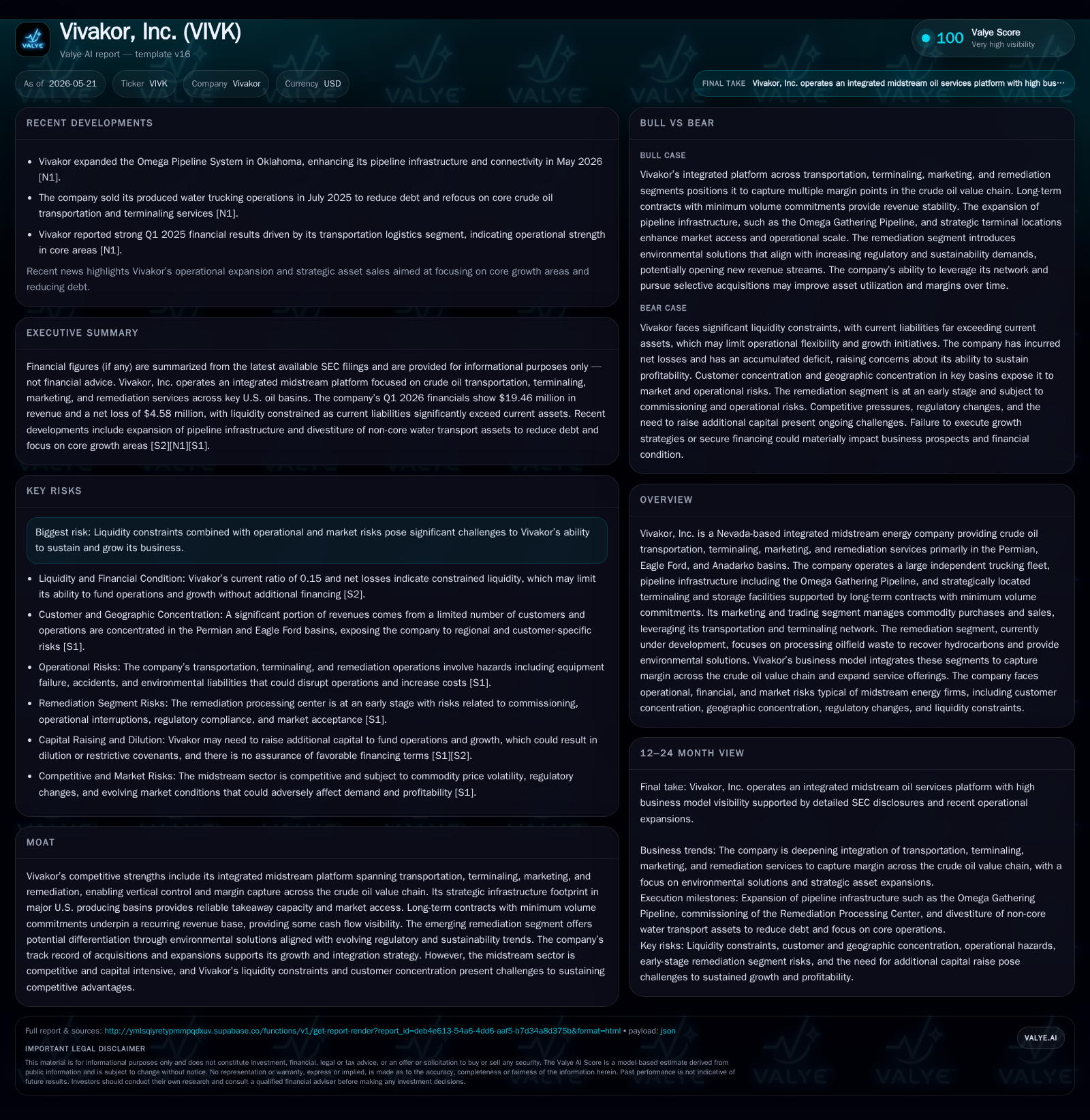
Vivakor’s May 2026 10-Q underscores ongoing infrastructure growth, including the Omega Gathering Pipeline expansion, alongside advancing environmental remediation operations. The company’s integrated midstream business model leverages trucking, pipeline, terminaling, and commodity marketing to capture margins across key U.S. basins, anchored by long-term contracts with minimum volume commitments. However, significant liquidity constraints and concentrated customer exposure remain near-term risks that could impact execution and growth prospects. Monitoring operational ramp-up milestones and financing outcomes will be critical to assessing Vivakor’s ability to scale its integrated platform effectively.
Recent Quarterly Operating Update: What Changed?
Vivakor’s May 20, 2026 10-Q filing presents a picture of cautious optimism tempered by financial constraints. Most notably, the company reiterated no material change in previously disclosed risk factors but highlighted ongoing operational initiatives focusing on pipeline infrastructure enhancements and remediation segment development [S2]. An event filing dated May 8 detailed an equity offering coupled with a Special Equity Purchase Agreement carrying customary default clauses that could amplify principal outstanding by 20% upon triggering event defaults [S3]. This financing move hints at tighter capital flexibility.
Complementing these filings is recent market news confirming Vivakor's operational strategy to expand its Omega Gathering Pipeline system in Oklahoma for increased capacity — a tangible growth action intended to boost throughput capabilities within the core Permian basin geography [N2]. The combined filings suggest Vivakor is aggressively pursuing asset growth while remaining vigilant about cash flow pressures.
Vivakor's Business Model: Harnessing an Integrated Midstream Platform
Vivakor operates as an integrated midstream energy provider with diversified service offerings spanning crude oil transportation via a large owned trucking fleet and pipeline infrastructure (e.g., the Omega Gathering Pipeline), terminaling and storage facilities strategically positioned in key U.S. producing basins such as Permian, Eagle Ford, and Anadarko [S1][S6]. This vertical integration allows the company to capture margin at multiple points along the crude oil logistics chain.
Revenue generation primarily stems from long-term contracts attracting minimum volume commitments from established customers like Jorgan Development LLC and Validus Energy II Midcon LLC [S6]. These agreements underpin recurring revenue streams albeit with notable customer concentration risks that warrant monitoring.
Furthermore, Vivakor manages commodity marketing activities leveraging its transport and terminal network to optimize purchasing and sales flows. A distinct growth vector is their emerging remediation division deploying Remediation Processing Centers (RPCs) designed to extract hydrocarbons from oil-contaminated waste streams — operations awarded Category A approval under Kuwait’s Environmental Remediation Project trials [S1]. This technology-driven environmental service integrates hydrocarbon recovery with sustainability compliance demands increasingly shaping midstream markets.
In essence, Vivakor's business model seeks margin capture through asset ownership across transportation modalities combined with specialized processing capabilities providing a differentiated value proposition amidst evolving regulatory frameworks.
Industry Context: Competitive Midstream Dynamics in U.S. Production Basins
The midstream sector’s structural dynamics encompass intense competition among independent operators controlling pipeline takeaway capacities, trucking fleets, and storage terminals within prolific U.S. basins. Operators compete on pricing power often constrained by utilization rates tied closely to regional production levels [S1][S6]. Amid this environment, long-term contracts secured with minimum volume commitments provide buffer against abrupt demand fluctuations but also introduce counterparty concentration risk.
Geographically concentrated exposure particularly in Permian and Eagle Ford basins subjects Vivakor to regional supply-demand swings impacted by natural events or regulatory changes [S17]. Switching costs for producers relate strongly to physical connectivity; thus strategic terminal locations interlinked with major pipelines enhance Vivakor’s market positioning by offering flexible delivery options.
Regulatory evolution emphasizing environmental responsibility simultaneously expands the midstream opportunity set toward hydrocarbon recovery and remediation services. This emerging niche benefits companies like Vivakor developing proprietary processing technologies complementing traditional downstream activities.
Growth Drivers: Expanding Footprint Through Infrastructure & Remediation
Growth at Vivakor is anchored by incremental physical capacity expansions such as the Omega Gathering Pipeline build-out in Oklahoma which directly supports increased crude volumes flowing through its network [N2][S1]. This expansion enhances takeaway capacity critical in capturing rising Permian basin production.
Parallelly, advancing the remediation segment presents potent new revenue potential aligned with tightening sustainability mandates. The Houston-area RPC commissioning symbolizes a strategic milestone aiming to serve growing demand for environmentally compliant hydrocarbon recovery solutions [S1].These centers refine oilfield waste into saleable byproducts including condensate and propane, bolstering asset utilization while differentiating service mix.
Moreover, selective acquisitions remain part of the strategic blueprint to augment scale and connectivity within core operating regions while striving to increase contract volumes underpinned by long-term agreements [S1][S6]. Synergistic asset integration across transportation, marketing, terminaling, and remediation strengthens competitive positioning enabling cross-segment margin enhancement.
Risks and Constraints: Liquidity Pressures and Market Challenges
Despite operational advances, Vivakor’s balance sheet signals pressing liquidity issues. With cash & equivalents dwindled at approximately $4.5K as of March 31, 2026—and current liabilities substantially outweighing current assets resulting in a distressed current ratio near 0.15—the company faces significant short-term funding challenges [F1][S2]. A net debt position around $27.7 million further constrains financial flexibility [F1].
High customer concentration intensifies revenue risk if key counterparties reduce volumes or delay payments. The capital-intensive nature of midstream investments impedes rapid scaling unless financed adequately.
Additionally, the complexity inherent in managing multiple integrated business lines—trucking fleet operations alongside pipeline infrastructure combined with advanced remediation processes—raises operational execution risks that can induce delays or cost overruns impacting profitability [S1].
Recent financing arrangements incorporating punitive provisions for defaults signal heightened sensitivity around Covenants possibly affecting refinancing options or triggering accelerated debt repayments should financial metrics deteriorate [S3]. Overall macro volatility in oil prices exerts underlying cyclicality pressures on throughput volumes underpinning top-line stability.
Monitoring Milestones: Key Near-Term Catalysts and Red Flags
Close attention should focus on volumetric ramp-ups evidencing uptake through expanded Omega Gathering Pipeline infrastructure reported recently [N2][S2]. Initial commissioning progress reports or throughput milestones at Houston RPC operations will indicate commercial viability gains for remediation efforts.
Observed developments on financing fronts post-May 2026 Offering events—including finalization of payment tranches or covenant waivers—will shed light on liquidity trajectory amid existing strain [S3]. Contract renewal activity or additions securing minimum volume commitments serve as critical indicators for stabilizing future revenue streams.
Operational updates clarifying integration efficiencies amongst trucking assets and terminal facilities could reveal margin improvement potential outlined in strategic objectives [S1][S6]. Conversely continued internal control weaknesses or failure to meet Nasdaq listing requirements previously highlighted should be flagged as potential red flags undermining investor confidence [S27].
Financial Profile: Current Liquidity, Debt, and Capital Structure Snapshot
As of Q1 2026 according to available disclosures, Vivakor holds cash balances dangerously low at roughly $4.5k USD against current liabilities exceeding $62.9 million USD—producing a severely imbalanced current ratio near 0.15—highlighting acute short-term liquidity distress [F1][S2]. Total debt outstanding approximates $27.7 million USD net of minimal cash holdings reflecting substantial leverage levels relative to asset base [F1], consistent with ongoing capital investments detailed earlier.
This precarious financial posture necessitates successful execution of growth initiatives alongside securing additional funding sources without incurring dilutive or restrictive capital structures beyond those already noted during the recent Offering that contains escalator provisions tied to default events [S3]. It underscores why operational improvements must translate quickly into positive cash flow enhancements to avert existential risks posed by external market shocks or internal slippages in execution.
Disclaimer: This analysis is based solely on public SEC filings dated through May 2026 inclusive of recent news disclosures. All financial figures are directly cited from reported data without extrapolation or prediction beyond stated information. No investment advice or research views are offered herein.
Disclaimer: This is research-only, informational analysis and not investment advice. It may include AI-generated interpretation and general industry context. Always verify important details using primary sources.

Comments