
VANJIA CORP: Sparse Revenue, High Liquidity, and the Stakes of an Unproven Operating Model
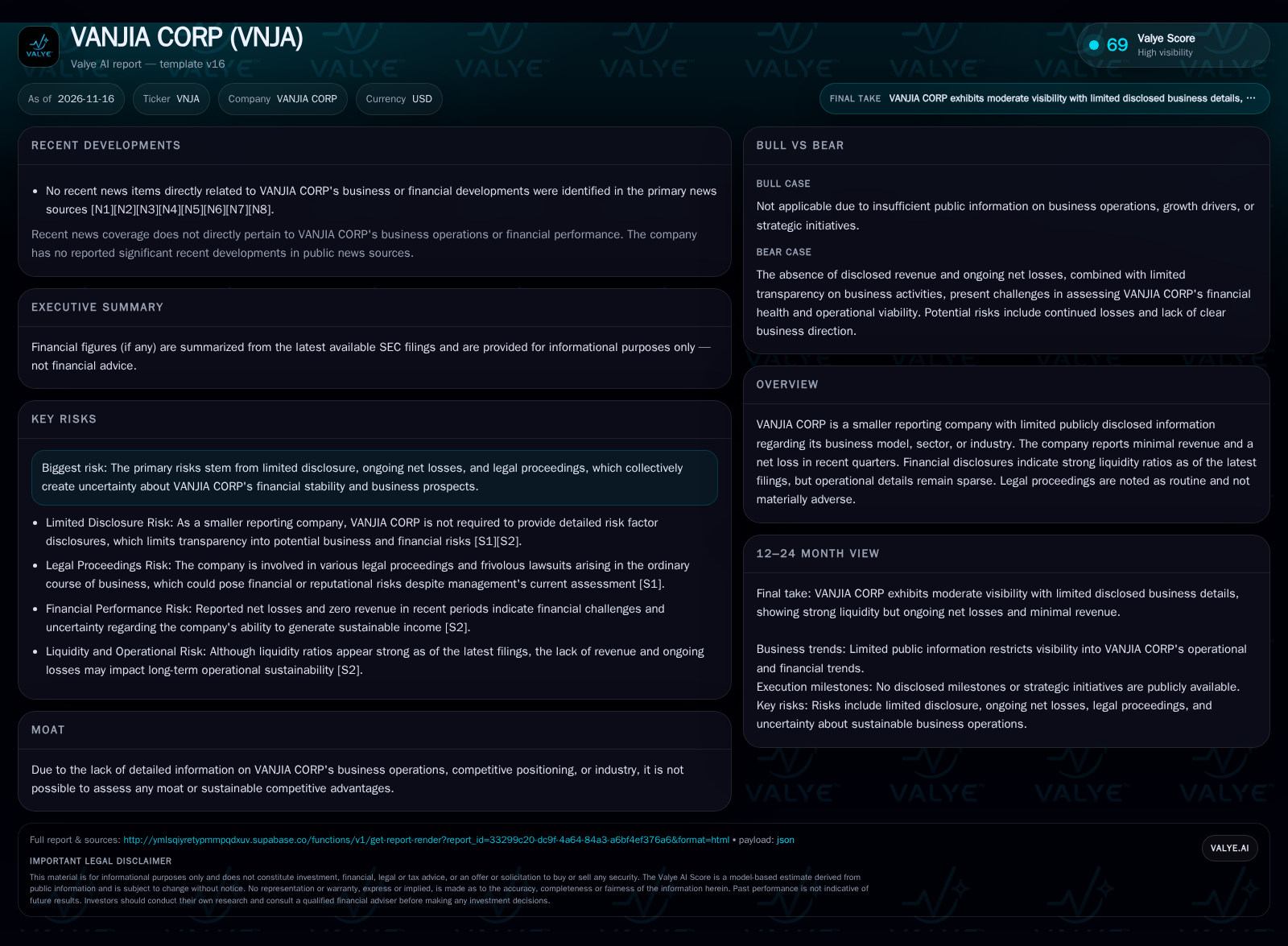
VANJIA CORP reports a high reported cash balance relative to liabilities but continues to post net losses with no recent revenue. With minimal public detail on its business model or sector, the company’s future hinges on whether it can translate operational plans into sustainable income before liquidity is eroded.
VANJIA CORP maintains a reported liquidity position but reports zero revenue and ongoing net losses, with limited public disclosure about its business model or sector. The company outlines plans for real estate development in Houston, yet there is no evidence of project execution or commercial traction. Its future viability depends on converting operational plans into revenue before cash resources are depleted.
VANJIA CORP presents an unusual financial profile: a company with a strikingly high liquidity position for its scale, yet zero revenue and ongoing losses, all set against a backdrop of minimal operational disclosure. The company's filings outline plans for real estate development activities in Houston, but the absence of evidence for revenue generation or tangible progress leaves critical questions about its business viability. Investors and analysts are left to weigh whether VANJIA CORP's liquidity is a springboard for future execution or simply a temporary buffer against continued cash burn in the absence of a proven commercial model.
Current Financial Profile: Reported Liquidity Position, Absent Revenue, and Persisting Losses
VANJIA CORP reported cash and cash equivalents of $58,639 and current assets of $63,359 as of March 31, 2026. Despite this, the company posted a net loss of $2,950 for the quarter ended September 30, 2026, and reported zero revenue for the quarter ended June 30, 2025. Legal proceedings are described as routine and not expected to have a material adverse effect, but ongoing losses and the absence of operational detail remain material concerns. [S1] [S2]
How Value Might Be Created: Real Estate Development Economics and the Cost of Inertia
The company's filings reference plans for website development, land subdivision, architect drawings, and residential construction in Houston—characteristics that suggest an intent to operate as a small-scale real estate developer. In this model, value is typically created by acquiring land, obtaining permits, constructing residential units, and selling them at a margin above all-in costs. Such projects are capital-intensive up front, with lumpy revenue recognition tied to asset sales or project completions, and relatively high fixed costs in the pre-construction phase (legal, architectural, permitting). Variable costs intensify during the build phase. The lack of reported revenue suggests that VANJIA CORP has not yet completed or sold any projects, or that sales activity remains immaterial. The company’s current cash position could cover near-term operating expenses, but sustained losses without a shift to revenue-generating activity would eventually erode liquidity. If the business can execute and monetize even a small project, it could demonstrate positive operating leverage; if not, cash burn will continue without offsetting inflows.
Competitive Realities in Small-Scale Real Estate: Barriers, Substitutes, and Execution Risk
If VANJIA CORP enters the residential development space in Houston, it faces a highly competitive market characterized by established regional developers, homebuilders, and real estate investment firms. Barriers to entry in this sector include land acquisition costs, regulatory compliance, permitting complexity, and access to skilled labor and project financing. Larger competitors may benefit from economies of scale in procurement, marketing, and project management, while smaller operators often struggle with resource constraints and project risk concentration. Substitute products (existing homes, rentals, or larger developers’ offerings) can pressure pricing and absorption. The absence of disclosed commercial activity or customer relationships means VANJIA CORP has not yet demonstrated any competitive edge, channel access, or differentiated product strategy. Its ability to build a moat will depend on unique land access, speed of permitting, superior execution, or specialized customer targeting—none of which are substantiated by current filings.
What Would Unlock Value: From Planning to Execution and Revenue Recognition
A favorable outcome for VANJIA CORP would require converting its operational plans into completed projects and recognized revenue. This would likely involve securing and subdividing land, obtaining permits, constructing homes, and successfully selling units—potentially targeting affordable housing programs as referenced in its filings. Evidence of value creation would include the announcement of land acquisitions, building permits, project starts, or sales contracts, followed by reported revenue and gross profit. If the company can demonstrate project delivery within budget and timeline, positive operating leverage could emerge due to the high fixed-cost base. Confirmation of this scenario would be visible in future filings through nonzero revenue, reduced net losses or net income, and working capital deployment into inventory or receivables. Falsification would occur if filings continue to show zero revenue, shrinking cash balances, or abandonment of operational plans.
Stalled Progress: Liquidity Persists but Business Remains Unproven
The most plausible near-term scenario is continued cash burn with limited or no revenue, as operational ramp-up fails to materialize or is delayed. VANJIA CORP may continue to allocate funds to overhead, compliance, and early-stage project planning without achieving project milestones or sales. The company’s liquidity ratios could remain high if spending is restrained, but without commercial activity, the business would remain in stasis. Filings would confirm this with ongoing net losses, zero or negligible revenue, and cash balances that decline gradually. Any sign of project execution, such as capitalized inventory or disclosed sales agreements, would shift the scenario toward upside; conversely, continued inertia or increased legal/administrative costs would confirm the base case.
Erosion of Reported Cash Balance: Persistent Losses and Strategic Drift
In an adverse scenario, VANJIA CORP’s cash resources are steadily depleted by operating and compliance expenses, with no offsetting revenue or project progress. Legal costs could escalate if routine proceedings become material, or if new disputes arise. The absence of revenue and lack of execution may ultimately force the company to seek dilutive external financing, restructure, or wind down operations. Downside confirmation would be visible through accelerating net losses, sharply declining cash balances, or warnings in filings about going-concern risks and funding needs. If the company fails to articulate or execute a viable business plan, the risk of value impairment increases substantially.
Benchmarks for Testing Whether VANJIA CORP’s Plans Can Become a Sustainable Business
Disclosure of any revenue, even at a small scale, would be a critical sign of operational traction.
Evidence of land acquisition, building permits, or project starts in Houston would test whether the company is executing its stated development plans.
Updates on cash and current asset balances over the next several quarters would indicate the rate of cash burn and the sustainability of operations. [S2]
Announcement of signed customer contracts, presales, or sales closings would support the case for business model viability.
Capitalized inventory or work-in-process assets on the balance sheet would suggest progress toward project completion.
Changes in the scale, frequency, or materiality of legal proceedings could signal emerging risks or distractions. [S1]
Any disclosure regarding access to external financing, debt issuance, or capital raises would clarify funding strategy and dilution risk.
Disclaimer: This is research-only, informational analysis and not investment advice. It may include AI-generated interpretation and general industry context. Always verify important details using primary sources.

Comments