
VPR Brands Updates Capital Structure and Navigates Regulatory & Litigation Challenges Amid Competitive Pressures
Recent amendments to preferred unit terms and patent settlements shape VPR Brands' near-term outlook in a competitive, regulated vaping industry.
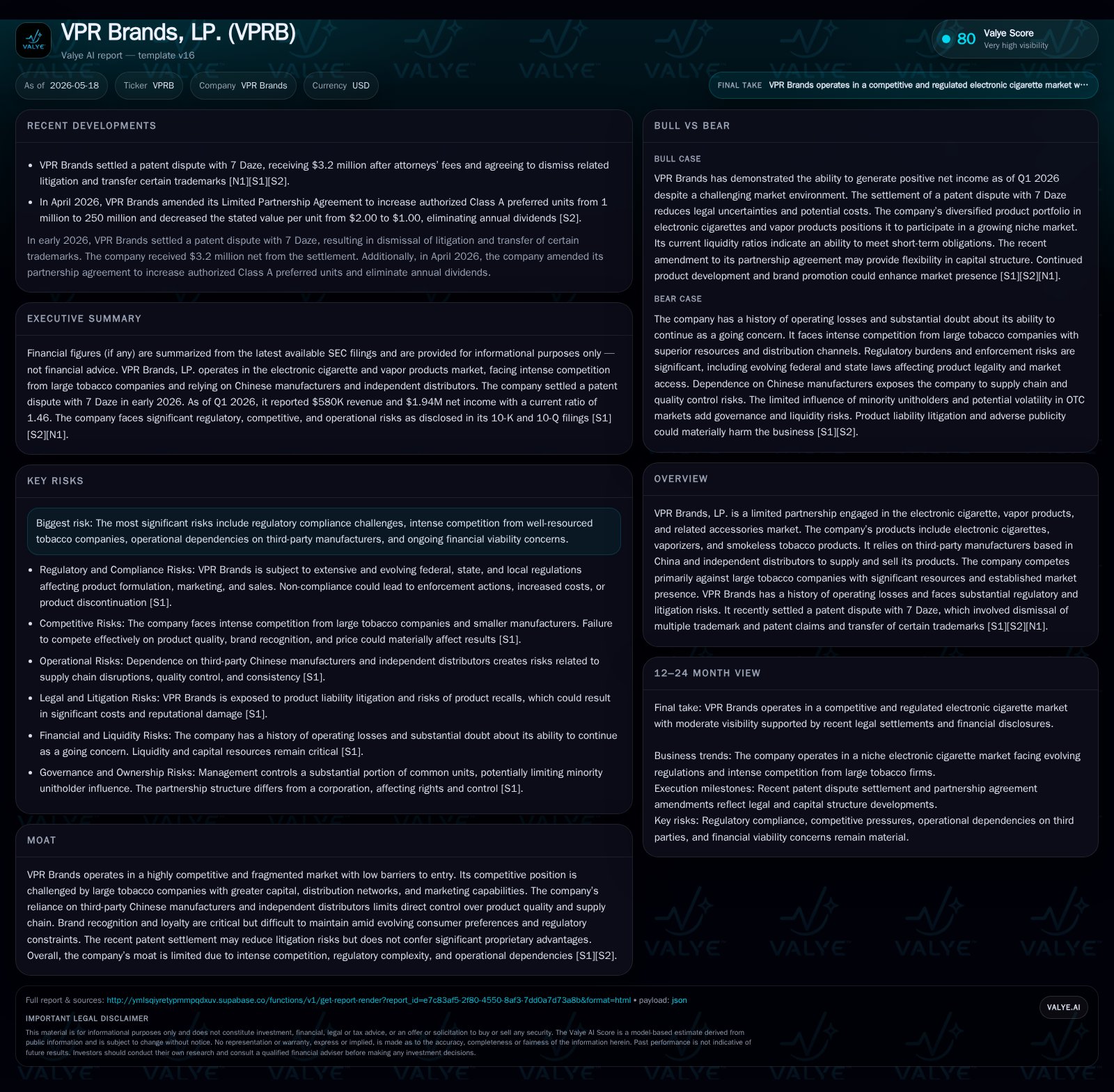
In the latest quarter ending May 2026, VPR Brands, LP. maintained its operational status without material changes in risk factors but amended its Class A preferred units to refine capital structure. The company operates in the evolving and heavily regulated electronic cigarette and vaporizers sector, relying on third-party Chinese manufacturers and independent distributors while competing against major tobacco incumbents. Despite a recent patent dispute settlement with 7 Daze mitigating some litigation risks, VPR Brands continues to face significant regulatory hurdles, intense competition, and operational dependencies that constrain growth prospects. The firm reported ongoing losses with limited financial cushion but stable current liquidity as of early 2026. Key drivers for growth remain linked to successful regulatory approvals and product innovation, while risks include regulatory clampdowns on flavored products, federal hemp regulations affecting CBD lines, and supply chain reliance.
Recent Operating Update
VPR Brands' most recent quarterly filing dated May 18, 2026 [S2] reports no change in the fundamental risk profile for the company compared to the prior annual report. However, a significant corporate event occurred on April 28, 2026 when Soleil Capital Management L.L.C., acting as the company's General Partner, enacted the Third Amendment to the Limited Partnership Agreement [S3]. This amendment modified the terms governing Class A preferred units, potentially affecting capital structure flexibility though specifics were not fully detailed in the filing.
Additionally, VPR Brands publicly disclosed settling a patent dispute with competitor 7 Daze in May 2026 [N1]. The resolution involved dismissal of multiple trademark and patent claims alongside transfer of certain proprietary trademarks. This settlement alleviates ongoing legal uncertainty that could have otherwise distracted management or induced operational disruptions.
No new material legal proceedings or litigation emerged during the quarter [S2][S8]. The absence of fresh risk factor revisions suggests ongoing challenges are consistent with those previously disclosed.
Business Model
VPR Brands operates as a limited partnership focused on the electronic cigarette (ENDS), vapor products, and related accessories sector [S1]. Its revenue derives from sales of a portfolio spanning electronic cigarettes, vaporizers, and smokeless tobacco variants distributed primarily through independent third-party channels rather than direct retail or proprietary storefronts.
Core manufacturing is outsourced to Chinese third-party producers under contract arrangements rather than vertically integrated production [S1]. This model reduces fixed capital intensity but limits direct control over product quality assurance, inventory responsiveness, and customization agility.
Sales volume and revenue depend heavily on product acceptance within increasingly fragmented consumer segments prioritizing safety perception, flavor profiles, nicotine delivery efficacy, and price competitiveness compared to both traditional tobacco firms and emerging alternative nicotine solutions. Pricing power is constrained by intense competition and regulatory restrictions especially impacting flavored offerings.
The dependence on distributors implies revenue recognition is likely driven by shipments rather than end-consumer sales data. Contractual terms with these intermediaries influence gross margins through negotiated pricing allowances. Brand loyalty is a critical yet fragile asset given frequent shifts in consumer preferences within the vaping ecosystem.
Industry Structure and Competitive Position
Operating within an electronic nicotine delivery system niche still maturing amid complex regulation places VPR Brands at a strategic disadvantage relative to dominant tobacco conglomerates such as Altria or British American Tobacco that combine scale advantages with broad retailer relationships [S1]. These incumbents benefit from comprehensive R&D budgets, deep pockets to absorb regulatory compliance costs including FDA premarket authorization (PMTA) expenditures and extensive marketing capabilities that smaller players lack.
Barriers to entry historically were low due to third-party OEMs proliferating vape hardware production globally; however recent FDA scrutiny heightens compliance costs substantially [S17]. Regulatory environment volatility continues acting as a moat-like barrier favoring well-capitalized firms able to endure prolonged market access trials.
Customer concentration risks are somewhat alleviated by distributing through numerous independent agents but limit pricing discipline. Additionally, consumer switching costs are low given plentiful alternatives both licit and illicit that can rapidly erode customer share if product relevance wanes.
Growth Drivers
Growth catalysts rely primarily on regulatory approvals allowing full market access for existing or newly developed products compliant with evolving federal standards. The March 9, 2026 FDA draft guidance amplifies evidentiary requirements for flavors other than tobacco by mandating proof of youth access prevention technology effectiveness such as biometric age gating or geofencing [S17]. VPR Brands' ability to meet these technical standards will be pivotal.
Innovation pipelines introducing advanced formulations or device enhancements may unlock new customer segments if differentiation succeeds amid commoditized hardware offerings [S11]. Expansion into compliant CBD/hemp-based product lines could offer incremental revenue streams though impending strict THC content rules due November 2026 threaten approximately 10% of this portfolio [S19].
Brand equity expansion through enhanced marketing support targeted at adult consumers willing to switch from combustible cigarettes also forms a growth lever but faces constraints from advertising restrictions under tobacco control laws.
Moreover, partnerships enhancing distribution breadth particularly targeting national retail chains could convert more stable revenue streams versus spot sales through independent distributors [S11]
Risks / Watchpoints / Growth Constraints
Regulatory Risks: The ever-tightening FDA PMTA framework poses profound uncertainty over product renewals; failure could lead to market withdrawal or forced reformulation incurring additional expenses [S17][S26]. State-level bans such as California's flavor prohibition materially reduce accessible addressable markets. Federal hemp regulations restructuring THC thresholds introduce existential threats for cannabinoid offerings [S19].
Litigation Risks: Though currently free from pending suits post-settlement with 7 Daze [N1], historical operating losses combined with potential future liability claims related to product safety emphasize continued vulnerability.
Operational Dependencies: Reliance on Chinese contract manufacturers creates exposure to supply chain disruptions related to geopolitical tensions or tariff escalations potentially inflating costs or delaying deliveries [S21]. Quality consistency remains an ongoing challenge limiting premium positioning.
Financial Constraints: Operating losses persist with negative operating income reported in prior periods (e.g., -$1.46 million operating income as of December 2025) while cash reserves remain modest, indicative of limited runway absent improved margins or external capital infusions [F1]
Management Control: Concentrated governance via the General Partner limits minority unitholder influence and raises succession risks given CEO centrality [S16][S22].
What To Watch Next
- Outcomes of FDA marketing authorization submissions for key flavored ENDS SKUs under heightened evidentiary standards.
- Effective implementation success of advanced Device Access Restriction technologies required by regulators.
- Any further amendments to partnership agreements that may materially impact capital structure or unit holder rights post-April 2026 amendment.
- Potential resurgence or resolution of litigation beyond the settled patent dispute.
- Development trajectories regarding federal hemp-derived product compliance after November 2026 rule enactment.
- Expansion efforts toward broader retail chain penetration beyond legacy independent distributor channels.
- Product innovation announcements adapting formulations or delivery devices responding proactively to evolving consumer health concerns and preferences.
Financial Profile Summary
While complete current quarter financials await release beyond SEC filings dated May 18th indicating stable but loss-making operations [S2], available data indicates persistent net losses (net income approx -$1.2 million as of December 2025) against revenues around $3.6 million [F1]. Total debt is low relative to cash balances (~$388K last reported), resulting in net cash positioning conducive to short-term obligations coverage (current ratio ~1.46) [F1]. Nonetheless scale limitations restrict investment flexibility amid tightening regulatory cost burdens.
This analysis draws exclusively upon public SEC filings up through May 18th, 2026 combined with contemporaneous news disclosures and industry context considerations specific to VPR Brands' vaping sector positioning without offering investment advice or price outlooks.
Financial position in context
As of 2026-03-31, companyfacts shows $2.7 million in cash and equivalents [F1]. Current assets of approximately $3.6 million and current liabilities near $2.4 million imply a current ratio of about 1.46x for 2026-03-31 [F1].
Disclaimer: This is research-only, informational analysis and not investment advice. It may include AI-generated interpretation and general industry context. Always verify important details using primary sources.

Comments