Vestis Corp Navigates Regulatory Complexity and Financial Challenges Amid Leadership Changes
An in-depth look at Vestis Corp's operational resilience within a heavily regulated industrial laundry environment marked by recent losses and executive turnover.
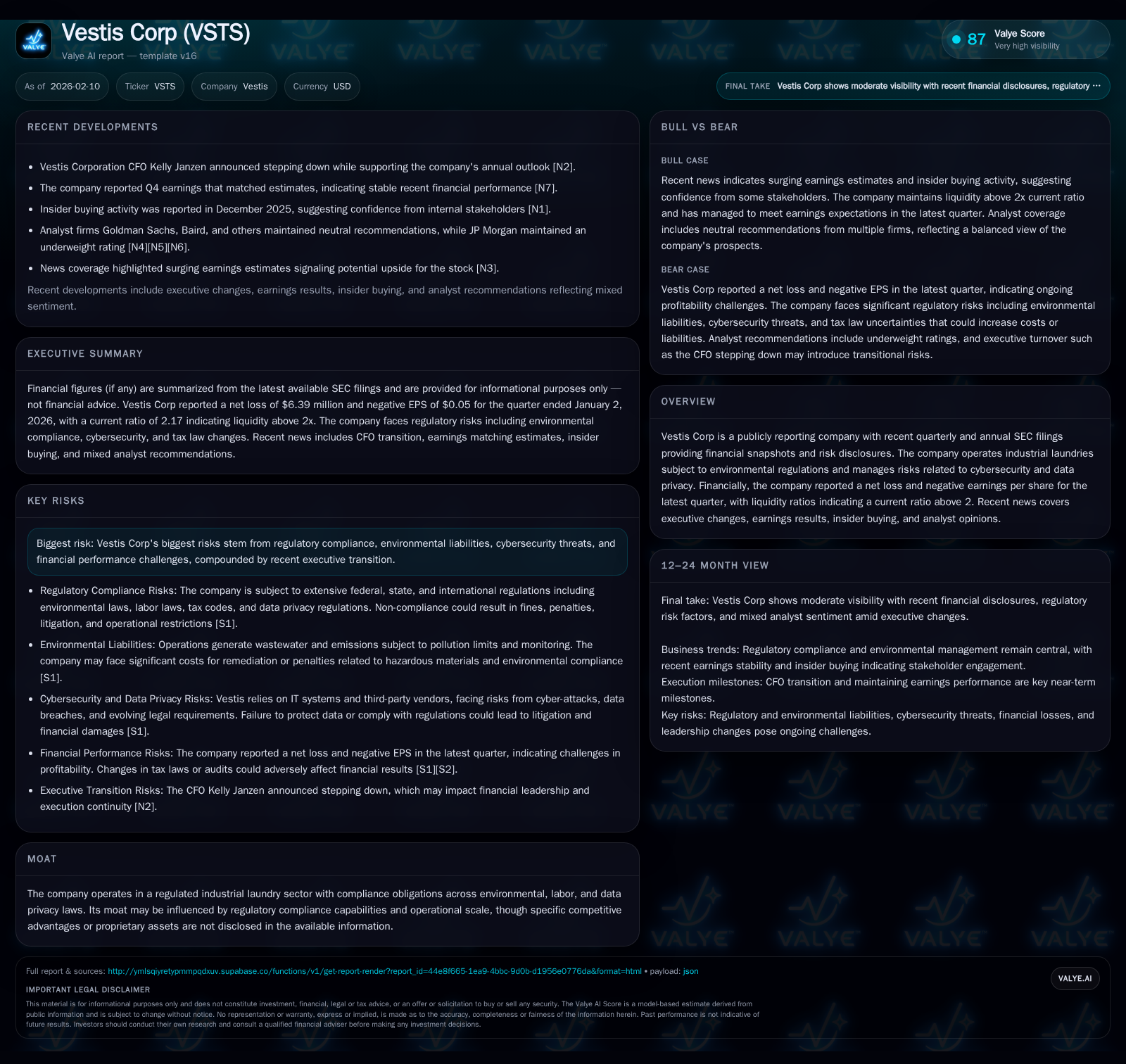
Vestis Corp operates within an industrial laundry sector characterized by stringent environmental and cybersecurity regulations, exposing it to unique operational risks. Despite posting a net loss of $6.39 million in the latest quarter, the company maintains a robust liquidity position with a current ratio exceeding 2.1, providing some financial buffer. Recent leadership changes introduce strategic uncertainty amid these challenges, highlighting the intersection of regulatory compliance demands with financial and operational pressures. Vestis’s competitive moat is shaped more by its regulatory navigation than proprietary assets, suggesting both barriers and burdens in a tightly regulated landscape.
Vestis Corp at a Crossroads: Industry & Regulation Dynamics
Vestis Corp occupies a distinctive niche within the industrial laundry sector, an arena markedly influenced by comprehensive regulatory mandates covering environmental emissions, water usage, chemical handling, labor standards, and increasingly stringent data privacy laws. The company's SEC disclosures underscore how these frameworks are not peripheral but central to daily operations [S1 Item 1 Business]. Compliance with environmental regulations involves navigating complex wastewater treatment requirements alongside extensive monitoring protocols to avoid fines or operational restrictions.
This regulatory entanglement shapes Vestis's operating environment in profound ways. Unlike many industrial service providers who might pivot rapidly or innovate aggressively, Vestis must align its processes meticulously with evolving legal criteria — a factor that governs capital expenditures, staffing competencies, and overall operational tempo. This environment limits rapid expansion or experimentation.
The very nature of industrial laundry services amplifies these pressures: large volumes of textiles processed generate significant chemical and water footprint liabilities. Alongside environmental factors, cybersecurity measures are vital given sensitive customer data increasingly digitized across operations [valye_report_excerpt overview]. Such a setting predicates a business model where resilience depends on rigid adherence to multiple intersecting regulatory layers.
Financial Snapshot: Navigating Losses with a Strong Liquidity Cushion
For the quarter ending January 2026, Vestis reported a net loss totaling approximately $6.39 million [F1 NetIncomeLoss], reflecting ongoing challenges in converting heavy regulation-laden operations into sustainable profitability. Nevertheless, the company maintains financial headroom illustrated by current assets valued around $853 million against current liabilities near $392 million, yielding a current ratio of roughly 2.17 [F1 CurrentAssets; F1 CurrentLiabilities]. Cash and equivalents alone stand at about $41.5 million [F1 CashAndCashEquivalentsAtCarryingValue], offering vital near-term liquidity.
This juxtaposition reveals an intriguing dynamic: while earnings performance under pressure signals structural or market challenges perhaps linked to cost inflation or pricing limitations under regulatory costs, strong liquidity suggests Vestis remains well-capitalized to fund operations or invest in necessary upgrades. The balance sheet provides a cushion allowing management breathing room to navigate operational improvements or explore strategic shifts without immediate solvency concerns [S2 MD&A].
However, sustained losses cannot be indefinitely offset by liquidity alone. The financial snapshot underscores the vital need for strategic clarity — harnessing operational scale effectively while managing costs intrinsic to its regulated footprint — if Vestis hopes to shift toward profitability over coming periods.
The Regulatory Gauntlet: Environmental and Cybersecurity Challenges
The twin specters of environmental regulation and cybersecurity represent critical axes of risk uniquely intensifying Vestis's operating complexity. Environmental risk factors detailed in SEC filings emphasize potential liabilities ranging from hazardous waste mismanagement to effluent discharge violations [S1 Risk Factors; S2 Risk Factors]. Given the industrial laundry process involves detergents, solvents, and significant water use, breaches can trigger costly remediation actions or reputational damage.
Cybersecurity risks compound this landscape. As Vestis digitizes workflows and maintains sensitive client information tied into payment systems or service scheduling platforms, vulnerabilities mount for potential data breaches or ransomware attacks [valye_report_excerpt risks]. These multifaceted compliance challenges demand continuous investment in monitoring systems and staff training — expenses that erode margins further yet are non-negotiable prerequisites.
This regulatory milieu simultaneously raises barriers against new entrants unable or unwilling to absorb such costs but also binds Vestis’s agility due to the capital-intensive requirements inherent to compliance infrastructure [valye_report_excerpt moat]. Operationally, this necessitates sophisticated governance frameworks able to dynamically respond to evolving rules across jurisdictions — no trivial feat within an industry historically low-margin.
Leadership in Transition: Impact of Executive Changes on Strategy
Recent disclosed changes within Vestis Corp’s executive ranks add another layer of uncertainty amidst this already challenging environment [valye_report_excerpt news on exec changes]. Leadership transitions during times of financial stress typically send mixed signals; they may herald renewed strategic focus or sow doubts regarding continuity.
While specifics around personnel movement remain limited, such shifts invariably test investor confidence and internal cohesion as new executives assimilate operational nuances particularly around compliance landscapes critical for long-term stability. Transition periods can slow decision-making precisely when nimble responses might mitigate emerging risk exposures or capitalize on shifting regulation-driven opportunities.
Thus, leadership dynamics must be viewed not merely as headline events but as pivotal components influencing Vestis’s capacity to orchestrate turnaround strategies while maintaining tight control over regulatory adherence.
Competitive Landscape and Moat Assessment: Compliance as a Double-Edged Sword
In assessing Vestis’s moat—or sustainable competitive advantage—it emerges that regulatory proficiency rather than technological innovation forms its primary shield. The company does not claim proprietary processes or breakthrough efficiencies but leverages demonstrated compliance capability under heavy scrutiny [valye_report_excerpt moat].
This presents both strength and vulnerability. On one hand, navigating environmental permits successfully along with labor laws creates barriers less adept competitors cannot easily surmount without substantial upfront investment. On the other hand, dependency on being ‘compliance-ready’ ties growth prospects closely to capital expenditure cycles focused on meeting ever-tightening standards rather than aggressive market expansion or service diversification.
Moreover, lack of explicit scale economies aside from geographic coverage means Vestis must continually reinvest just to maintain baseline operational status quo—potentially ceding innovation ground to disruptive technologies emerging outside traditional frameworks.
The duality here reflects how regulation shapes both moat formation around access control but also imposes rigidity curbing agility during market shifts.
Risk Management Deep Dive: Evaluating Operational and Financial Vulnerabilities
Unpacking Vestis’s risk profile points sharply toward intertwined vulnerabilities: environmental noncompliance penalties threaten cost escalations; cyber incidents risk data integrity erosion; financially sustained quarterly losses strain investment capacity; all compounded by executive turnover introducing strategic flux [S1 Risk Factors; S2 Risk Factors; valye_report_excerpt risks; F1 NetIncomeLoss].
The environmental liabilities carry latent exposure—contamination claims or fines could materialize unexpectedly given stringent oversight agencies enforce complex statutes governing pollutant discharge or waste streams post-industrial laundering cycles.
Cybersecurity concerns extend beyond typical IT incidents into reputational harm impacting clientele trust in managing confidential healthcare uniforms or hospitality linens under increasingly strict data governance frameworks.
Simultaneously negative income trends highlight that cost structures aligned with compliance overheads require reevaluation relative to pricing power constrained by competitive forces.
Management must therefore balance prudential risk mitigation investments against imperatives for efficiency gains—a delicate equilibrium demanding coherent leadership especially as transitions unfold.
Outlook and Analyst Perspectives: Can Vestis Pivot Toward Profitability?
Recent insider buying activity injects nuanced optimism reflecting confidence among some executives regarding future strategic direction despite short-term earnings setbacks [valye_report_excerpt insider buying]. Analysts appear cautiously attuned to this signal yet temper expectations owing to consistent loss patterns and formidable industry constraints [valye_report_excerpt analyst opinions].
Potential pathways forward likely hinge on leveraging expertise built around compliance infrastructure as not only defensive mechanisms but as platforms for differentiated customer assurance—turning regulation navigation into service quality enhancements.
Moreover, innovation may arise through incremental automation reducing manual intervention in processes otherwise burdened by regulatory checklists; similarly exploring partnerships could diversify revenue streams less affected by margin pressures typical in core laundering functions.
Ultimately Vestis's trajectory will depend on blending rigorous compliance maintenance with judicious cost management under stable leadership—a complex task but not unattainable given its existing liquidity buffer facilitates this transitional runway.
Disclaimer: This report is for informational purposes only based on publicly available information as of February 2026. It does not constitute investment advice nor an offer to buy or sell securities.
Disclaimer: This is research-only, informational analysis and not investment advice. It may include AI-generated interpretation and general industry context. Always verify important details using primary sources.

Comments