
Vivos Therapeutics’ Shift to Medical Practices Signals New Growth Horizon
Vivos Therapeutics is advancing its pivot from a dental appliance-centric business model to an integrated medical-provider platform to drive growth and improve treatment delivery for obstructive sleep apnea.
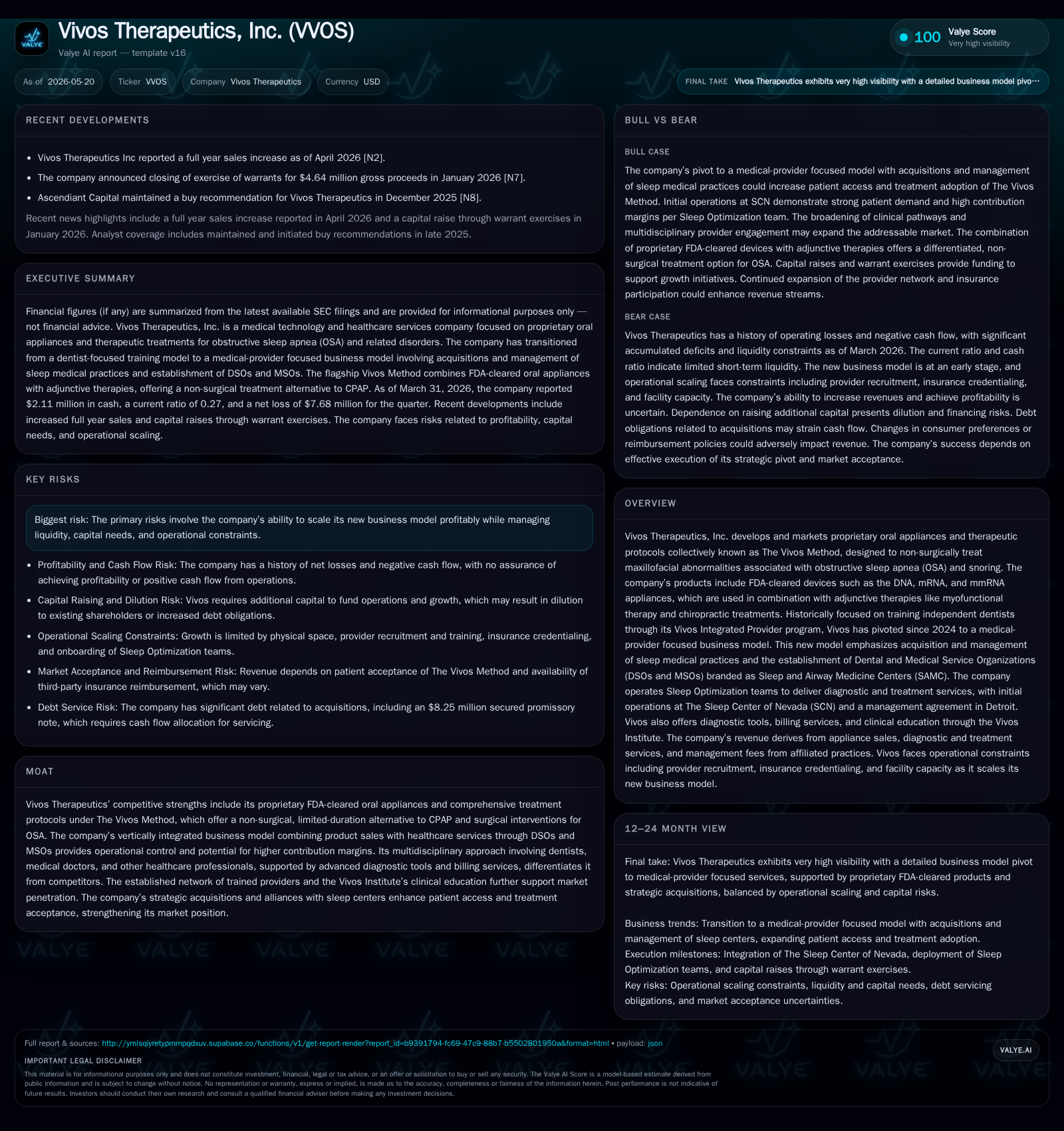
In its latest quarterly filing, Vivos Therapeutics underscored ongoing operational transitions as it strives to meet Nasdaq’s equity requirements through recent equity raises, while scaling a novel business model focused on acquisition and management of sleep medical practices. The firm’s proprietary oral appliances and The Vivos Method remain central, but the shift toward medical service organizations (MSOs) and dental service organizations (DSOs) branded as Sleep and Airway Medicine Centers (SAMC) represents a strategic repositioning targeting higher-margin healthcare services revenue alongside device sales. This transformation aims to broaden patient access and deepen provider integration amid competitive and regulatory complexities. Capital constraints and execution risks present near-term challenges that will require diligent monitoring as the company pursues growth via acquisitions, alliances, and expanded clinical programs.
Recent Quarterly Update Highlights Key Operating Shifts
The most recent quarterly filing dated May 20, 2026 [S2] spotlights critical developments in Vivos Therapeutics’ operational landscape as it navigates compliance with Nasdaq’s minimum stockholders' equity rule. After receiving notice regarding non-compliance earlier in the year [S3], the company completed two key equity financing transactions by March 31 totaling $6.8 million through warrant inducements and private placements. Although these efforts have materially bolstered stockholders' equity compared to prior quarters, full cure of the deficiency remains pending with a formal plan due by June 1, 2026. Nasdaq’s Staff may grant an extension up to October 14 for compliance contingent on acceptance.
From a broader operational perspective, the quarter underscores continuing challenges associated with transitioning away from legacy revenue streams towards new business formats requiring significant capital investment and operational recalibration. The filings reflect a continued history of losses and negative operating cash flows [F1], balanced against steps taken to secure incremental financing. These developments collectively signal both near-term execution risk and potential runway extension.
Evolving Business Model: From Dentist Network to Medical Provider Platform
Historically rooted in licensing its proprietary oral appliance technology primarily through trained dentists under the Vivos Integrated Provider (VIP) program [S1], the company has pivoted sharply since 2024 to build vertically integrated Sleep and Airway Medicine Centers (SAMCs). This shift moves Vivos toward direct acquisition or joint management arrangements with sleep medical practices via Dental Service Organizations (DSOs) and Medical Service Organizations (MSOs), compatible with complex corporate practice of medicine regulations [S1].
This evolving approach offers multiple strategic advantages. Firstly, it expands revenue beyond device sales into higher-margin healthcare service provision involving diagnostics, treatment monitoring, billing services, and multidisciplinary care coordination that harnesses broader healthcare professional involvement beyond dentistry alone—including physicians, nurse practitioners, chiropractors and others aligned around airway health [S1]. Secondly, direct operational control is expected to enhance patient case completion rates for Vivos treatments due to tighter clinical pathways managed within affiliated practices—an outcome less attainable through independent dental providers.
Nevertheless, this complex integration entails substantial organizational shifts. The company must navigate diverse legal frameworks across states regarding ownership structures; maintain rigorous compliance with anti-kickback statutes; develop robust internal clinical education beyond its traditional dentist audience; and manage new cost bases associated with healthcare facility operations [S4], [S6]. These factors compound execution complexity but hold promise for improved economics if successfully scaled.
Vivos Method and Product Portfolio: Proprietary Oral Appliances and Therapeutic Protocols
At the heart of Vivos Therapeutics’ offering is The Vivos Method—a package encompassing FDA-cleared oral appliances such as DNA®, mRNA®, and mmRNA® devices designed for non-surgical correction of maxillofacial abnormalities that contribute to obstructive sleep apnea (OSA) [S1]. These appliances are complemented by adjunct treatments including myofunctional therapy and chiropractic care aimed at optimizing airway function.
Clinical estimates suggest effectiveness or indication in approximately 80% of compliant OSA patients within FDA-cleared usage parameters [S1]. Globally, upwards of 75,000 patients have received treatment incorporating these devices—over 60,000 treated via the original C.A.R.E.-branded oral appliances distributed through over 2,000 trained dentists historically.
The therapeutic strategy contrasts markedly with conventional CPAP usage or invasive surgical options by emphasizing limited-duration interventions intended to anatomically remodel airways rather than continuous mechanical support [S1]. This modality offers a differentiated value proposition that appeals particularly to patients unable or unwilling to tolerate CPAP compliance issues.
Supporting this framework is the Vivos Institute which provides structured clinical education enhancing provider competency across multiple disciplines—a critical moat given industry fragmentation in OSA care delivery.
Industry Structure and Competitive Positioning in Obstructive Sleep Apnea Treatment
The OSA treatment sector has long been dominated by CPAP therapy devices largely commoditized within durable medical equipment categories subject to competitive pricing pressure and payer scrutiny [S1]. Increasingly though there is movement toward multimodal integrated care that combines diagnostics with personalized therapeutic regimens delivered through specialized sleep centers
Vivos positions itself uniquely at this intersection by blending proprietary medical devices cleared by FDA with clinically supported protocols embedded within vertically operated MSOs/DSOs. This hybrid model captures value not only from product sales but also recurring revenues from diagnostic testing services and care management—a strategy designed to improve provider stickiness and elevate contribution margins [S16], contrasting peers who rely predominantly on standalone device distribution.
Regulatory oversight adds complexity—particularly corporate practice of medicine restrictions impact ownership structures across jurisdictions—and stringent billing compliance regimes introduce audit-related risk exposures absent in pure product businesses [S4], [S6]. Yet successful navigation promises durable switching costs given comprehensive service portfolios augmented by advanced diagnostics capabilities.
No precise market share data is available; however, Vivos’ ability to secure strategic alliances like SCN acquisition along with diversified multi-specialty provider engagement positions it competitively against fragmented legacy dental appliance vendors or purely medical equipment-centric firms.
Growth Catalysts: Strategic Acquisitions, Provider Expansion, and Market Penetration
Since acquiring Sleep Center of Nevada (SCN) operating assets in June 2025 for approximately $7.3 million consideration combined with assumed liabilities [S5], Vivos has deployed Sleep Optimization teams comprising nurse practitioners or physician assistants paired with dentists plus support personnel designed for scalable deployment across high-demand markets. Early internal results from SCN’s two active centers indicate potential monthly collections surpassing $500k per team net of adjustments with over 50% contribution margin—metrics representing meaningful uplift relative to previous dental-centric revenues [S25].
Building on these learnings, the company intends to refine operations while targeting further acquisitions or management partnerships using revised MSO/DSO co-ownership models providing operational control without full capital outlays commonly associated with outright purchases [S16], offering flexibility in scaling footprint.
Additional growth avenues include launching pediatric OSA programs addressing an underserved demographic segment hinted at in disclosure materials [S1] alongside collaborations with specialty medical groups lacking internal sleep disorder capabilities but seeking integrated referral pathways.
These initiatives collectively aim toward increased patient volume penetration while enhancing case close rates due to centralized clinical workflows supported by extensive training infrastructure provided via the Vivos Institute.
Operational and Financial Risks: Capital Needs and Compliance Challenges
The transition toward acquiring/managing medical practices heightens exposure to regulatory scrutiny regarding corporate practice laws governing physician ownership interests as well as fraud-and-abuse statutes impacting referral patterns—complexities amplified by variability across U.S. states [S4], [S23]. Billing audits represent tangible risk where retroactive adjustments could adversely affect financials if compliance gaps emerge.
Historically significant net losses exceeding $21 million in fiscal year ending December 2025 reflect an ongoing need for external capital infusion captured in recent funding rounds totaling nearly $7 million since late 2025 but underscoring persistent cash burn concerns [F1], [S2]. The balance sheet depicts limited liquidity with cash & equivalents around $2.11 million countered by high current liabilities (~$17.9 million), producing a low current ratio near 0.27 indicative of working capital stress that could constrain operational flexibility absent additional financing or improved margin capture [F1].
Product liability risk arising from off-label use or misuse remains an inherent hazard common among medical device firms including Vivos given reliance on independent practitioner judgment despite internal marketing restrictions placed on sales force communication [S11], [S19]. Legal exposures stemming from past litigation settlement on advertising claims also spotlight reputational vulnerabilities requiring close management attention [S18].
Finally, integration risks related to acquired entities—notably SCN—and scaling newly formed operating models could dilute management focus affecting execution timeliness—a prevalent challenge for companies undergoing fundamental strategic pivots entailing workforce expansion and systems upgrades [S17].
Upcoming Milestones and Indicators: What Investors Should Watch Next
Key upcoming timelines include the Nasdaq-required submission date for the comprehensive plan addressing stockholders’ equity compliance set for June 1, 2026—with possible extension allowing up through October midpoint contingent upon Staff approval extending the cure period through October 14th [S3]. Monitoring related disclosures regarding acceptance or rejection will be critical in assessing stock listing status stability.
Operationally important will be disclosed progress on integration metrics post-SCN acquisition including utilization rates per deployed SO team alongside early datapoints from pediatric OSA pilot programs currently under pilot evaluation referenced in filings [S5]. Additional announcements concerning new acquisition targets or management service collaborations leveraging co-ownership constructs would offer concrete signs validating growth narrative assumptions.
Financial updates reflecting gross revenues derived from SAMC operations compared against prior VIP model outputs will provide insight into revenue mix evolution along with reported contribution margins offering clarity on profitability trajectory under new structure scenarios described internally as targeting ~50% margins could confirm scalability prospects [S16], [S25], [S27].
Concise Financial Overview: Liquidity Status and Funding Efforts
As per the latest available data dated March 31, 2026 [F1], Vivos held approximately $2.11 million in cash and equivalents with total debt of about $617,000, resulting in a net cash position of roughly $-1.49 million. This reflects working capital constraints that may require additional financing or operational improvements to alleviate short-term liquidity pressures.
Despite this financial profile typical of development-stage medical technology firms undergoing strategic transformation, recent equity financings and ATM offerings demonstrate the company’s ability to access growth capital, albeit with potential dilution or pricing sensitivity [S2], [S3], [F1].
Management commentary anticipates continued reliance on financing instruments alongside anticipated ramp in service-driven revenues contributing positively towards narrowing losses over time; realization hinges heavily on timely execution of integration plans alongside sustained reimbursement environment stability reflecting payer acceptance of emerging non-CPAP OSA solutions.
Disclaimer: This analysis is based exclusively on publicly filed SEC documents dated through May 20, 2026 (), contemporaneous market disclosures (), and company financials ([F1]) without incorporating speculative forward-looking statements beyond evidenced milestones; it aims solely at informed business assessment without investing research views.
Disclaimer: This is research-only, informational analysis and not investment advice. It may include AI-generated interpretation and general industry context. Always verify important details using primary sources.

Comments