
Webstar Technology Group Advances Specialty Real Estate Amid Financing and Execution Challenges
Webstar Technology Group is transitioning into a green-focused real estate developer, managing its first major Atlanta mixed-use project under capital constraints.
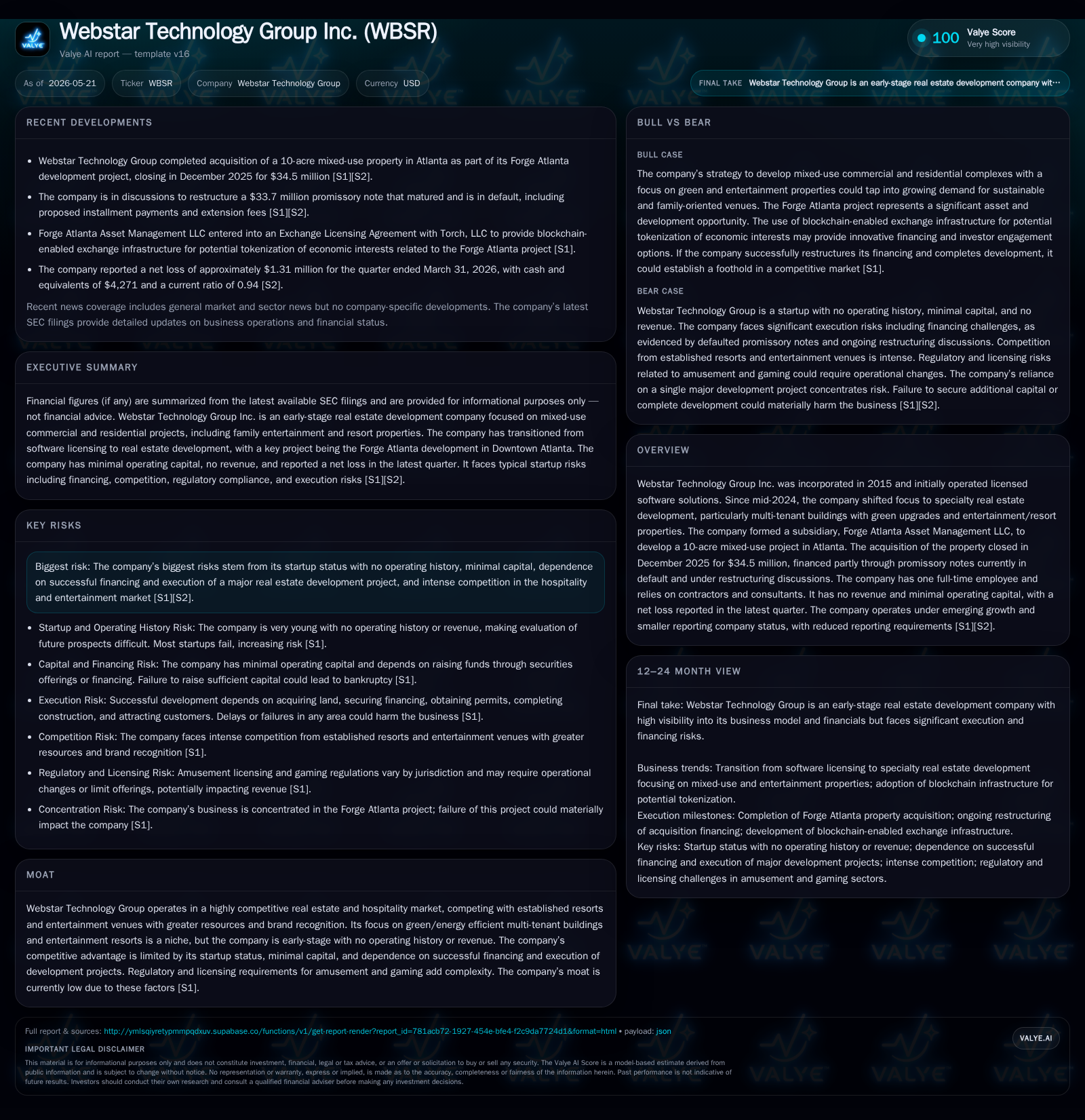
In the latest quarter ending March 2026, Webstar Technology Group Inc. continued its pivot from software licensing to specialty real estate development, primarily through its subsidiary Forge Atlanta Asset Management LLC. The company closed on a $34.5 million mixed-use property in Atlanta in December 2025 but is currently facing promissory note defaults and restructuring talks with the seller. Operating with minimal staff and no revenue, Webstar depends heavily on external contractors and financing success to advance its green multi-tenant and entertainment resort projects. While its niche focus could differentiate it over time, near-term execution, capital limitations, and competitive pressures represent significant hurdles.
Recent Operating Update
The latest quarterly filing dated May 20, 2026, confirms that Webstar Technology Group remains an early-stage specialty real estate developer actively engaged in acquiring and developing multi-tenant green buildings along with entertainment-resort properties [S20][S24]. Its primary asset is a 10-acre commercial/residential property in Atlanta's Castleberry Hill district acquired through its subsidiary Forge Atlanta Asset Management LLC. The acquisition closed in December 2025 for $34.5 million, financed predominantly by promissory notes that have since matured and fallen into default as of April 2026. The company is actively negotiating restructuring terms including an extension fee of $900,000 and installment payments that combine interest at a punitive rate of 12.5% per annum plus fees
Despite this sizeable investment, Webstar has yet to generate operating revenue or commence scaled construction activity. It operates with one full-time employee—CEO Ricardo Haynes—and outsources most functions to contractors and consultants minimizing fixed costs during uncertain capital availability [S11][S2]. This operating posture underscores the company's nascent commercial position within highly capital-intensive specialty real estate.
The balance sheet as of March 31, 2026 shows current liabilities exceeding current assets ($40.5M vs $38.1M) translating to a sub-1 current ratio (0.94), signaling tight liquidity conditions exacerbated by only $4.3K in cash against nearly $898K debt outstanding primarily related to acquisition financing [F1]
Business Model
Webstar generates value by identifying and developing specialty real estate properties primarily focused on mixed-use multi-tenant buildings designed for green/energy efficient upgrades alongside resort/entertainment venues. It acts as a holding company orchestrating project-specific special purpose vehicles such as Forge Atlanta Asset Management LLC which manage land acquisition, development planning, financing arrangements, regulatory approvals, and eventual leasing or sale operations [S16][S11].
Revenue mechanics depend on creating attractive commercial/residential or hospitality real estate that can ultimately be leased or sold at sufficient premiums to cover upfront land acquisition and construction costs plus generate returns. However, currently there is no operational revenue stream since projects remain under development or pre-development phases.
Management drives value through strategic acquisitions like the Fulton County land parcels but must secure favorable financing terms and execute complex permitting and construction processes. The company also explores leveraging digital asset innovation via a partnership with Torch LLC that provides blockchain-based exchange infrastructure intended for potential tokenization of economic interests associated with their flagship projects—an emerging trend intended to facilitate investor participation and liquidity in private real estate development assets [S21][S11]
Margins will eventually reflect typical specialty real estate developer economics: land acquisition cost leverage; construction cost controls; lease-up speed coupled with rental pricing power; allocation mix between residential versus commercial space; and efficient capital structuring including debt/equity balance.
Industry Structure and Competitive Position
Webstar operates at the nexus of real estate development specialized in sustainability-focused multi-tenant buildings combined with hospitality-oriented entertainment resorts—a segment where incumbents possess deep operational experience, significant capital backing, extensive brand recognition, and established distribution networks.
This competitive landscape favors players capable of absorbing long lead times for zoning/regulatory approvals, managing complex construction supply chains amid evolving building codes related to energy efficiency standards, and attracting tenants or guests through differentiated offerings.
Currently, Webstar's competitive position is constrained by its startup status: minimal operating history; limited organizational scale (one full-time employee); scarce capital reserves (low cash on hand versus substantial debt); and reliance on external consultants hinder operational agility [S1][F1]
While their niche focus on green building enhancements aligns well with growing market demand for sustainable development—a structurally positive trend driven by corporate ESG commitments and governmental incentives—this advantage remains theoretical until tangible project milestones are realized.
Furthermore, the complexities around amusement licenses or gaming permits needed for resort operations add regulatory layers complicating speed-to-market relative to pure residential/commercial developers.
Growth Drivers
Distinct growth catalysts include:
- Successful Completion of Forge Atlanta Development: The closure of the notable $34.5 million land purchase represents a foundational step. Progressing master planning into actual construction followed by tenant lease-up will generate nascent revenues.
- Financing Restructuring Success: Addressing current promissory note defaults via repayment extensions or refinancings will stabilize financial footing critical for securing contractor commitments.
- Regulatory Approvals: Obtaining necessary zoning variances, environmental certifications reflecting green building standards compliance (e.g., LEED), permits for entertainment/resort use.
- Digital Tokenization Adoption: Implementing cutting-edge fractional ownership models via blockchain may attract novel investors providing liquidity premium relative to traditional private equity funds.
- Market Demand Tailwinds: Rising demand for mixed-use urban developments integrated with sustainability features continues expanding driven by demographic shifts favoring live-work-play environments.
Risks and Watchpoints
Several material risks bear monitoring:
- Capital and Liquidity Constraints: With negative operating income reported previously (-$495K) combined with a net loss exceeding -$1 million annually [F1], ongoing funding needs are acute. Failure to raise adequate capital threatens project continuity.
- Execution Risk: Lack of direct hospitality management experience coupled with reliance on third-party contractors may hinder timely delivery impacting cost overruns or tenant satisfaction.
- Competitive Pressure: Larger established developers can leverage economies of scale absent at Webstar; ability to differentiate sufficiently matters.
- Regulatory Complexity: Entertainment resorts face additional licensing burdens potentially delays or restrictions impacting timetable.
- Debt Default Consequences: Current promissory note defaults attract heightened interest charges (12.5%) imposing cash flow stress until restructured or repaid [S20].
- Market Volatility: Economic downturns affect leasing velocity and pricing power directly challenging revenue assumptions.
What to Watch Next
Key upcoming developments include:
- Outcome of ongoing discussions with McCall Railroad LLC regarding extension terms of promissory notes due October 1, 2026 plus installment payments required starting April 15 through August 30, representing significant cash commitment [S20].
- Progress updates on physical development activities such as permit acquisitions, ground-breaking schedules at Forge Atlanta project.
- Additional capital raises or refinancing events disclosed publicly providing clarity on the financial runway ahead.
- Regulatory filings relating to digital securities offering connected to project tokenization partnership with Torch LLC showcasing innovative funding mechanisms [S21].
- Management additions beyond single full-time employee indicating scaling capabilities.
Financial Profile Summary
As of March 31, 2026, Webstar's balance sheet reflects constrained liquidity characterized by only around $4K cash compared to nearly $898K total debt primarily linked to acquisition financing obligations resulting in approximate net debt near $894K [F1]. Earlier reported net losses surpass $1 million annually underscoring absence of operating income generation so far [F1]. These metrics highlight pronounced financial risk stemming from thin capitalization amidst capital-intensive project ramp-up phase requiring imminent successful financing actions.
Disclaimer: This analysis is based exclusively on information available from publicly filed SEC documents up to May 2026 and does not constitute investment advice or research views.
Disclaimer: This is research-only, informational analysis and not investment advice. It may include AI-generated interpretation and general industry context. Always verify important details using primary sources.

Comments