
Western Digital Corp: Navigating Storage Industry Dynamics with Scale and Innovation
Western Digital leverages its manufacturing scale, intellectual property, and diversified customer base to maintain a competitive position in the evolving data storage market.
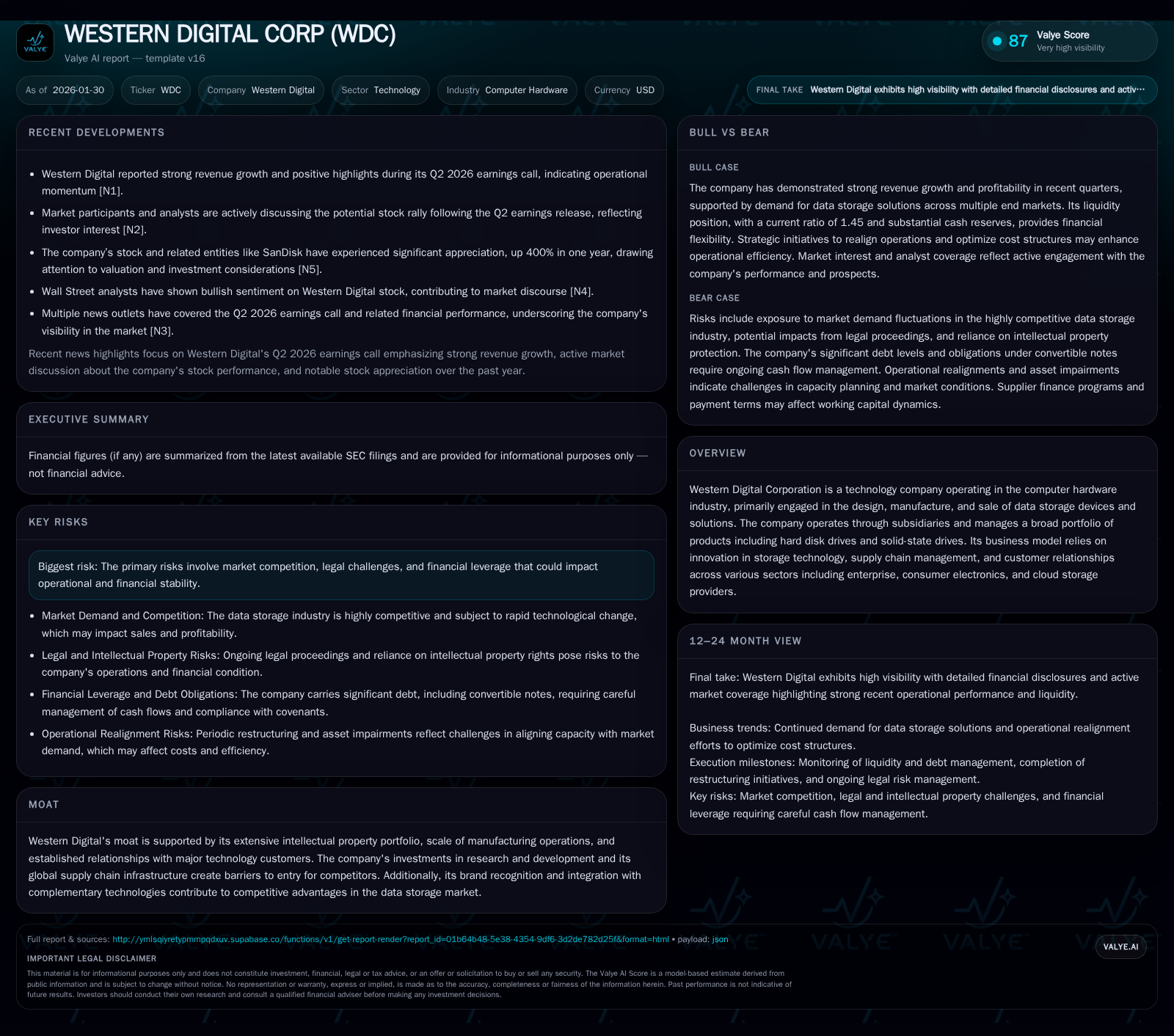
Western Digital Corporation remains a pivotal player in the global data storage industry, capitalizing on its extensive product portfolio, including HDDs and SSDs, and a broad customer base spanning enterprise to consumer sectors. Recent earnings signals show solid revenue growth, reflecting demand resilience despite macroeconomic headwinds. The company's business model, anchored in innovation and scale, faces competitive pressure from intensified rivals and industry shifts towards solid-state storage, while financial leverage and legal risks warrant ongoing scrutiny.
What Changed Recently
Western Digital released its Q2 2026 earnings, reporting strong revenue growth across multiple business segments, notably enterprise and cloud storage solutions, indicating resilience in demand despite broader macroeconomic uncertainty and market volatility [N2, N3]. Market commentary highlights a notable stock price appreciation of approximately 400% over the past year alongside SanDisk, reflecting investor enthusiasm about the company’s growth trajectory and industry positioning [N4]. However, analyst sentiment remains cautiously optimistic, emphasizing the need to monitor competitive pressures and technological transitions within the storage sector [N5].
Business Model as a System
Western Digital operates as an integrated technology company focused primarily on the design, manufacture, and sale of data storage devices, encompassing both hard disk drives (HDDs) and solid-state drives (SSDs) [S1]. Its broad product portfolio serves multiple end markets: enterprise data centers, cloud service providers, consumer electronics, and personal computing.
The company’s operations span multiple subsidiaries responsible for various facets of production and distribution. Its manufacturing footprint is global, leveraging economies of scale and advanced fabrication technologies to maintain cost competitiveness. Key system components include proprietary intellectual property assets critical for differentiating product performance and reliability.
Revenue streams derive from device sales, with pricing influenced by technology generation, capacity, and form factor. Customer relationships are strategic, often involving long-term supply agreements, particularly with hyperscale cloud operators and major OEMs. This model necessitates sophisticated supply chain coordination, balancing component procurement with capacity utilization across factories.
Financially, Western Digital carries a significant debt load including senior unsecured notes and convertible bonds, demanding disciplined capital management to service obligations while funding R&D and capital expenditures [S6, S7]. Liquidity metrics as of early 2026 indicate a current ratio of approximately 1.45, with nearly $2 billion in cash reserves, supporting operational flexibility [sec_xbrl].
Industry Map & Competitive Battlefield
The global data storage industry is characterized by rapid technological evolution and intense competition. Western Digital competes primarily against Seagate Technology and Toshiba in HDDs, while in SSDs, the landscape broadens to include flash memory manufacturers like Samsung, Micron, and SK Hynix.
Demand drivers include escalating data generation, growth in cloud computing, expansion of enterprise storage infrastructure, and evolving consumer device requirements. These forces push adoption of higher-density, lower-cost, and faster storage solutions.
The HDD market faces secular pressure from SSD substitution, driven by SSDs’ superior speed and power efficiency. However, HDDs retain advantages in cost per terabyte and capacity scaling, especially for cold storage and archival applications. Western Digital’s dual focus on HDD and SSD technologies aims to capture value across this shifting spectrum.
Competitive dynamics revolve around product innovation cycles, manufacturing cost efficiency, and customer lock-in through integration and service agreements. Intellectual property portfolios and proprietary process technologies serve as both barriers to entry and strategic assets.
Supply chain robustness is critical amid semiconductor shortages and geopolitical uncertainties affecting component sourcing and logistics.
Where the Economics Become Real
Western Digital’s unit economics hinge on production yields, component costs, and pricing power in a commoditized market. Manufacturing scale drives down fixed costs per unit, but capital intensity remains high due to investments in fabrication facilities and equipment.
Component procurement, particularly of NAND flash memory and mechanical parts, represents a significant variable cost. Market volatility in semiconductor prices and supply constraints can compress margins.
R&D spending is essential to sustain technological leadership but must be balanced against margin pressures.
Pricing dynamics reflect the interplay of supply-demand balances, competitive pricing strategies, and product lifecycle stages. SSD segments typically command higher margins than HDDs, influencing product mix economics.
Financial leverage introduces risk, as servicing debt requires consistent cash flow generation. Covenant compliance and refinancing capacity are important constraints, particularly in volatile market conditions [S6, S7].
Diligence Questions / Disconfirming Signals
- How resilient is Western Digital’s revenue growth if the macroeconomic environment worsens, particularly with respect to enterprise and cloud spending?
- What is the company’s strategic roadmap for managing the HDD-to-SSD transition in its product portfolio?
- How sustainable is the margin profile given input cost volatility and competitive pricing pressures?
- Are there emerging legal or regulatory risks that could materially affect operations or financials beyond disclosed contingencies?
- How effectively can Western Digital optimize its supply chain amid global semiconductor shortages and geopolitical tensions?
- What is the risk profile associated with its current debt structure, especially convertible notes and near-term maturities?
- To what extent do customer concentration risks exist, particularly reliance on hyperscale cloud operators?
- Are there signs of technological disruption by competitors that could erode Western Digital’s intellectual property moat?
This analysis synthesizes publicly available information and industry context without specific forecasts or investment recommendations. It aims to provide a grounded understanding of Western Digital’s operational and competitive positioning as of early 2026. Readers should consider multiple data sources and perform their own due diligence before forming conclusions.
Disclaimer: This is research-only, informational analysis and not investment advice. It may include AI-generated interpretation and general industry context. Always verify important details using primary sources.

Comments