
Wetouch Technology: Margin Expansion and Capacity Bets Amid China-Specific Risks
Wetouch Technology’s transition toward higher-margin, specialized touchscreens is fueling gross margin gains and supporting ongoing capacity investments, but regulatory, currency, and customer concentration risks unique to its China-centric business model remain defining variables for future value creation.
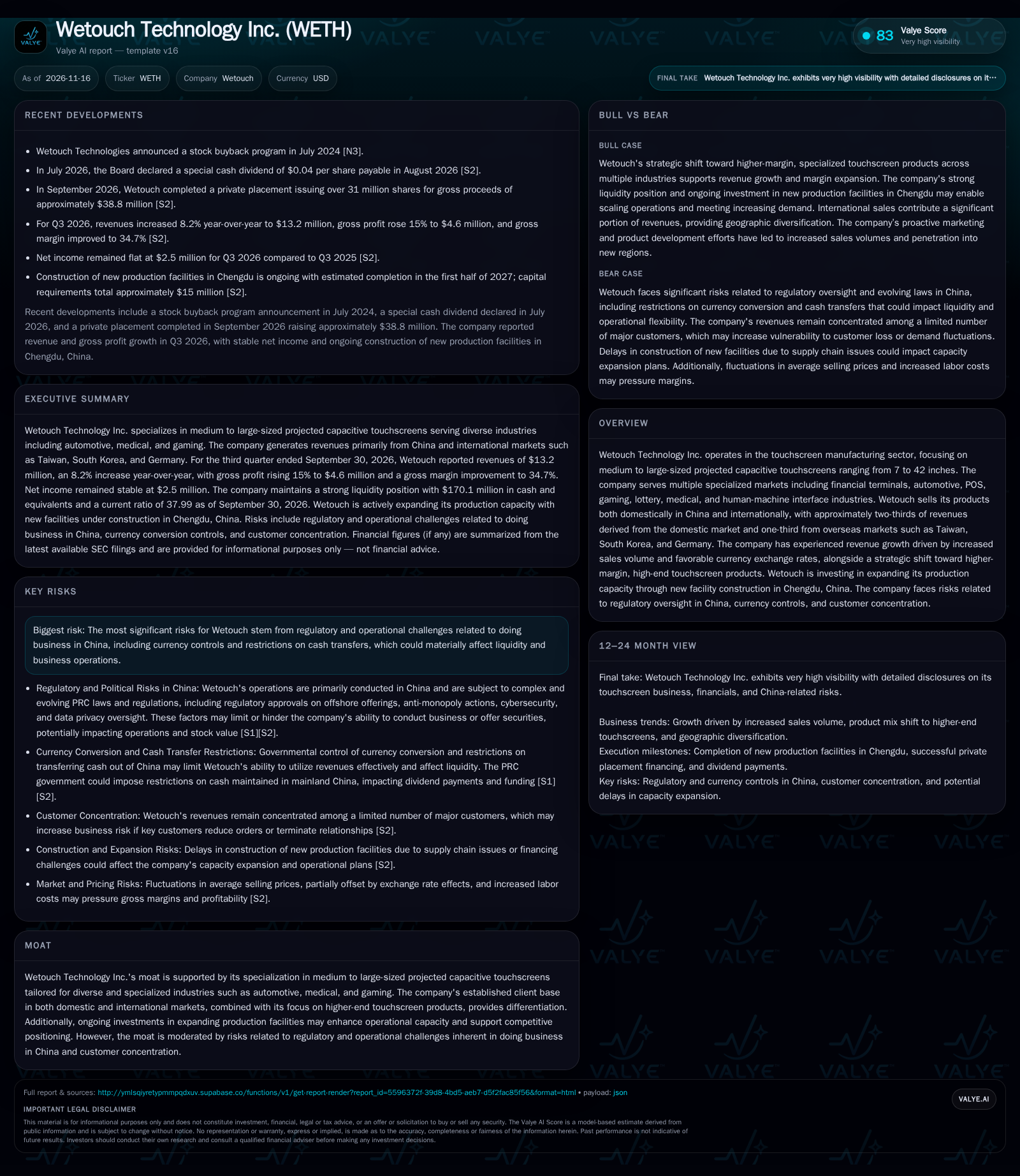
Wetouch Technology reported Q3 2026 revenues of $13.2 million (up 8.2% YoY) and expanded gross margins to 34.7% on the back of a shift to higher-end touchscreen products, while maintaining a large cash position and launching new facility construction in Chengdu. However, risks tied to regulatory oversight, currency controls, and reliance on a handful of major customers continue to shape the company’s risk/reward profile. [S2]
Wetouch Technology Inc. is at a turning point: its pivot to higher-margin, specialized touchscreen products is delivering measurable gains in gross margins and supporting continued expansion, including new production facilities in Chengdu. Yet the company’s China-focused operating base exposes it to regulatory, currency, and customer concentration risks that could sharply affect future cash flows and strategic flexibility. [S2]
Recent Results Spotlight Margin Expansion and Capital Deployment
Wetouch Technology reported Q3 2026 revenues of $13.2 million, an 8.2% increase over the prior year, with gross profit rising 15% to $4.6 million and gross margin improving to 34.7% from 32.7%. This margin expansion was attributed to a shift toward higher-end product categories such as medical, POS, and automotive touchscreens, partially offset by higher labor costs and a 2% decrease in average selling prices in RMB. Net income held steady at $2.5 million amid these offsetting factors. The company ended the quarter with cash and equivalents of $170.1 million and a current ratio of 37.99, reflecting a reported liquidity position. Notably, Wetouch is investing approximately $15 million in new production facilities in Chengdu, with $9.2 million already recorded as construction in progress. The company also completed a $38.8 million private placement and paid a special $0.04/share dividend in August 2026. [S2]
How Product Mix and Scale Could Reshape Wetouch’s Profit Model
Wetouch’s business model is anchored in the manufacture and sale of medium to large-sized projected capacitive touchscreens for specialized sectors. The company’s revenue is driven by a mix of volume, product mix, and pricing. The recent shift toward higher-margin, higher-value products—such as medical, automotive, and industrial touchscreens—has enabled gross margin expansion even amid modest declines in average selling prices. This suggests that product differentiation and application-specific engineering can support premium pricing, though the durability of this advantage depends on sustained technological leadership and customer relationships.
Fixed costs in touchscreen manufacturing—especially for large-format products—are substantial, encompassing R&D, facility overhead, and capital equipment. As Wetouch expands capacity in Chengdu, operating leverage could improve if new facilities are efficiently utilized and demand continues to grow. However, this also raises capital intensity and the risk of under-absorption if volumes disappoint or if construction is delayed. Variable costs, primarily materials and labor, have been subject to inflationary pressures, and the company has already reported increased labor costs.
However, capital allocation decisions—balancing dividends, buybacks, and reinvestment—will be critical, especially given ongoing China-specific currency controls and cash-transfer restrictions.
Differentiation in Specialized Touchscreens: Moat or Mirage?
Wetouch’s competitive positioning is built around specialization in medium-to-large format capacitive touchscreens tailored for demanding verticals—financial terminals, automotive, gaming, medical, and industrial HMI. This focus can create switching frictions for customers who require high reliability, integration support, and industry-specific certifications. The company’s ability to serve both domestic (China) and international (notably Taiwan, South Korea, Germany) markets provides some geographic diversification, though domestic sales still account for roughly two-thirds of revenue.
In the broader landscape, Wetouch faces competition from both global touchscreen giants and regional players, many of whom operate at significant scale and may compete aggressively on price, technology, or integration services. The shift toward higher-end products could provide a buffer against pure commodity price competition, but it also invites more specialized competitors and raises the bar for continuous innovation. Customer concentration remains a notable risk: losing a major customer could materially impact revenue, and the lack of long-term recurring contracts heightens this vulnerability.
Regulatory risks in China—ranging from anti-monopoly actions to cybersecurity and currency controls—add another layer of complexity, potentially constraining Wetouch’s ability to move cash, price flexibly, or pivot strategy in response to international demand shifts.
Unlocking Operating Leverage Through Successful Scale-Up and Product Leadership
If Wetouch executes effectively on its facility expansion in Chengdu, ramps utilization efficiently, and continues its pivot toward higher-margin, customized touchscreens, the company could achieve a step-change in operating leverage and earnings power. Increased capacity would allow Wetouch to serve larger orders, deepen penetration in international markets, and potentially diversify its customer base, reducing concentration risk.
Sustained gross margin improvement—driven by a richer product mix and disciplined cost management—could translate into higher net income growth, especially if labor and material inflation moderates.
Evidence that would confirm this scenario includes: consistent increases in international sales as a share of revenue, rising gross margins above 35%, successful commissioning and ramp-up of new facilities on schedule, and a reduction in customer concentration (with a broader, more diversified order book).
Product Mix Gains Offset by Enduring Structural Risks
The most plausible trajectory for Wetouch is steady revenue and modest margin growth as the company continues to shift its product mix upmarket and brings new capacity online. Gross margins may gradually improve if specialized applications grow as a share of sales, but these gains could be partially offset by ongoing labor cost inflation, pricing pressure from larger competitors, and the need to offer selective discounts to retain major customers.
Customer concentration is likely to remain a structural feature in the near term, limiting revenue visibility and creating periodic volatility. Regulatory and currency risks in China will continue to constrain the company’s potential financial flexibility, especially in deploying capital internationally or repatriating profits. Operational execution—particularly the timely and cost-effective completion of the Chengdu facility—will be essential to avoiding negative surprises.
Confirmation of this scenario would include: incremental but not dramatic gross margin improvements, stable or slightly rising revenue, continued high customer concentration, and periodic regulatory or currency-related disclosures in filings.
Regulatory Shocks or Customer Loss Could Derail Growth Momentum
The principal downside risks for Wetouch stem from its exposure to China-specific regulatory and operational uncertainties, as well as its dependence on a handful of large customers. Similarly, any escalation in anti-monopoly or cybersecurity oversight could disrupt business practices or require costly compliance upgrades.
A loss or significant reduction in orders from one or more major customers—whether due to competition, pricing, or shifting industry standards—could create a sharp revenue shortfall, especially in the absence of long-term contracts or recurring revenue streams. Delays or cost overruns in the Chengdu expansion project, whether from supply chain disruptions or regulatory holdups, would further strain margins and capital allocation.
Downside confirmation would come from a sudden drop in revenue, margin compression, rising accounts receivable or inventory, regulatory filings disclosing new restrictions or penalties, or project delays and cost overruns in facility construction.
Signals That Will Clarify Wetouch’s Margin Story and China Risk Trajectory
Monthly or quarterly updates on the commissioning and utilization of the new Chengdu production facilities—are timelines and budgets being met?
Gross margin trends by product category, especially the share of revenue from higher-margin segments such as medical, automotive, and industrial control touchscreens.
Movement in customer concentration metrics: are new customers being added, or is revenue still dominated by a few large accounts?
International sales as a percentage of total revenue—does overseas penetration increase, and is geographic diversification improving?
Changes in regulatory disclosure language relating to currency controls, anti-monopoly, or cybersecurity oversight in China.
Working capital trends, particularly changes in inventory and receivables that could signal demand volatility or collection risk.
Updates on capital allocation: further dividends, buybacks, or significant new investments—do these actions align with stated growth and risk-management strategies?
Effective tax rate developments, which may reflect changes in China’s regulatory environment or the company’s global tax planning.
Disclaimer: This is research-only, informational analysis and not investment advice. It may include AI-generated interpretation and general industry context. Always verify important details using primary sources.

Comments