
Where Food Comes From, Inc. Revenue Growth Challenges and Strategic Responses Through Verification Innovation
WFCF faces cyclical industry pressures and inflationary costs but leverages comprehensive food verification services and sustainability consulting to drive growth.
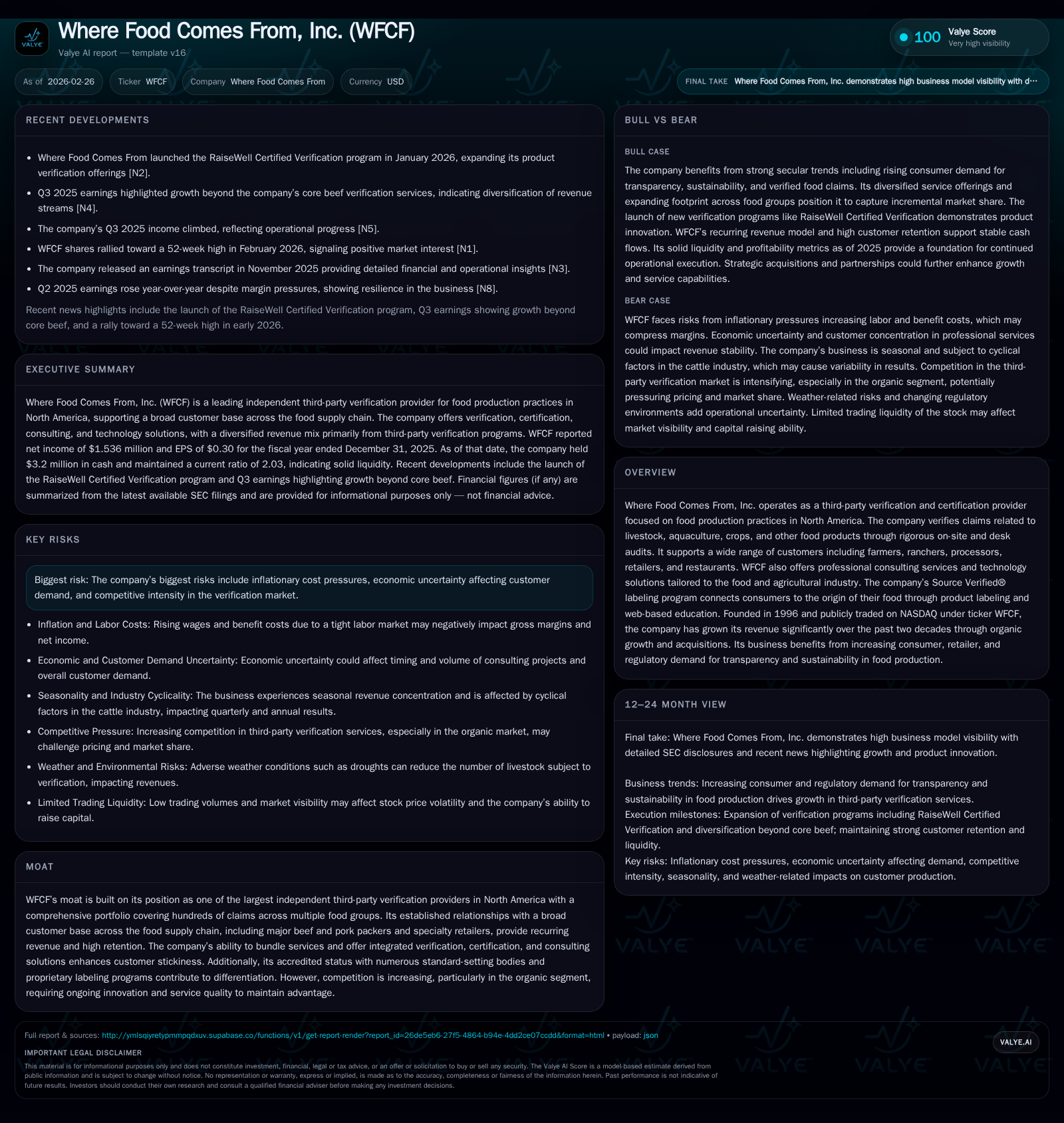
Where Food Comes From, Inc. (WFCF) has evolved into a leading third-party food verification provider with a diverse service portfolio spanning livestock, crops, and other food products. Historically, the company posted robust revenue growth driven by organic expansion and targeted acquisitions, yet recent years reveal margin pressures from inflation and economic uncertainty impacting consulting demand. WFCF aims to capitalize on the growing emphasis on ESG and food transparency by broadening its verifications and consulting offerings while navigating risks including weather-driven supply fluctuations, competitive intensity, and regulatory complexities. Capital returns remain disciplined with modest share buybacks funded from steady operating cash flow.
Business Overview and Historical Performance
Where Food Comes From, Inc. (WFCF) stands as a prominent independent third-party verification provider serving North America's food production ecosystem since its founding in 1996 [S15]. The company verifies claims on livestock, aquaculture, crops, and other food products through rigorous onsite audits combined with desk verifications. Over time it has expanded organically and through acquisitions to support over approximately 17,500 customers including ranchers, processors, retailers, restaurants, wineries, distributors, consumer brands, chefs, trade associations, and more [S15]. The breadth of its verification services spans hundreds of claims covering beef, pork, lamb, poultry, seafood, dairy, eggs, fresh produce, nuts/grains and wine among others – positioning WFCF as a full-spectrum solution provider within food traceability.
From a financial perspective,[F1] reveals significant growth from $11.6 million in revenue during fiscal year (FY) 2016 to around $20.8 million by FY2019—a compounded annual growth rate (CAGR) approximating 17%. This reflects successful penetration into additional customer bases and food groups combined with expanded verification program adoption responding to increasingly stringent food labeling standards [S15].
Historical performance (annual)
| FY | Net ($mm) | CFO ($mm) | OpInc ($mm) | Capex ($) | Net YoY |
|---|---|---|---|---|---|
| 2025 | 2 | 2 | 1 | 155000 | -27.5% |
| 2024 | 2 | 3 | 2 | 159000 | -1.5% |
| 2023 | 2 | 3 | 3 | 148000 | +7.9% |
| 2022 | 2 | 3 | 3 | 89000 |
Source: SEC companyfacts cache [F1].
Capital returns and efficiency (annual)
| FY | Buybacks ($mm) | FCF ($mm) | ROE% |
|---|---|---|---|
| 2025 | 2 | 1 | 16.5 |
| 2024 | 2 | 3 | 21.3 |
| 2023 | 4 | 3 | 19.9 |
| 2022 | 3 | 3 | 16.0 |
Source: SEC companyfacts cache [F1].
*Latest years available include detailed profitability indicators; earlier years limited to revenue figures only from historical data[F1].
Operating profit margins faced headwinds post-2022 despite continued top-line gains; operating income dropped by nearly half from roughly $2.7 million in mid-2020s to $1.21 million in FY2025 due mainly to inflationary pressures and tighter labor markets increasing wages/benefits costs [F1][S6]. Net income followed a similar trend falling around 27% YoY in FY2025 though free cash flow remained positive due to conservative capital expenditure amounts (around $150k annually). Notably capital allocation included consistent share repurchases totaling over $2 million during the latest periods indicative of management’s confidence amidst cost headwinds [F1].
Industry Context and Market Positioning
WFCF operates at the intersection of rising consumer demand for transparency around food provenance and increasing retailer/government mandates for verified production practices [S7]. Whereas early company growth was sparked by age/source verification for beef aligned to export markets’ safety concerns (e.g., following mad cow disease scares), contemporary demand incorporates broader social responsibility themes including animal welfare standards (“humane handling”), non-GMO claims, antibiotic-free assurance, organic certifications, environmental sustainability metrics (ESG), and more subtle consumer preference signals embedded in product labels [S16]
The evolving regulatory landscape also plays a pivotal role: USDA Animal Disease Traceability rules impose traceability requirements affecting audit volumes; international export agreements leverage non-hormone treated cattle verification programs fueling demand; meanwhile newly introduced EU deforestation regulations add complexity requiring clear supply chain documentation leading companies back to trusted third parties like WFCF for authentication services [S20]. Meeting these multiple intersecting demands requires a system capable of bundling diverse compliance standards into streamlined auditing solutions – an area where WFCF’s comprehensive portfolio covering multiple food groups is an advantage over smaller niche competitors [S12][S13]. Their proprietary Source Verified® labeling program creates unique consumer-facing engagement linking package claims directly back to audited source farms or ranches leveraging web-based education – allowing brands differentiated shelf space with verified stories underpinning purchasing decisions [S15].
Growth Drivers and Constraints
Historical growth momentum was driven primarily by organic expansion into new claims/programs aligned with rising consumer expectations for trustworthiness coupled with strategic acquisitions that broadened service reach across adjacent industries like wine certification or seafood verifications [S11]. The company's ability to cross-sell bundled services such as combining age/source verification with animal welfare audits or sustainability consulting helped deepen existing customer relationships while attracting new market segments including specialty retailers focused on differentiated sourcing [S4][S16].
Looking forward several growth opportunities present:
- ESG & Sustainability Consulting: With heightened awareness of climate change impacts on agricultural supply chains plus emerging governance requirements many customers seek expert assistance meeting complex carbon reporting or land stewardship standards beyond auditing alone — areas where WFCF has invested expertise (see S6 on marketing sustainability-focused solutions).
- Expanding Food Group Coverage: Although already extensive across beef/pork/lamb/poultry/wine/fish/produce categories WFCF continues extending into beverages/seafood/finished goods adding incremental addressable markets.
- International Growth: While currently focused on North America limited entries into overseas markets provide upside but will require risk management addressing geopolitical/trade barriers noted as constraints in filings (see S21).
However headwinds temper near-term outlooks:
- Economic Uncertainty Impacting Customer Demand: Inflationary pressures elevate personnel costs eroding margins; simultaneously tight budgets delay or reduce professional services contract approvals important for consulting revenues causing fluctuations difficult to forecast reliably (highlighted prominently at S6).
- Weather & Cyclicality Risks: Livestock audit volumes are affected negatively when drought shrinks herd sizes as observed in key US beef-producing states driving fewer verifications – compounded by longer herd production lifecycle cycles making timing unpredictable (discussed deeply at S19).
- Competitive Intensification: The organic certification niche experiences stronger competition from established firms focusing exclusivity mandates squeezing margins; other technology entrants may challenge traditional audit-based methods pushing innovation demands higher on WFCF’s product roadmaps ([S12]).
Financial Outlook & Performance Metrics
Explicit company guidance remains limited publicly but key performance milestones can be tracked via updated SEC disclosures detailing Consumer-facing service revenues representing over 80% of total top-line with stable product sales constituting around ~14% related chiefly to ear tags used for livestock identification systems essential for integrated verifications schemes ([S4]). Healthy client retention rates evidenced by no single customer exceeding 10% revenue concentration reduces dependency risks.
Financial returns portray disciplined capital stewardship: approximate return on equity stands near a respectable ~16.5% based on latest net income compared to equity base despite margin compression ([F1]). Operating cash flow remains solid albeit trending down from prior peaks consistent with lower earnings momentum but sufficient to cover modest capex requirements supporting innovation pipelines ([F1]). The company maintains prudent liquidity reflected by a current ratio just above two comfortably meeting near-term obligations ([F1]). Share repurchases continue as a method to enhance shareholder value given limited dividend history but controlled buyback scale preserves financial flexibility ([F1]).
Capital Allocation & Intellectual Property
Capital allocations prioritize balancing operational stability with judicious reinvestment into proprietary technologies protecting competitive advantages grounded in patents/trademarks/intellectual property rights—crucial given evolving cyber threats targeting interconnected audit platforms potentially housing sensitive client data ([S18]). Investments also cover expanding digital features underpinning Source Verified® programs critical for marketplace differentiation ([S15]). Share repurchase activity exceeding two million dollars annually highlights management’s intent to deploy available cash efficiently while maintaining necessary reserves ([F1]).
Risks Summary
Key risk exposures noted span:
- Inflated labor costs due to tight employment markets stretching margins.
- Economic downturn-caused demand softness particularly delaying professional services engagements.
- Seasonal fluctuations inherent in agro-livestock cycles affecting headcounts recalled for audits.
- Weather pattern shifts causing natural disasters such as drought or hailstorms curtailing agricultural outputs directly diminishing verification volume opportunities.
- Regulatory volatility introducing compliance ambiguity jeopardizing predictable market access timing.
- Escalating competition requiring continuous innovation investments.
- Information security vulnerabilities necessitating significant IT protective spending.
- Integration execution risks relating to acquisitions potentially diverting focus or incurring unexpected costs ().
Conclusion
Where Food Comes From leverages its extensive third-party audit infrastructure combined with emerging consultative capabilities tuned to ESG priorities enabling incremental revenue streams beyond traditional certification fees – critical as consumer demands evolve toward comprehensive transparency across complex agricultural supply chains. The company’s historical growth track record is clear though recent profitability stress highlights operational challenges common within cyclical commodity-linked sectors exacerbated by labor cost inflation coupled with cautious customer spending on consulting projects amid volatile macroeconomic conditions. Navigating these factors prudently while capturing new certification categories plus expanding sustainability advisory offerings constitute important strategic imperatives going forward. Capital discipline complemented by ongoing investments protecting intellectual property position WFCF well against intensifying competition though regulatory uncertainties remain important watch points. Operating effectively through seasonal variations tied to agriculture cycles alongside maintaining trust via rigorous independent audits should sustain its moat earned across decades servicing a highly diversified client base ranging from ranchers up through premium retail channels connected directly with end consumers. Overall balance between extending product scope organically plus selective bolt-on acquisitions underlies the company’s long-term value creation aspirations within the globalively evolving food transparency ecosystem.
Disclaimer: This report is intended solely for informational purposes based on the provided data sources without offering investment advice or recommendations concerning securities trading decisions.
Disclaimer: This is research-only, informational analysis and not investment advice. It may include AI-generated interpretation and general industry context. Always verify important details using primary sources.

Comments