
Weatherford International’s Financial Resurgence Amid Governance Strength and Operational Ambiguity
An in-depth look at Weatherford International's recent earnings gains juxtaposed with uncertain competitive positioning and macroeconomic risks.
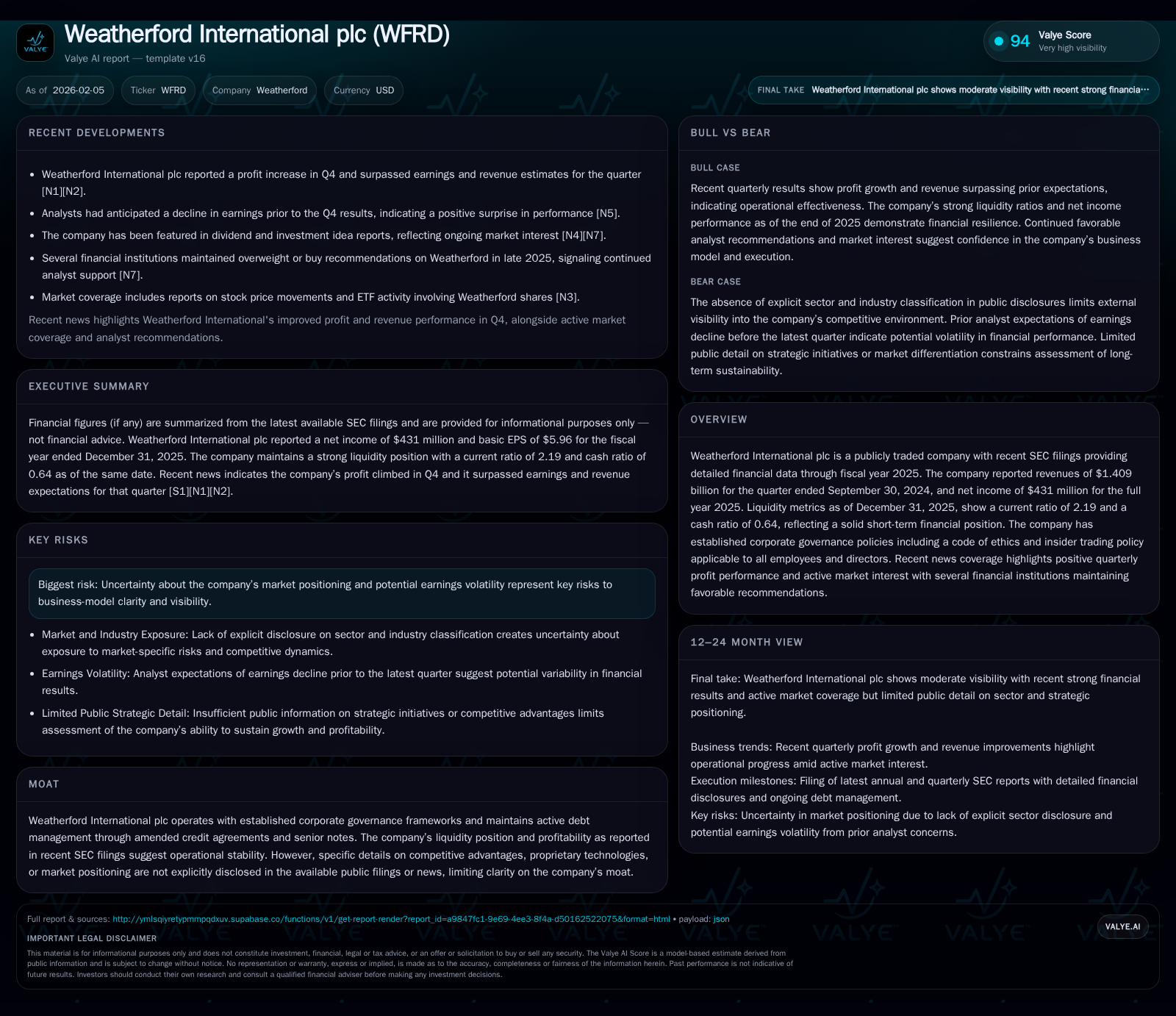
Weatherford International delivered a notable upside surprise in its Q4 2024 revenue and full-year 2025 net income, underpinning a renewed narrative of operational resilience. The company exhibits solid liquidity and active debt management alongside robust governance frameworks that reinforce its sustainability foundation. Yet, lack of explicit disclosure on proprietary technological advantages or clear market moat introduces ambiguity about long-term competitive durability. Concurrent geopolitical tensions and volatile oil markets compound risk factors, while fluctuating analyst sentiment reflects a nuanced investor outlook on Weatherford’s prospects.
Financial Performance: Breaking Down the Latest Earnings Beat
Weatherford International surprised the market by exceeding revenue and earnings estimates in the fourth quarter of 2024. The company reported quarterly revenues of $1.409 billion [F1], a figure that outpaced modestly bearish analyst expectations flagged earlier in January 2026 [N2]. This top-line strength carried through to full fiscal year 2025 results, where Weatherford booked net income of $431 million [F1]. This turnaround sheds light on effective cost management or margin improvements that have bolstered profitability despite industry headwinds.
Prior analyst skepticism centered around potential earnings softening proved overly conservative as Weatherford demonstrated operational resilience reflecting either improved contract execution or tighter expense controls [N1,N3]. The quarterly profit beat therefore contributes a signal that the firm might be stabilizing following previous volatility—an encouraging sign given its capital-intensive business framework.
Liquidity and Capital Structure: Signs of Financial Stability Amid Debt Management
From a balance sheet perspective, Weatherford finished calendar year-end 2025 with current assets totaling approximately $3.37 billion against current liabilities near $1.54 billion. This results in a current ratio of roughly 2.19 [F1], affirming strong short-term liquidity buffers capable of absorbing eventual shocks or delayed receivables.
Further supporting financial flexibility is the nearly $987 million held in cash and equivalents [F1], which acts as a reserve amid ongoing capital deployment needs. Importantly, filings detail amended credit agreements alongside senior note obligations maturing through the decade; these illustrate active liability management efforts to optimize interest costs and maturity profiles [S1].
While such debt servicing requirements inherently imply ongoing cash flow demands, Weatherford’s liquidity position currently cushions against immediate refinancing risks—critical for sustaining operations within a cyclical energy services sector often buffeted by external shocks.
Governance and Ethical Frameworks: Foundations for Sustainable Operations
Weatherford codifies corporate conduct expectations through an established "Weatherford Code of Business Conduct" applicable company-wide, encompassing officers, directors, and employees alike [S1]. This is complemented by an insider trading policy designed to enforce securities law compliance.
Though these governance provisions align with industry norms rather than constituting a unique competitive advantage, they nonetheless serve as meaningful ballast against reputational or regulatory pitfalls—a non-trivial benefit in an environment of heightened ESG scrutiny and legal complexity.
Effective governance structures also underpin more transparent financial reporting and internal controls. Such foundational elements form part of what might be considered operational moats from an organizational risk perspective even if not directly linked to market dominance.
Competitive Moat Blindspots: What the Filings Reveal — and Conceal
Despite positive financial metrics, Weatherford’s disclosures stop short of outlining any distinctive technical capabilities or differentiated service offerings that might confer sustainable competitive advantage going forward [S1,valye_report_excerpt].
Absent detailed commentary on proprietary technologies or entrenched customer relationships, investors are left without clear indicators of how the company defends pricing power or market share against rivals in the global oilfield services arena.
This opacity complicates confidence in projecting durability beyond cyclical upswings—as intangible yet critical factors like innovation adoption pace or digital transformation remain insufficiently illuminated publicly.
Industry analysis suggests competitive positioning relies heavily on legacy service breadth rather than singularly disruptive solutions at present (analysis). Thus, ongoing due diligence should monitor potential strategic initiatives aimed at closing these moat gaps.
Navigating Macroeconomic and Geopolitical Headwinds: Risk Factors in Focus
Weatherford operates within an inherently volatile nexus reshaped by geopolitical conflicts—in particular the Russia-Ukraine war and unrest in Middle Eastern countries—as noted extensively in risk disclosures [S1]. These conflicts introduce uncertainties ranging from supply chain disruptions to sanctions exposure.
Additionally, broad inflationary pressures globally threaten input cost escalation while recession concerns weigh on capital expenditure budgets from core energy sector clients.
Specific vulnerabilities include tightened compliance regimes around environmental regulation, cybersecurity threats heightened by increased remote IT reliance, and price volatility for oil and natural gas commodities themselves—each layering complexity onto strategic planning.
Management’s transparency regarding these risk areas signals awareness but also underscores reliance on factors largely outside corporate control [S1].
Market Sentiment and Analyst Views: Interpreting Recent Stock Moves
The equity market's reaction to Weatherford has been decidedly mixed yet with bouts of pronounced optimism. Following a bounce witnessed in early January (+9.5% gain) [N7], another surge was noted later that month (+6.5%) [N6]. These spikes suggest momentum-driven buying possibly tied to broader cyclicality or sector rotation narratives.
Conversely, several analysts issued cautionary projections regarding earnings softness ahead of quarterly releases [N2], reflecting unresolved concerns over sustainability despite recent beats.
This divergence points toward an investor community wrestling between recognizing recovery signals against persistent business model ambiguities.
The accompanying positive press coverage further amplifies interest but stops short of definitive bullish consensus [N8].
Future Outlook: Balancing Opportunities Against Structural Challenges
Looking forward, multiple dynamics will shape Weatherford’s trajectory. The company’s robust liquidity positions it well to pursue selective investments or weather intermittent downturns.
However, much depends on its ability to adapt technologically—particularly integrating digital tools such as AI for enhanced operational efficiency—and participation in emerging energy transition arenas like carbon capture or geothermal services as outlined in filings [S1].
Equally important is effective capital allocation prioritizing growth areas without jeopardizing financial prudence plus continuous workforce engagement amidst inflation-driven wage pressures.
Absent clear visibility on innovation differentiation or strategic pivots addressing evolving market demands, maintaining profitability gains will be challenging but feasible if current enhancement efforts persist.
Closing Thoughts: Assessing Weatherford in Today’s Volatile Energy Landscape
Weatherford International presents a complex investment puzzle defined by recent demonstrable financial strength married with opaque long-term competitive positioning. Its solid governance practices offer operational stability safeguards albeit without translating into obvious market barriers.
Heightened external risks spanning geopolitical strife to commodity pricing infuse volatility into forecasts creating layered uncertainty for stakeholders.
As such, continuous monitoring focusing on execution of technological adaptation strategies alongside disciplined capital management is warranted to understand how effectively Weatherford can transform apparent short-term resilience into durable value creation within an unforgiving industry context.
This report emphasizes data-driven evaluation grounded strictly in disclosed evidence without extrapolative speculation — reflecting the nuanced reality confronting energy sector participants today.
Disclaimer: This is research-only, informational analysis and not investment advice. It may include AI-generated interpretation and general industry context. Always verify important details using primary sources.

Comments