
Wix.com Ltd. Surges Past Revenue Milestones Amid Operational Reevaluation
Wix’s 2025 results showcase robust revenue growth alongside renewed net income, underpinned by capital maneuvers and cost management amid a competitive SaaS environment.
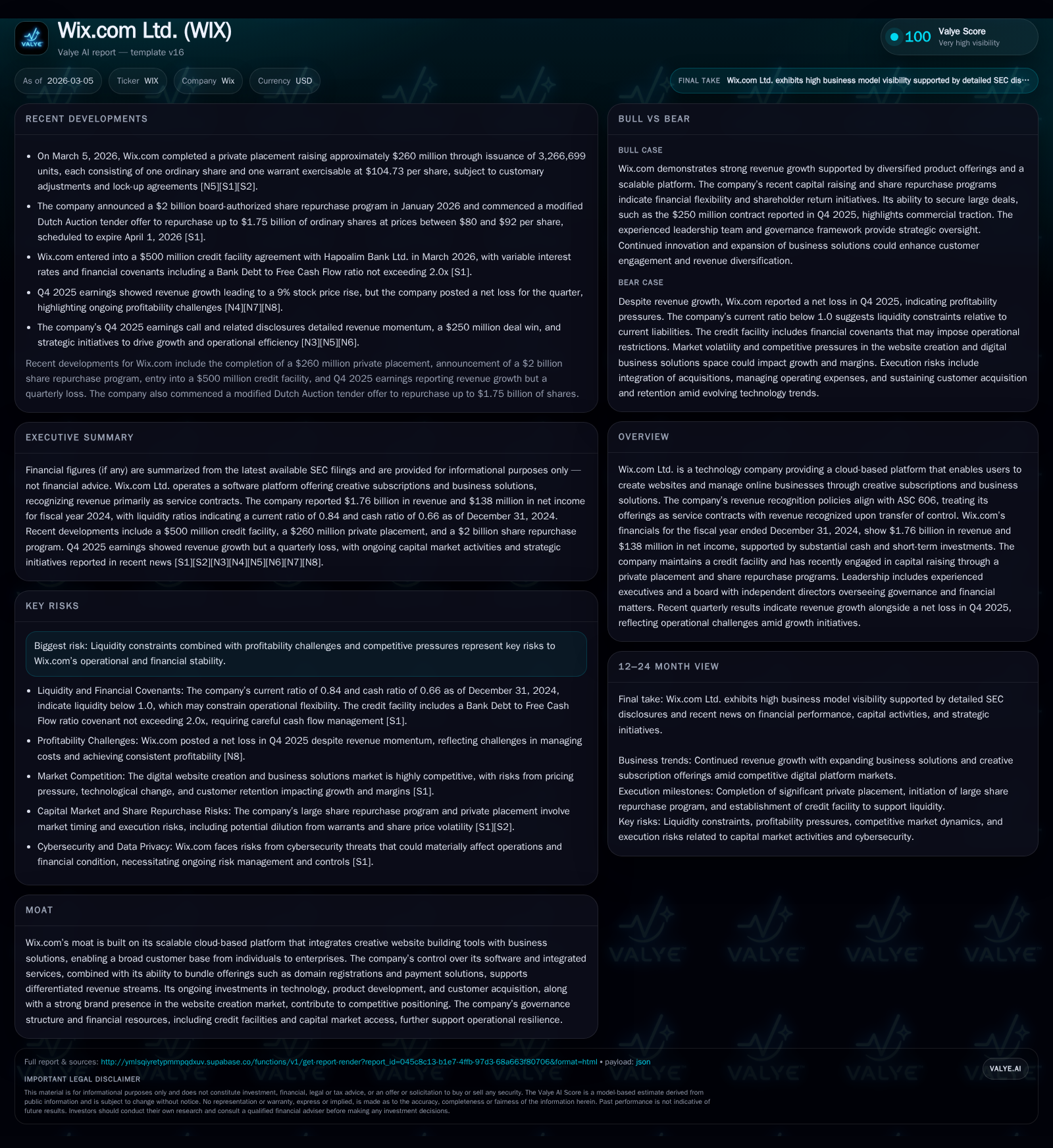
Wix.com Ltd. reported a substantial 27.6% revenue increase in fiscal year 2025, reaching approximately $2.0 billion, marking a significant milestone over prior years. This top-line surge was accompanied by a turnaround to positive net income of $50.6 million, signaling improving operational discipline despite operating margins remaining narrow. The firm strengthened liquidity through a $260 million private placement and maintains a sizeable $500 million credit facility backed by collateral, while aggressively deploying capital via a $2 billion share repurchase program authorized in early 2026. Future growth hinges on expanding bundled subscription offerings and new large contract wins, though risks from liquidity constraints and competitive SaaS pressures remain salient.
Revenue Expansion and Operating Margins: Gains and Growing Pains
Wix.com Ltd.’s fiscal year ending December 31, 2025 demonstrated notable top-line momentum with reported revenues reaching approximately $1.993 billion ([F1]). This represents a striking 27.6% year-over-year growth over the approximately $1.56 billion recorded in FY2024, fueled by broad customer adoption across its cloud-based creative subscriptions and integrated business solutions platforms ([N1]). Despite such scale expansion, operating income was just marginally positive at roughly $1.75 million—improving over 107% versus the prior year’s operating loss but still reflective of tight margins under active investment strategies ([F1]). These figures illustrate Wix’s ability to grow revenue but also underscore ongoing operating leverage challenges typical in high-growth SaaS models where scaling costs can compress margins initially.
Historical performance (annual)
| FY | Rev ($mm) | Net ($mm) | CFO ($mm) | OpInc ($mm) | Rev YoY | Net YoY |
|---|---|---|---|---|---|---|
| 2024 | 1993 | 51 | 583 | 2 | +27.6% | +52.8% |
| 2023 | 1562 | 33 | 248 | -24 | +12.5% | +107.8% |
| 2022 | 1388 | -425 | 37 | -285 | +9.3% | -262.5% |
| 2021 | 1270 | -117 | 66 | -326 |
Source: SEC companyfacts cache [F1].
Capital returns and efficiency (annual)
| FY | Buybacks ($mm) | ROE% |
|---|---|---|
| 2024 | 575 | -13.8 |
| 2023 | 127 | -60.8 |
| 2022 | 232 | 161.4 |
| 2021 | 200 | -80.4 |
Source: SEC companyfacts cache [F1].
Wix achieved nearly $2 billion in revenue for FY2025 with continued improvement in net profitability despite thin global operating margins.
Key Drivers Behind the Revenue Growth in FY2025
The robust revenue growth stems from Wix’s strategic focus on integrating creative website-building tools with comprehensive business solutions including domain registrations and payment processing ([N1],[S12]). The company’s cloud platform benefits from recurring subscription revenue streams combining product bundles that enhance overall customer lifetime value. Sector-native subscription monetization models emphasize driving average revenue per user through upselling complementary services.
Customer acquisition dynamics also played a role; broadening enterprise adoption alongside SMEs helped fuel volume increases despite rising customer acquisition costs, consistent with industry trends balancing growth and profitability ([N2],[S12]). Geographic expansion efforts complemented these gains with regional products tailored to local e-commerce regulations enhancing competitive positioning.
Shifts in Profitability: From Losses to Positive Net Income
Wix’s jump to positive net income of roughly $50.6 million in FY2025 marks marked improvement over prior years’ losses exceeding hundreds of millions ([F1],[N10]). Operational advances reflect tighter cost structures and potential economies of scale in hosting infrastructure.
However, operating income remains relatively flat near break-even illustrating ongoing margin compression amid competitive pricing pressure and reinvestment requirements ([F1],[N10]). The modest operating leverage gains suggest cautious optimism as the firm works to convert enhanced revenues into sustainable profits without undermining innovation or market share.
Liquidity, Debt Structure, and Bank Credit Facility Insights
Liquidity remains adequate; Wix closed the period with approximately $311 million cash equivalents supplemented by access to a sizable revolving credit facility totaling $500 million arranged with Hapoalim Bank ([S4],[S20]). This facility offers drawdowns through March 2027 with tiered interest margins linked to SOFR plus markups.
A critical covenant mandates maintaining bank debt to free cash flow ratio below 2.0x reinforcing disciplined leverage management ([S4]). Collateralization involves designated accounts holding Israeli government bills valued at roughly NIS 1 billion (~$284 million) plus an additional $120 million cash deposit securing the line ([S4]). Negative pledge clauses limit encumbrances on assets underscoring prudent capital stewardship.
The Private Placement Raising Approximately $260 Million
In early March 2026, Wix completed a private placement raising gross proceeds near $260 million via issuance of roughly 3.27 million units comprising ordinary shares plus warrants exercisable into additional shares at approximately a premium strike price ([S2],[S4]). Durable Capital Partners was notable among investors participating for approximately $162.5 million. The deal strengthens capital amid volatile periods enabling operational flexibility without immediate dilution pressure due to warrant anti-dilution provisions.
Exercise conditions allow net share settlement or cash options adding liquidity management versatility while timing windows span three years post-close providing funding optionality ([S2]).
Share Repurchase Program: Scale, Timing, and Capital Deployment
Reflecting board confidence despite equity impairment—shareholders' equity stood negative around -$366 million due largely to accumulated losses—management authorized a groundbreaking $2 billion buyback program initiated January 2026 ([S3],[F1],[S6]). Wix repurchased approximately $575 million worth of stock during FY2025 deploying capital aggressively amid discounted stock valuations relative to prior peaks.
The repurchase strategy aims both at bolstering investor confidence and offsetting dilution from equity-linked financing while leveraging market windows given share price volatility ([S3],[F1]). The program's flexibility enables open market transactions or privately negotiated buys subject to regulatory constraints ([S8],[S9]). No dividends have been paid or indicated near term consistent with growth company practices focused on reinvestment over yield generation ([S10]).
Looking Ahead: Market Opportunities and Financial Covenant Watchpoints
Growth prospects appear favorable given expansion into enterprise SaaS deals exemplified by newly reported substantial contracts including a headline-grabbing $250 million agreement indicating increasing scale acceptance ([N1],[N7],[S12]). Product development around bundled offerings encompassing Google Workspace integrations and payment facilitation diversifies revenue streams reducing segment concentration risk.
Nonetheless, evolving competitive pressures pose margin challenges coupled with need for vigilant covenant monitoring imposed by recent credit arrangements ([S11],[S15]). Governance disclosures note risk factors related to liquidity constraints necessitating proactive cash flow oversight particularly amid uncertain macroeconomic conditions where software spending may fluctuate ([S11],[S19]).
Evaluating Free Cash Flow Generation and Equity Positioning
Operating cash flow showed strength at about $583 million following investments capped off with restrained capex spending around $19 million—leading to estimated free cash flow near $564 million ([F1]). Such healthy cash conversion underscores fundamental business resilience.
Despite positive earnings conversion-to-cash-flow performance, shareholder equity remains deeply negative (~-$366m) reflecting legacy accumulated losses undermining return on equity metrics currently approximated at -13.8% ([F1],[S6]). This contrast presents valuation complexity as strong liquidity contrasts strained balance sheet position potentially constraining future financing absent material profit improvements or asset restructurings.
Balancing Innovation Investments With Capital Returns and Risk Management
R&D expenditures focus on platform enhancements aligned with wider SaaS standards including cybersecurity protocols compliant with ISO certifications demanded within fintech-adjacent payment services ([S22],[S26]). Investment grants targeting national priority employment areas exemplify leveraging external incentives without royalty burdens enhancing margin sustainability.
Meanwhile, capital returns via substantial buybacks juxtaposed against reinvestment emphasize careful balancing acts within management approaches seeking operating leverage effects while mitigating dilution risks amid persistent litigation and regulatory considerations outlined comprehensively in filings ([S26],[S17]). Maintaining operational agility alongside expanded go-to-market execution will be key to preserving competitive advantages.
Disclaimer: This analysis synthesizes documented financial data and corporate disclosures through March 5, 2026 without offering investment recommendations or price targets.
Disclaimer: This is research-only, informational analysis and not investment advice. It may include AI-generated interpretation and general industry context. Always verify important details using primary sources.

Comments