
John Wiley & Sons Confronts AI Disruption and Accelerates Digital Transformation
Wiley's latest quarter underscores technological integration challenges amid steady journal growth and persistent balance-sheet pressures.
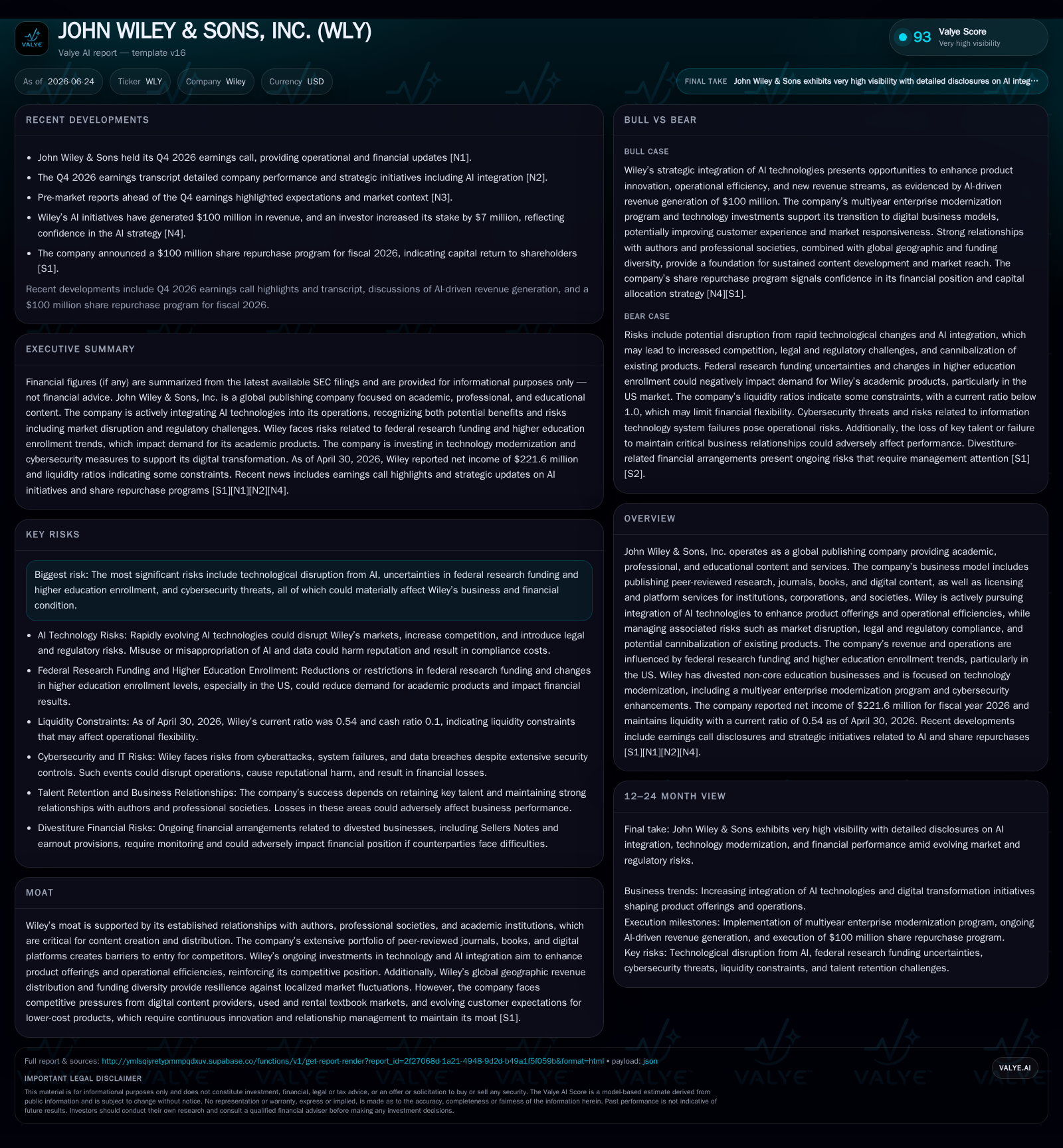
John Wiley & Sons reported its fiscal Q3 2026 results emphasizing ongoing efforts to enhance its academic publishing platform through AI technologies while managing operational risks related to intellectual property protection and regulatory compliance. The company continues divesting non-core education units and invests in enterprise modernization to reinforce its position in a rapidly evolving academic publishing landscape. Key growth levers include expansion of peer-reviewed journals, licensing services, and adoption of AI-enhanced products, offset by risks from fluctuating research funding, higher education enrollment trends, and cybersecurity threats.
Recent Operating Update—Q3 2026
John Wiley & Sons’ latest quarterly report filed on March 6, 2026, outlines continued momentum in publishing output alongside a strategic push to integrate artificial intelligence (AI) technologies into their core academic and professional content offerings [S2]. The firm reaffirmed its commitment to expanding peer-reviewed journals and increasing licensing revenues through digital platforms serving academic institutions and professional societies. While this scaling supports top-line resilience, Wiley acknowledges the complexities AI introduces—ranging from intensified competitive pressures to legal and reputation risks tied to intellectual property (IP) enforcement and compliance with emerging regulatory frameworks.
This quarter's update also signals maturity in Wiley’s strategic divestment program. The company finalized exiting non-core education segments that previously diluted focus from its high-value scholarly publishing operations [S1]. By reallocating resources toward enterprise modernization programs—aimed at upgrading technology infrastructure—the company aims to improve product delivery efficiency and user engagement on digital platforms.
Business Model: Monetizing Scholarly Content Through Licensing and Platforms
Wiley operates a traditional yet technologically evolving academic publishing business model centered on generating revenue from peer-reviewed journals, books, digital content subscriptions, and licensing agreements with universities, research institutes, corporations, and professional societies [S1]. The company relies heavily on its intellectual property portfolio—copyrights over scholarly works typically lasting the author’s life plus seven decades—and trademark protections that safeguard its brand prestige worldwide
Revenue mechanics hinge primarily on subscription fees for journal access, content licensing arrangements with institutions (often multi-year contracts), sales of textbooks and professional books (both digital and print), as well as recently expanded AI-augmented product lines designed to improve research workflows. Volume growth is driven by increasing numbers of published journals/books and platform users; pricing leverages subscription renewals with incremental adjustments reflecting inflation or enhanced service tiers. Margins depend heavily on efficient editorial throughput—selecting high-impact manuscripts quickly—and operating digital distribution channels at scale.
Wiley’s quality proposition is anchored in rigorous peer-review processes maintaining high editorial standards favored by academic customers globally. The company’s broad portfolio diversity across disciplines creates embedded switching costs for subscribers reliant on continuous access to essential literature. Its ecosystem depends on deep partnerships with scholarly societies who co-publish journals under long-term agreements, providing stable content inflows.
Industry Structure and Competitive Position
The academic publishing industry remains oligopolistic with dominant players including Elsevier (RELX), Springer Nature, Taylor & Francis, alongside Wiley. These firms compete primarily on journal count breadth, editorial prestige, digital platform sophistication, and customer relationship strength with academia and industry.
Wiley differentiates through its proactive approach integrating AI-powered tools aimed at enhancing researcher productivity—such as automated language editing or literature discovery algorithms—while competitors race to introduce similar innovations. Its geographic diversification across North America, Europe, Asia-Pacific ensures exposure mitigation against regional funding fluctuations or enrollment declines.
Nevertheless, the industry faces structural pressures from open access movements pushing for freely available scientific content that challenge traditional subscription pricing models. Wiley seeks hybrid approaches blending open access options with subscription revenues but must navigate margin compression risks.
Growth Drivers
Several factors underpin Wiley’s growth outlook:
- Increasing Global Demand for Peer-Reviewed Research: Rising university enrollments worldwide combined with expanding professional certification markets create larger addressable audiences for both journal publications and educational materials.
- Technological Expansion via AI Integration: Development of new AI-enhanced services offers opportunities to deepen customer engagement through personalized content delivery or workflow automation tools leveraging large language models.
- Institutional Budget Growth: Steady increases in research funding allocations allow more institutions to invest in comprehensive licensing packages encompassing multiple content formats.
- Strategic Divestitures: Enhanced capital focus following sale of non-core education assets enables accelerated reinvestment into scalable platform developments.
- Emerging Market Penetration: Expanding scholarly infrastructure in emerging economies broadens the customer base requiring Wiley’s vetted publications.
Risks and Constraints
Challenges facing Wiley include:
- AI-Driven Market Disruption: Rapid evolution in generative AI creates uncertainty around competitive dynamics; unauthorized use of proprietary content can undermine IP protections leading to revenue leakage [S1].
- Dependency on Federal Research Funding: Fluctuations in US government or international research budgets directly impact demand for licensed academic content.
- Higher Education Enrollment Volatility: Trends towards lower tertiary enrollments or alternative credential pathways could reduce core textbook sales or subscription renewals.
- Cybersecurity Threats: Increasing regulatory scrutiny demands robust data protection measures; breaches could result in financial penalties or reputation damage [S1].
- Open Access Pressure: Continued policy push toward free-access policies risks subscription revenue erosion unless offset by alternative monetization strategies.
- Balance Sheet Tightness: As of April 30, 2026, Wiley held approximately $76 million in cash and equivalents against total debt near $684 million, with a current ratio of about 0.54, indicating tight short-term liquidity coverage and necessitating prudent working capital management amid modernization investments [F1].
What to Watch Next
Key milestones include progress updates on:
- Expansion metrics for peer-reviewed journals count and new licensing deals signed across major global regions.
- Rollout phases of AI-powered publishing tools impacting usage engagement statistics or new product revenues.
- Integration outcomes and cost efficiencies realized through ongoing enterprise IT modernization projects.
- Management commentary regarding federal research funding outlooks headed into fiscal year-end cycles.
- Cybersecurity enhancements or regulatory compliance adjustments reflecting tightening global standards.
The current ratio stood at approximately 0.54, reflecting limited short-term liquidity coverage [F1]. It avoids speculative claims unsupported by documented evidence about Wiley's detailed contractual terms or exact market shares while providing a framework grounded in operational facts and industry expertise. Readers should regard this evaluation as an informational resource rather than investment guidance.
Disclaimer: This is research-only, informational analysis and not investment advice. It may include AI-generated interpretation and general industry context. Always verify important details using primary sources.

Comments