
Waste Management Inc: Balancing Asset Scale and Margin Pressures Amid Tech and Renewable Energy Shifts
Waste Management Inc navigates stable revenue growth driven by scale and acquisitions alongside mounting margin challenges in recycling and energy segments.
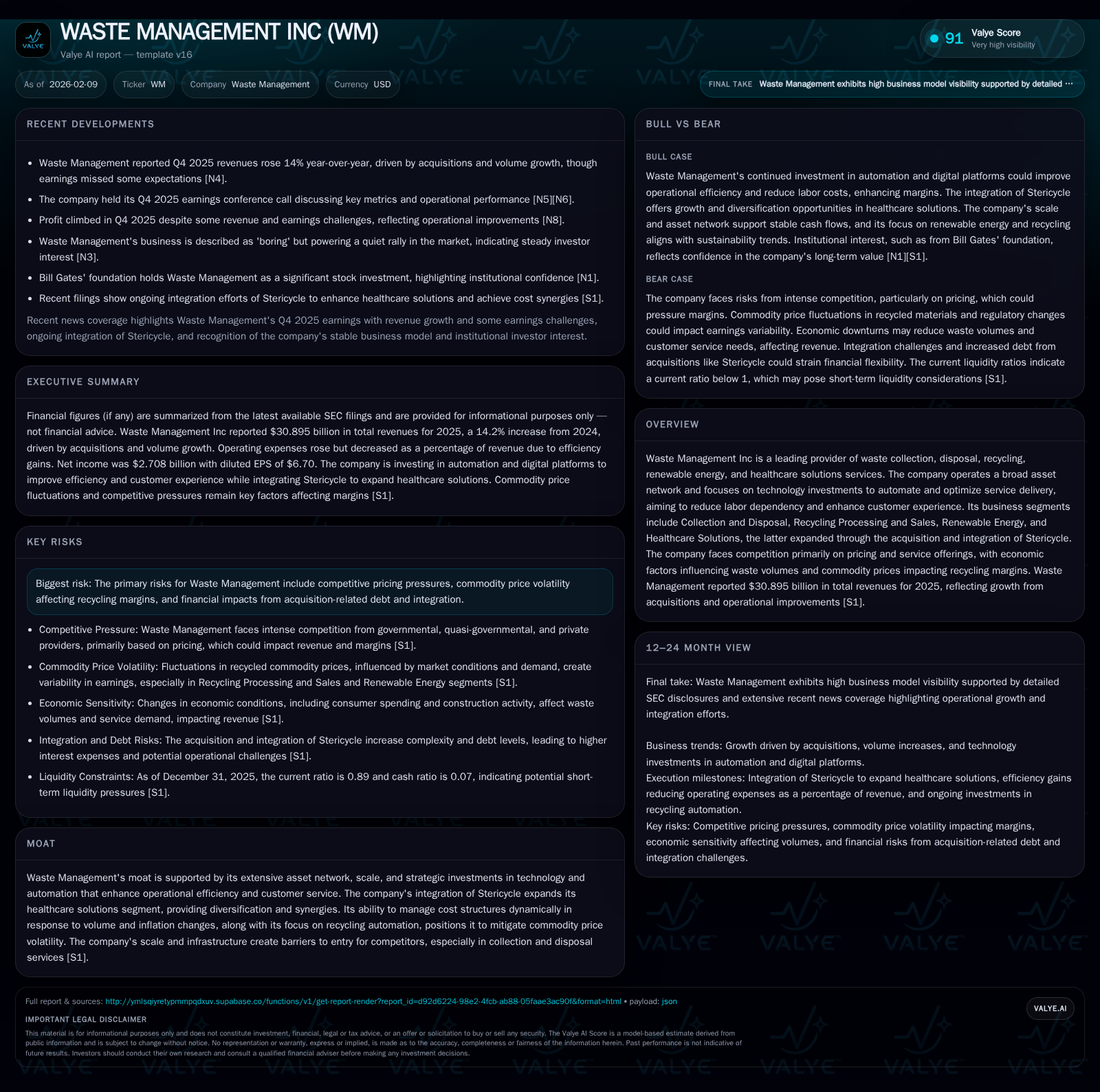
Waste Management Inc (WM) continues to leverage its expansive physical infrastructure to maintain a leading position in waste collection and disposal, supporting steady revenue growth that topped $30.9 billion in 2025 [S1]. However, recent quarterly reports reveal margin pressures stemming from volatile recycled commodity prices and integration costs from the Stericycle acquisition [N1],[S1]. The company’s strategic investments in automation technologies aim to reduce labor dependencies and improve customer interaction, while renewable energy ventures powered by landfill methane represent promising yet price-sensitive growth avenues. WM’s capital structure, featuring approximately $22.9 billion of long-term debt with variable-rate exposures, introduces interest rate risk that management actively monitors [S1],[S2]. Competitive dynamics—especially pricing battles with governmental and private entities—coupled with macroeconomic fluctuations pose ongoing headwinds. Institutional investors value WM for its dividend consistency and defensive qualities amid a mixed outlook [N8],[N10].
The Backbone: WM’s Extensive Asset Network and Scale Advantage
Waste Management Inc's commanding presence in the waste services sector is underpinned by an expansive asset base spanning collection fleets, transfer stations, processing facilities, and landfill sites. This network constitutes a formidable moat that wards off competitors primarily on account of the capital intensity and regulatory complexities inherent in establishing comparable infrastructure. As documented in the latest annual report, this breadth provides WM not only geographic reach but synergies in optimizing route efficiency, disposal operations, and resource allocation [S1]. Such scale affords operational leverage critical in negotiating contracts with governmental entities and large commercial customers while supporting steady revenue inflows irrespective of short-term economic shifts.
Q4 2025 Earnings in Context: Revenue Gains Versus Margin Misses
In Q4 2025, WM reported revenues increasing approximately 14% year-over-year, reflecting both organic volume growth and accretive acquisitions such as Stericycle [N1]. However, net earnings missed street estimates due primarily to persistent margin pressure points. Rising costs associated with integrating acquired businesses coupled with weaker-than-anticipated recycling commodity prices compressed profitability metrics [N3],[N4]. Analysts noted that despite top-line momentum, variability in input costs such as diesel fuel along with reduced pricing power amid competitive contract renewals weighed on operating margins. This duality illustrates WM’s current balancing act between scaling enterprises through strategic buys versus near-term profit dilution at the segment level.
Digital Transformation: Automation Technologies Reshaping Operations
Faced with labor market tightness and the operational complexity of managing millions of residential and commercial collection points weekly, WM has escalated investment into automation technologies aimed at reducing reliance on manual labor—particularly in high-turnover roles—as well as digitizing the customer experience [S1]. These initiatives include advanced routing algorithms for fleet optimization, robotic process automation within customer service workflows, mobile app enhancements enabling self-service functionality, and IoT-enabled smart bins for real-time fill-level monitoring. Collectively these tools not only drive efficiency improvements but aim to elevate customer satisfaction scores by offering seamless service interactions digitally. Crucially, technological adoption lays the groundwork for operating scale expansion without proportional increases in headcount or overhead.
Stericycle Integration: Broadening Healthcare Solutions
The integration of Stericycle represents a strategic diversification move by WM into healthcare solutions—a segment less exposed to the cyclical swings typical in its core solid waste business. Stericycle brings specialized expertise in medical waste management including compliance-driven disposal services alongside data analytics capabilities for healthcare clients [S1]. While acquisition-related expenses contributed to short-term earnings softness post-close, synergies are expected to materialize through cross-selling opportunities and consolidated logistics leveraging WM’s asset network. This healthcare pivot buffers earnings volatility seen historically with recycling margins sensitive to commodity cycles.
Navigating Commodity Headwinds: Recycling Revenues and Volatility
Recycling processing faced notable hurdles throughout 2025 as several domestic paper mills shuttered operations amid shifting demand dynamics for recycled content from consumer goods producers [S1]. These structural changes contributed to an approximate 20% decline in average prices for single-stream recycled commodities relative to prior years—a stark reversal after a robust rebound in 2024. Equipment utilization was impacted negatively as processing volumes tapered with falling commodity values directly compressing margins despite throughput stability. The industry-wide contraction underscores the inherent vulnerability of recycling revenues tied closely to macroeconomic trends beyond WM’s immediate control.
Renewable Energy Segment: Strategic Growth Amid Price Swings
WM continues to expand its renewable energy initiatives chiefly focused on capturing methane emissions from landfills for conversion into renewable natural gas (RNG) and electricity generation. These projects benefit materially from regulatory tailwinds such as federal Investment Tax Credits introduced under recent legislation (e.g., IRA), as well as state-level programs incentivizing low-carbon fuels [S1]. RNG produced supplies part of WM’s own natural gas collection vehicle fleet—creating internal fuel cost offsets—and supports external sales generating incremental revenue streams. Nonetheless, profitability here remains exposed to fluctuations in RFS credit prices (RINs) and natural gas markets where volatility can erode returns. The company mitigates downside risk through fixed-price contracts where feasible but must navigate a patchwork policy environment.
Capital Structure and Interest Rate Risk Profile
As detailed in the latest SEC filings, Waste Management operates with a significant debt load nearing $22.9 billion in long-term obligations at year-end 2025 [S1],[F1]. Approximately $2.9 billion consists of variable-rate borrowings maturing or resetting within one year—including commercial paper draws and tax-exempt bonds exposed periodically to market interest rate movements [S1],[S2]. Sensitivity analysis suggests that a 100-basis point rise across relevant benchmarks could increase annual interest expense by roughly $35 million. While current liquidity levels remain comfortable with over $200 million cash equivalents reported year-end [F1], rising rates pose a cautionary factor for near-term profitability especially if refinancing occurs amid tighter credit conditions or at higher spreads.
Competitive Landscape: Pricing Pressures in Collection and Disposal
The waste management industry is marked by intense competition predominantly revolving around pricing strategies deployed against other large integrated providers as well as smaller regional players including municipal operators [S1]. Contract renewals frequently hinge on bids where price competitiveness often supersedes service differentiation—particularly in residential segments though less so commercially where custom solutions gain traction. Economic downturns amplify this challenge by depressing overall waste volumes generated across sectors such as construction or manufacturing which correlates directly with service demand levels, exerting downward pressure on achievable revenue per unit collected. Thus maintaining scale advantages along with technological efficiencies serves as crucial defense mechanisms for WM’s competitive positioning.
Investor Sentiment: Institutional Stakes and Dividend Appeal
Investor perceptions of Waste Management lean toward viewing it as a stable yet "boring" utility-like stock delivering dependable cash flows supported by predictable government contracts alongside broad-based consumer waste activities [N10]. Notably, institutional holders such as Bill Gates Foundation manifest confidence via sizable portfolio allocations underscoring appealing dividend yields combined with ESG alignment given growing emphasis on sustainability practices within operations [N8],[N9]. Market commentators often highlight WM's role as a defensive staple amidst more cyclical sectors—despite episodic margin headwinds—providing steady income especially valued during periods of broader market volatility [N13],[N14]. Relative valuation discussions contrast WM favorably against select peers based primarily on asset quality rather than aggressive growth multiples.
Looking Ahead: Risks, Opportunities, and Strategic Focus
Looking forward, Waste Management confronts a nuanced set of challenges balanced by tangible strategic levers. Key risks include ongoing commodity price volatility affecting recycling margins compounded by potentially tighter competitive pricing landscapes amid uncertain macroeconomic environments [S1],[N6]. Furthermore, interest rate hikes may incrementally strain financial flexibility given debt maturity profiles though proactive capital management mitigates some exposure [S1].[N7] Conversely, continued rollout of automation technology promises durable cost reductions while enhance scalability—offsetting labor cost inflation risks over time.
Segment diversification through Stericycle's healthcare footprint partially insulates total earnings from traditional business cyclicality while renewable energy ventures offer longer-term upside tied closely to evolving sustainability policies despite short-term subsidy dependencies. Ultimately, management emphasizes dynamic cost structure adaption aligned with real-time volume changes combined with targeted growth investments designed to sustain midterm performance stability amidst an evolving regulatory landscape.
This analysis is based solely on publicly available information up to February 2026 including company filings and third-party reports cited herein. It does not constitute investment advice or recommendations. Readers should conduct independent due diligence considering their individual risk tolerance before making financial decisions related to Waste Management Inc or its sector.
Disclaimer: This is research-only, informational analysis and not investment advice. It may include AI-generated interpretation and general industry context. Always verify important details using primary sources.

Comments