
WRAP Technologies: Integrated Non-Lethal Ecosystem Aims for Recurring Revenue and Market Expansion
WRAP Technologies has transitioned from a single-product provider to an integrated platform for non-lethal law enforcement and public safety solutions. Recent capital infusions and product launches position the company to pursue recurring revenue, but commercial traction, platform execution, and regulatory complexity remain critical watchpoints.
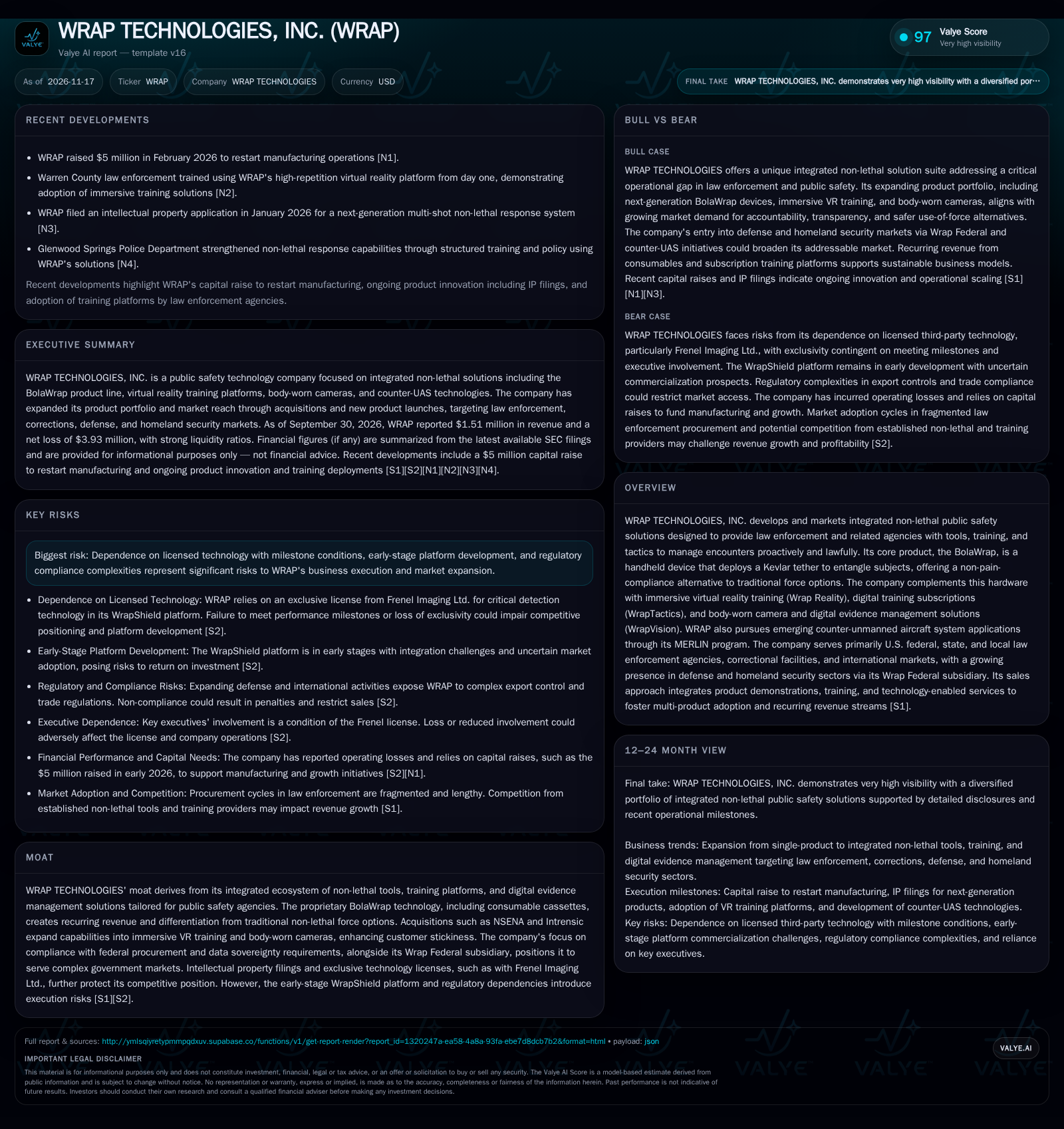
WRAP Technologies has leveraged acquisitions and new product launches to build a diversified portfolio spanning non-lethal hardware, training, and digital evidence management for law enforcement and defense. With a recent $5M capital raise to resume manufacturing and IP filings for next-gen products, the company is betting on recurring revenue from consumables and subscriptions. Execution risks include tech licensing dependencies, early-stage platform development, and the challenge of scaling in fragmented, compliance-heavy markets. [S1] [S2] [N1] [N3]
WRAP Technologies has evolved from a niche device maker into a diversified provider of integrated non-lethal solutions for law enforcement, corrections, and public safety. The company's recent $5 million capital raise, new product development, and expansion into digital evidence management and virtual training reflect a strategic shift toward recurring, solution-based engagements. However, the company continues to face executional and structural challenges, including dependence on licensed technology, fragmented procurement cycles, and the hurdles of scaling new platforms in a compliance-intensive sector. The next phase will test whether WRAP can convert its broadened portfolio into sustainable, multi-product customer relationships and recurring revenue streams. [S1] [S2] [N1] [N3]
Recent Capital Infusion and Product Innovation Define WRAP’s Near-Term Outlook
WRAP Technologies raised $5 million in February 2026 to restart manufacturing operations, underscoring the company’s ongoing need for external capital to support business continuity and scale production. This follows a period of operational reset, suggesting that liquidity and manufacturing capacity remain central to near-term execution. [N1]
In January 2026, WRAP filed an intellectual property application for a next-generation multi-shot non-lethal response system, signaling a commitment to ongoing product innovation and attempts to strengthen its technology moat. [N3]
As of September 30, 2026, WRAP reported $1.51 million in revenue and a net loss of $3.93 million, with cash and equivalents of $12.1 million and a reported current ratio of 10.09. The company reported cash and liquidity metrics for the period; these figures do not by themselves establish operating runway, investment capacity, financial flexibility, or financing capacity. [S2]
Recent acquisitions—NSENA for VR training and Intrensic for body-worn cameras—have broadened WRAP’s offerings, aiming to leverage integrated, recurring-revenue solutions for law enforcement and public safety agencies. [S1]
Integrated Solutions and Recurring Revenue: The Evolving Economics of WRAP’s Model
WRAP’s business model has shifted from a single-product device sale to an integrated solutions approach that combines hardware, proprietary consumables, digital training, and evidence management. The BolaWrap device itself is paired with proprietary cassettes, which serve as consumables and may provide a source of recurring revenue if agencies replenish inventory on a regular cycle. While the company now also offers subscription-based digital training (WrapTactics) and cloud-based evidence management (WrapVision), the actual adoption rates and contract structures for these services are not disclosed, so the durability of recurring revenue remains unproven. [S1]
The company’s economics are likely characterized by high upfront R&D and integration costs, especially given ongoing product development and the need to support multiple business lines. If WRAP can drive agency-wide adoption of its ecosystem—including recurring consumables, training, and digital services—operating leverage could improve as fixed costs are spread over a larger installed base.
However, the need to raise $5 million to restart manufacturing in 2026 highlights ongoing capital intensity and potentially lumpy cash flows, particularly if sales cycles remain unpredictable. The company’s current net loss and reliance on external funding suggest that break-even will depend on both expanding the customer base and increasing the depth of adoption per agency. [N1] [S2]
Integrated Platform as Differentiator—But Execution and Compliance Risks Loom Large
WRAP aims to differentiate through an integrated ecosystem—combining non-lethal hardware, immersive training, and digital evidence management—which, if successfully adopted, could increase switching costs and customer stickiness. Proprietary consumables and subscription platforms may provide a moat versus traditional hardware-only competitors.
However, the market for law enforcement tools and training is crowded, with established players in non-lethal devices (such as conducted energy weapons and chemical sprays), body-worn cameras, and training platforms. Many competitors have deeper sales channels, more established customer relationships, and larger R&D budgets.
WRAP’s expansion into defense and homeland security via Wrap Federal, and its pursuit of counter-UAS solutions, opens new addressable markets but also exposes the company to stricter export controls and compliance risks. The company’s dependence on an exclusive technology license from Frenel Imaging Ltd. for the WrapShield platform introduces further execution risk, as loss of exclusivity or failure to meet performance milestones could erode the company’s competitive position. [S1] [S2]
If Agencies Embrace the Full WRAP Ecosystem, Recurring Revenue Could Accelerate
The most favorable scenario envisions law enforcement agencies adopting WRAP’s integrated solution across tools, training, and digital services, leading to multi-year, multi-product contracts. Proprietary consumables (BolaWrap cassettes) and digital training subscriptions could drive recurring revenue, while agency-wide deployments would increase switching costs and customer retention.
Successful commercialization of the next-generation multi-shot BolaWrap and further uptake of WrapVision body-worn cameras—especially if tailored to federal procurement standards—could cement WRAP’s position as a technology partner rather than a niche device vendor. The company’s expansion into defense and counter-UAS markets could open high-value contracts if regulatory hurdles are navigated.
Evidence that would confirm this scenario includes: a disclosed backlog of multi-year contracts, rising renewal rates for training and digital services, reported increases in consumable sales per agency, and announcements of large-scale deployments or reference customers in federal or international markets.
Incremental Adoption and Proving Platform Value Remain Central Challenges
The most plausible near-term outcome is gradual expansion of WRAP’s installed base, with agencies initially adopting a subset of the company’s offerings—such as the BolaWrap device or VR training—and only selectively adding subscriptions or digital evidence management. Procurement cycles in law enforcement remain lengthy and fragmented, often requiring pilots, demonstrations, and budget approvals at the local level.
Revenue growth may be driven by new product launches and agency wins, but recurring revenue from consumables and digital platforms will likely remain a modest portion until WRAP can demonstrate reliable renewal rates and deeper integration into agency workflows. The timing and magnitude of defense and homeland security contracts are likely to be lumpy and unpredictable, given regulatory and procurement complexity.
Key evidence supporting this scenario would include steady but modest revenue growth, pilot programs expanding to department-wide rollouts, and incremental increases in consumable or subscription sales. A lack of large-scale, multi-product contracts or slow adoption of new platforms would be a sign that the platform strategy is still in a proof-of-concept phase.
Execution Stumbles and Licensing Risks Could Undercut Platform Ambitions
The adverse scenario sees WRAP struggling to convert its broadened portfolio into meaningful recurring revenue, with agencies either slow to adopt new solutions or reverting to established providers. If the company fails to meet performance milestones required for its exclusive technology license with Frenel Imaging Ltd., it could lose access to critical IP, compromising the WrapShield platform and future product roadmap. [S2]
Regulatory compliance failures, particularly in defense or international markets, could result in restricted sales or penalties, while ongoing operating losses and reliance on external capital could force further dilution or operational cutbacks if revenue growth does not materialize.
Signals supporting this scenario would include disclosure of lost or non-renewed licenses, regulatory setbacks, continued net losses without improvement in gross margin, and a need for additional capital raises absent clear commercial momentum.
Milestones That Will Clarify WRAP’s Recurring Revenue and Platform Adoption Trajectory
Agency-wide, multi-year contract wins—especially if covering multiple solutions and geographies—would validate the integrated platform strategy.
Trends in consumable (BolaWrap cassette) sales per installed device: rising replenishment rates would support recurring revenue expectations.
Subscription renewal rates and customer retention for WrapTactics and WrapVision, if disclosed, would clarify the stickiness and durability of platform economics.
Evidence of federal or international contract awards, particularly in defense and counter-UAS, could signal expansion beyond core law enforcement markets.
Updates on the status, exclusivity, and milestones of the Frenel Imaging Ltd. technology license—loss or modification would be a major negative inflection.
Gross margin trends and operating leverage as manufacturing scales back up post-capital raise—improving margins would suggest better cost absorption.
Regulatory disclosures related to export controls, compliance, or trade restrictions, as these could impact addressable market and sales execution.
Product development milestones for the next-generation multi-shot BolaWrap system—successful commercialization would bolster the technology moat.
Disclaimer: This is research-only, informational analysis and not investment advice. It may include AI-generated interpretation and general industry context. Always verify important details using primary sources.

Comments