
West Pharmaceutical Services Strengthens Integrated Drug Delivery Leadership With Solid Q1 Momentum
West Pharmaceutical Services posts robust Q1 results, highlighting growth in proprietary drug delivery solutions amid operational resiliency and elevated full-year guidance.
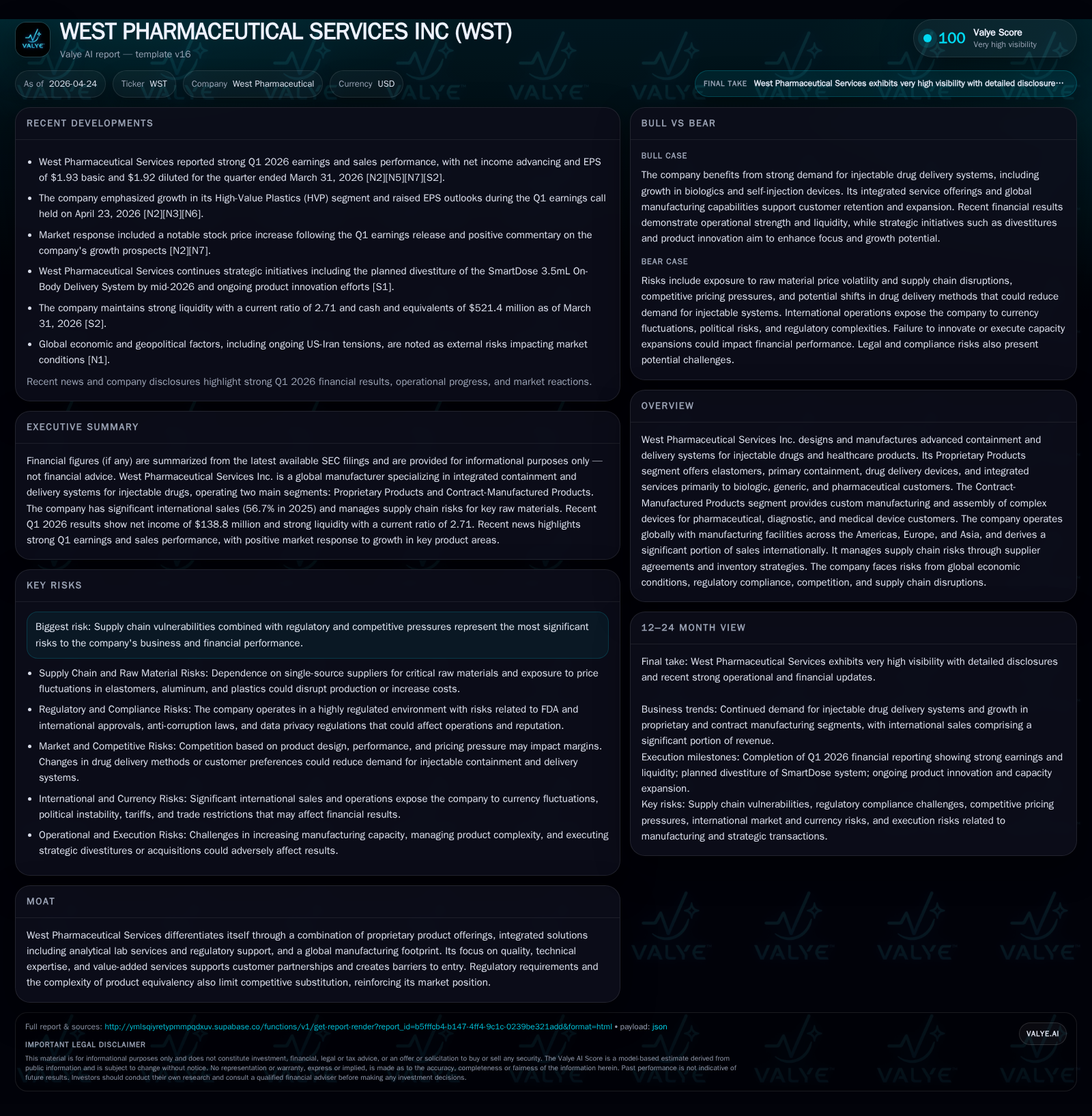
In Q1 2026, West Pharmaceutical Services demonstrated solid operating momentum driven by strength in its proprietary products segment, particularly high-value elastomers and advanced injectable delivery devices. The company raised its full-year outlook supported by sustained demand from biologics and generic pharmaceutical customers despite ongoing supply chain complexities. West’s business model, rooted in integrated containment and delivery system offerings coupled with contract manufacturing services, underpins a durable competitive moat reinforced by regulatory barriers and global manufacturing scale. Challenges persist due to raw material inflation and regulatory compliance, but growth catalysts include expanded at-home injection adoption and connected health opportunities.
Q1 2026 Operating Update: Key Results and Implications
West Pharmaceutical Services reported first-quarter revenues that surpassed market expectations primarily due to robust demand within the Proprietary Products segment [S2], [N1]. Management highlighted strong sales growth in high-value elastomer components used for biologic injectable drugs as a key contributor [N13]. Earnings per share outpaced consensus estimates, prompting an upward revision of the company’s full-year financial guidance—a notable signal of sustained operational momentum [S3], [N14]. Margin pressures from elevated raw material costs were partially offset by operational efficiencies and strategic pricing adjustments. Noteworthy is management’s emphasis on improved order trends from both pharmaceutical innovators and generic drug manufacturers seeking advanced containment systems to meet growing biologics requirements [N2]. This quarterly update confirms a continuation of prior year trends favoring proprietary product innovation and deeper customer integration.
Business Model Deep Dive: Proprietary Products and Contract Manufacturing Integration
West operates through two complementary reportable segments: Proprietary Products and Contract-Manufactured Products [S1], [S24]. The core Proprietary Products portfolio includes elastomeric stoppers, seals, syringe components, and patient-centric drug delivery devices designed predominantly for injectable biologics, generics, and pharmaceutical clients. These products address critical formulation compatibility challenges—particularly glass incompatibility—and support drug stability through advanced materials such as synthetic elastomers with specialized coatings (e.g., FluroTec®). The segment also integrates analytical lab services that aid pre-approval packaging validation alongside engineering and regulatory expertise, creating a full-spectrum service offering that enhances switching costs for clients [S24].
The Contract-Manufactured Products segment specializes in high-precision custom device assembly using processes such as multi-component molding and cleanroom molding tailored to customer-owned designs for pharmaceuticals and diagnostics. This unit benefits from deep engineering expertise including mold design and automated assembly capacities that enable integrated solutions spanning the value chain [S24]. The dual-segment model allows West to capture value both through proprietary IP-driven components securing regulatory approvals and through bespoke contract manufacturing capabilities addressing evolving customer complexity demands.
Competitive Moat and Industry Positioning in Containment & Delivery Systems
West maintains a defensible competitive moat underscored by its technology IP portfolio protecting proprietary elastomeric materials and device innovations [S23]. Furthermore, stringent global regulatory regimes require extensive data demonstrating equivalency for component substitution—this regulatory barrier imposes significant switching costs on customers reliant on validated suppliers like West [S6]. Quality assurance protocols including vision inspection, sterilization services, coatings application, and end-to-end supply chain traceability cultivate high customer reliance on West’s integrated solutions [S1].
The company’s geographically diversified manufacturing footprint across North America, Europe, and Asia mitigates regional disruptions while facilitating supply continuity for international customers who accounted for approximately 56.7% of sales in fiscal 2025 [S4]. Moreover, supplier partnerships adopting bulk commitments help manage elastomer raw material risks which constitute one of the firm’s primary input cost considerations [S19]. This global scale combined with technical expertise erects high entry barriers relative to emerging competitors or commodity suppliers lacking comparable service breadth.
Supply Chain and Regulatory Dynamics Shaping Risk and Opportunity
Supply chain volatility remains an ongoing operational challenge as West sources critical commodities such as synthetic elastomers, aluminum alloys, and specialty plastics essential for containment systems. The company’s supply management strategy leverages agreements with integrated suppliers possessing multi-site operations coupled with bulk purchasing tactics designed to buffer against interruptions while balancing inventory carrying costs [S4], [S19]. Management reports no material disruptions in this quarter but continues monitoring inflationary input costs that exert margin pressure without immediate pass-through capability [N2].
Compounding these dynamics are evolving regulatory oversight frameworks globally—FDA approval pathways (including 510(k) reviews for medical devices), EMA scrutiny, and emerging mandates on environmental compliance such as PFAS restrictions impact product development cycles [S5], [S13]. While these regulations elevate compliance costs, they concurrently reinforce West's competitive positioning by impeding rapid switching among suppliers due to complex equivalency data burdens placed on customers [S6]. The company’s integrated regulatory consulting services further strengthen client retention by assisting customers through approval pathways.
Growth Catalysts and Potential Constraints Beyond Current Earnings
Several structural growth drivers underpin West’s outlook. Increasing adoption of patient-friendly self-administration injectable devices driven by chronic biologic therapies expands TAM significantly; the integration potential with connected health tech enhances adherence monitoring capabilities providing differentiated value propositions [S22], [N13]. Geographic expansion into faster-growing emerging markets alongside solid international sales penetration remains a focus for scaling proprietary offerings.
Potential constraints include ongoing consolidation within the pharmaceutical sector enhancing buyer power resulting in downward pricing pressures necessitating demonstration of comparative value advantages to sustain margins [S18]. Litigation risk stems from pending securities class actions related to past disclosures; while management asserts vigorous defense plans accompanied by accruals when probable losses emerge these represent an uncertain cost factor [S9]. Macroeconomic volatility could influence customer inventory strategies affecting near-term demand—a typical cyclical sensitivity in contract manufacturing-dependent businesses although longer-term biologics growth provides counterbalance [S16].
Looking Ahead: Guidance, Market Indicators, and Execution Milestones
Management has signaled confidence with raised full-year revenue projections driven by sustained organic growth in the Proprietary Products segment supported by momentum in High-Value Packaging (HVP) initiatives highlighted during recent earnings calls [N2], [N13]. Monitoring execution around supply chain resiliency initiatives remains critical given input cost inflation risks. Additionally, upcoming regulatory approvals or launches tied to novel drug-device combinations will serve as important milestones validating R&D effectiveness. Competitive dynamics warrant vigilance especially if industry pricing tactics intensify or new alternative delivery modalities gain traction beyond injectable platforms.
Investor focus should also remain tuned to contract wins leveraging West’s end-to-end service model including increased penetration into connected drug delivery devices. Margin sustainability will hinge on continued operational leverage improvements alongside successful raw material cost pass-through.
Summative Financial Overview: Liquidity, Capital Structure, and Profitability
Historical performance (annual)
| FY | Net ($mm) | CFO ($mm) | OpInc ($mm) | Capex ($mm) | Net YoY |
|---|---|---|---|---|---|
| 2025 | 494 | 755 | 585 | 286 | +0.2% |
| 2024 | 493 | 653 | 570 | 377 | -17.0% |
| 2023 | 593 | 777 | 676 | 362 | +1.3% |
| 2022 | 586 | 724 | 734 | 285 |
Source: SEC companyfacts cache [F1].
Capital returns and efficiency (annual)
| FY | Div ($mm) | Buybacks ($mm) | FCF ($mm) |
|---|---|---|---|
| 2025 | 61 | 134 | 469 |
| 2024 | 59 | 561 | 276 |
| 2023 | 57 | 438 | 415 |
| 2022 | 54 | 203 | 439 |
Source: SEC companyfacts cache [F1].
As of March 31, 2026 quarter-end, West holds $521 million in cash & equivalents against total debt approximating $203 million yielding a net cash position near $318 million—a healthy liquidity cushion supporting operational agility [F1], [S2].
The latest fiscal year-end showed stable top-line growth (2% YoY) coupled with modest operating income expansion (2.6% YoY), indicative of steady earnings quality despite sector challenges [F1]. Operating cash flow generation remained strong at approximately $755 million annually against capex spending near $286 million pointing to healthy free cash flow conversion ($469 million).
Capital allocation balances dividend distributions (around $61 million annually) with active share repurchase programs ($134 million executed in FY2025), reflecting disciplined return-of-capital philosophy guided by underlying free cash generation capacity [F1].
This analysis is based solely on publicly available SEC filings as of April 23–24, 2026 along with supplemental news sources referenced herein. It does not constitute investment advice or recommendations but aims to provide an informed perspective on West Pharmaceutical Services’ operational performance and strategic positioning within its industry context.
Disclaimer: This is research-only, informational analysis and not investment advice. It may include AI-generated interpretation and general industry context. Always verify important details using primary sources.

Comments