
Westin Acquisition Corp: The Stakes of SPAC Execution as the First Choice Healthcare Deal Proceeds
With its business combination agreement with First Choice Healthcare Solutions now in motion, Westin Acquisition Corp faces acute execution and liquidity pressures. The outcome will pivot on the management team’s dealmaking skills, the quality and integration of the target, and the ability to transition from a capital-raising shell to a viable public operating company.
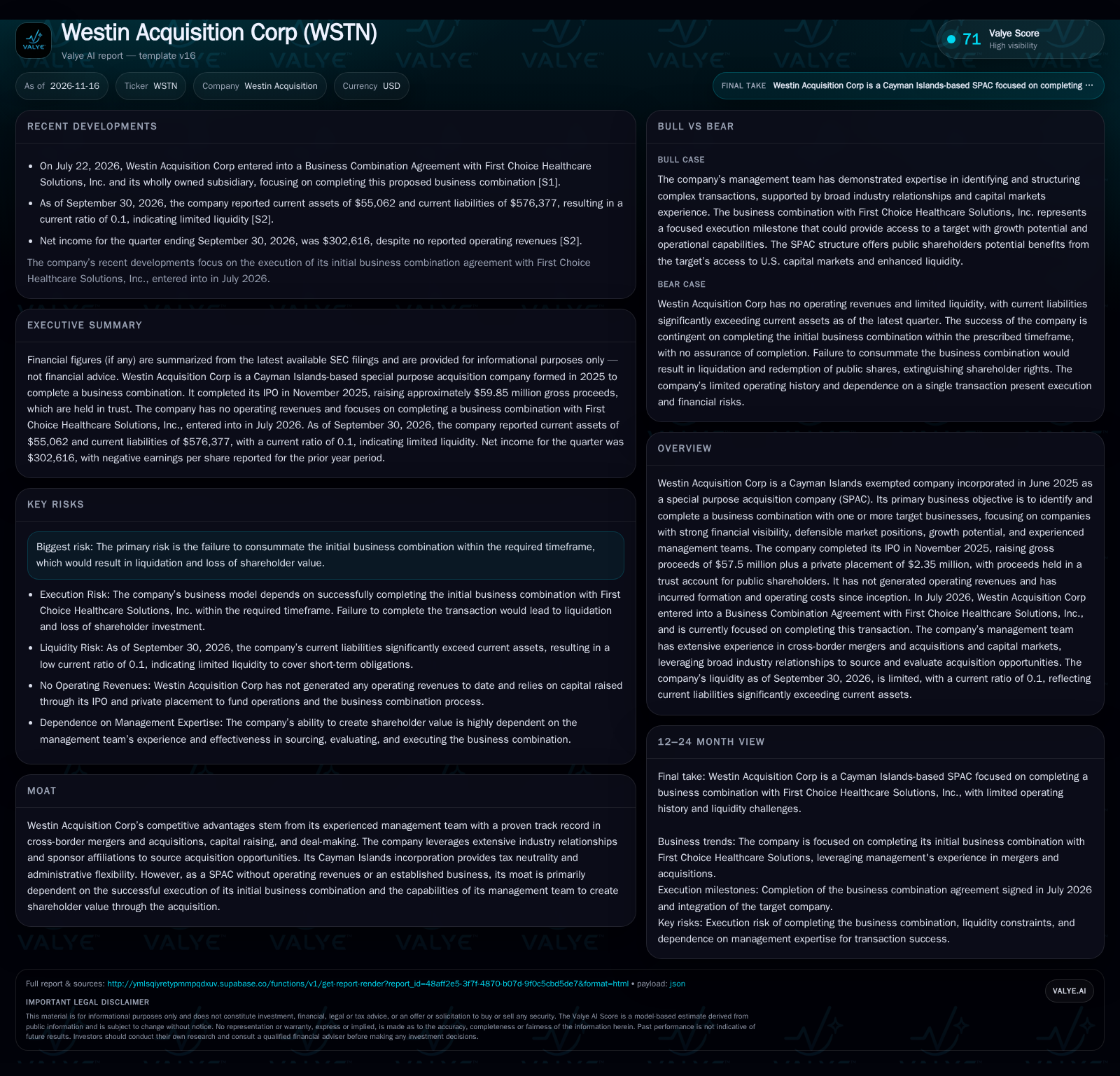
Westin Acquisition Corp, a Cayman Islands-based SPAC, has entered a business combination agreement with First Choice Healthcare Solutions. The company’s future depends entirely on successfully closing this deal within the prescribed timeframe, as failure would trigger liquidation. [S1] [S2]
Westin Acquisition Corp epitomizes the binary risk-reward profile of the modern SPAC. Having raised nearly $60 million in late 2025 and now under the gun to consummate a business combination, Westin’s fate is tied to its July 2026 agreement with First Choice Healthcare Solutions. The next several quarters will reveal whether Westin’s acquisition thesis translates into a sustainable public enterprise—or a rapid return of capital to shareholders. [S1] [S2]
Deal Execution and Liquidity Define the Immediate Outlook
The most material current development for Westin Acquisition Corp is the signing of a business combination agreement with First Choice Healthcare Solutions, Inc. on July 22, 2026. This step marks a transition from capital-raising and target search to the high-stakes execution phase typical for SPACs nearing their deadline. The company reported cash and liquidity metrics for the period; these figures do not by themselves establish operating runway, investment capacity, financial flexibility, or financing capacity. Despite reporting net income of $302,616 for the quarter, Westin still has no operating revenues, and its financial results are shaped by non-operating items rather than business activity. The company now faces a narrow window to close the First Choice deal and avoid automatic liquidation, making execution risk and short-term cash needs the central variables for shareholder outcomes. [S1] [S2]
SPAC Economics: How Value Is (or Isn’t) Created Pre- and Post-Merger
Westin’s ability to create value for shareholders depends entirely on the successful consummation and subsequent performance of its initial business combination. Until that event, the company has no revenue-generating operations; its cash flows are dictated by interest income on trust assets and the burn rate of formation and transaction expenses. The economics of a SPAC hinge on minimizing costs during the search phase and maximally deploying the trust proceeds into a viable target. If the First Choice Healthcare Solutions transaction closes, the merged entity’s economics will depend on the target’s revenue, margin, and capital structure—not Westin’s pre-merger shell. The SPAC structure typically involves substantial fixed costs (legal, advisory, and administrative) and variable costs related to deal structuring and potential redemptions. Operating leverage post-merger is determined by the target’s business model: if First Choice is asset-light, incremental margins could be high, but if capital-intensive, the combined entity may require additional funding or face dilution. [S1] [S2]
Assessing Westin’s Edge: Sponsor Experience and Structural Constraints
Westin’s primary competitive advantage is the experience and relationships of its management and sponsor teams, who are seasoned in cross-border M&A and capital markets. This network may provide access to proprietary or higher-quality deals relative to less-connected SPACs. However, Westin operates under the same structural constraints as all SPACs: a fixed capital pool, a ticking clock to complete a deal, and the risk of shareholder redemptions at the time of merger. Its Cayman Islands domicile offers tax neutrality and administrative flexibility, but these are generic advantages across the SPAC ecosystem. The true differentiator will be the quality and defensibility of the First Choice Healthcare Solutions target, including its growth prospects, operational resilience, and ability to attract post-merger investor interest. Westin faces competition from both other SPACs and traditional private equity buyers, as well as direct listings and IPOs as alternative routes for attractive targets. Its ability to close and integrate a value-accretive transaction will determine whether its sponsor network translates into lasting shareholder value.
What a Successful Merger Could Unlock for Shareholders
The favorable scenario for Westin hinges on the smooth closing and integration of the First Choice Healthcare Solutions transaction. If the target company meets or exceeds expectations for revenue growth, profitability, and market positioning, the merged entity could benefit from public market access, enhanced liquidity, and strategic capital for expansion. Success would be confirmed by the absence of significant shareholder redemptions, positive post-merger trading performance, and early disclosure of operational milestones (such as customer wins or margin expansion) by First Choice. Additional validation would come from the ability to retain key management, attract follow-on investors, and demonstrate synergies or accelerated growth as a result of the business combination. A strong post-close balance sheet and cash flow generation could eventually support further acquisitions or organic investment, driving a virtuous cycle of value creation. Confirmation of this scenario would require timely deal completion, evidence of low redemption rates, and robust initial operating metrics for the merged company.
The Most Probable Outcome: Deal Closure with Moderate Redemptions and Integration Uncertainty
The most plausible path forward is that Westin completes its business combination with First Choice Healthcare Solutions within the required timeframe, but experiences a moderate-to-high level of shareholder redemptions. This is a common outcome for SPACs, especially those with reported liquidity position and a late-stage deal. The merged entity will need to manage the transition from a capital-raising shell to an operating company, with potential challenges in integrating the target, meeting public market expectations, and stabilizing post-merger trading. Evidence confirming this scenario would include successful deal closure, but with a reduced cash pool due to redemptions, and the need for additional capital or restructuring in the early quarters post-merger. Falsification would come from a failed or delayed closing, or an immediate liquidation if the deal cannot be consummated in time.
Failure to Close: Liquidation Risk and Erosion of Shareholder Value
The adverse scenario is that Westin is unable to complete the First Choice Healthcare Solutions transaction within the 18-month window post-IPO. In this event, the company would be forced to liquidate, returning trust proceeds to public shareholders and extinguishing any potential upside from the SPAC structure. This outcome would likely result from failed negotiations, regulatory hurdles, or insurmountable redemptions that leave the post-merger entity undercapitalized. Confirmation would come from missed deal milestones, public disclosure of failed negotiations, or a formal announcement of liquidation. Falsification would be signaled by the announcement of a successful close and commencement of operations as a combined entity.
Milestones and Metrics That Will Determine Whether Westin Delivers
Progress toward closing the business combination with First Choice Healthcare Solutions, including regulatory approvals and shareholder votes.
Redemption rates at the time of the merger vote—high redemptions would reduce available capital and could jeopardize deal economics.
Any amendments to the combination agreement or timeline extensions sought by management, which would indicate execution risk or negotiation friction.
Disclosure of post-merger financial projections and initial operating results by First Choice, if available, to assess the viability of the combined entity.
Changes in the composition or retention of key management personnel at both Westin and First Choice post-merger.
Announcements of additional financing or capital raising efforts, which may signal post-close funding needs or integration challenges.
Material changes in trust account value, legal disputes, or regulatory developments affecting the transaction timeline or structure.
A useful metric would be the combined company’s projected and actual post-merger cash runway, as this will determine the ability to invest and grow.
Disclaimer: This is research-only, informational analysis and not investment advice. It may include AI-generated interpretation and general industry context. Always verify important details using primary sources.

Comments